
I find my 17 is also probably the hardest to shoot straight, but coincidentally much improved after replacing the stock barrel with a Storm Lake barrel. My questionable shooting skills aside I was told this might have to do with the light weight and (hence?) the tendency of the gun to rotate as a counter reaction to the bullet spin, but the jury is still out on that one IMO.













































You are using an out of date browser. It may not display this or other websites correctly.
You should upgrade or use an alternative browser.
You should upgrade or use an alternative browser.
I can't shoot my glock for ####....
- Thread starter ShaneN.
- Start date

- Location
- Somewhere on the Hudson Bay Coast
Being a 1911 enthusiast, I don't like having to transition from DA to SA and I particularly dislike the Glock trigger. Although my groups when shooting a Glock aren't bad they do tend to string out horizontally a bit, where my 1911 groups tend to be round rather than linear.
As for sight picture, I prefer to have a front sight that has ample room in the notch of the rear sight, yet is still wide enough that you can see detail on the face of the ramp. When you focus on the front sight and the rear sight blurs slightly, so a front sight wide enough to fill or nearly fill the rear notch makes keeping the front sight centered in the notch without shifting your focus back to the rear sight difficult. If your focus shifts back to the rear sight, your group will enlarge, or it will take more time to get the shot off as you shift you focus back to the front sight.
IMHO, in order to shoot a Glock well means that you must shoot it a lot, ignoring other gun types until it has been mastered. If I was mandated to carry a Glock, I would have to spend a great deal of time on the range before I developed a comfort level with it, and the biggest reason for that is the trigger.
As for sight picture, I prefer to have a front sight that has ample room in the notch of the rear sight, yet is still wide enough that you can see detail on the face of the ramp. When you focus on the front sight and the rear sight blurs slightly, so a front sight wide enough to fill or nearly fill the rear notch makes keeping the front sight centered in the notch without shifting your focus back to the rear sight difficult. If your focus shifts back to the rear sight, your group will enlarge, or it will take more time to get the shot off as you shift you focus back to the front sight.
IMHO, in order to shoot a Glock well means that you must shoot it a lot, ignoring other gun types until it has been mastered. If I was mandated to carry a Glock, I would have to spend a great deal of time on the range before I developed a comfort level with it, and the biggest reason for that is the trigger.
All the info in this thread covers what you need to do. The suggestions repeated most are what you do first.
You are a new shooter, shooting consistently down and to the left. There may be an issue with the glock, but odds are you also have to improve your grip and have a flinching problem. These need to be corrected. If others shoot the glock well, then its shooting well. The issue might be that a glock is not as forgiving as a heavier 1911, perhaps the angle of the grip doesn't suit your, or the grip is too fat, or as you say, the sights are not as easy to use.
The solution, if you want to keep the gun, is to practice and learn to be a better shooter.
I highly recommend a private lesson. Either with Jim @ DVC or Murray at Poco. One hour with either of those guys and you will at least know exactly what you are doing wrong and have measurable things to practice to correct it.
In the meantime, practice dry-firing at the Tv hundreds of times, until the front post never moves when you pull that trigger.
You are a new shooter, shooting consistently down and to the left. There may be an issue with the glock, but odds are you also have to improve your grip and have a flinching problem. These need to be corrected. If others shoot the glock well, then its shooting well. The issue might be that a glock is not as forgiving as a heavier 1911, perhaps the angle of the grip doesn't suit your, or the grip is too fat, or as you say, the sights are not as easy to use.
The solution, if you want to keep the gun, is to practice and learn to be a better shooter.
I highly recommend a private lesson. Either with Jim @ DVC or Murray at Poco. One hour with either of those guys and you will at least know exactly what you are doing wrong and have measurable things to practice to correct it.
In the meantime, practice dry-firing at the Tv hundreds of times, until the front post never moves when you pull that trigger.

The biggest difference between the glock and the 1911 is the grip size and angle. This indicates, as others have said already, that your grip could be an issue. Grip can also be affected by your stance.
Check out these 3 videos, I'm no expert on glock shooting personally, but this guy is a master.
http://www.youtube.com/watch?v=A1Cf0WEeXZk
http://www.youtube.com/watch?v=22msLVCtPk8
http://www.youtube.com/watch?v=3Xa5JPLGIsU
Check out these 3 videos, I'm no expert on glock shooting personally, but this guy is a master.
http://www.youtube.com/watch?v=A1Cf0WEeXZk
http://www.youtube.com/watch?v=22msLVCtPk8
http://www.youtube.com/watch?v=3Xa5JPLGIsU


Try replacing the factory glock sights with some aftermarket ones, I replaced mine with a pair of Heinie sights.
I've got the trijicon night sights and I really don't like them. I'm considering trying the XS sights. It looks like they make one with a BIG dot and a SMALL dot up front. Seems like it would help me focus on placing the front sight on the target.

Your problems are almost certainly stemming from your grip and trigger manipulation. Don't give up on the glock yet, it may take some time to get used to the grip angle and trigger. If you can have an experienced glock shooter give you some pointers on the range. As far as the XS sights go, see if you can try out a set on a rental or borrowed gun first, they are not for everyone and if tight groups are what you are after they may not be your best choice.

- Location
- Niagara Region, Ontario. For now
Its all in the trigger. I have both a 1911 and a g17 and at 15m I have to work alot harder on my trigger pull with the glock. My 1911 is light and crisp where as the glock is a very different mechanism. When I shoot the glock I just focus on the trigger nothing else. Watch the sights but dont worry about anything except a slow steady trigger pull. I can still manage to put some decent groups at 15-20m with the glock but really that isn't what it is meant for. Thats why I have the 1911. I use the glock with a holster for action shooting games.

Don't want to sound condescending but have seen this allot with the glocks and once the sights are checked and its not that, it is trigger pull and grip.
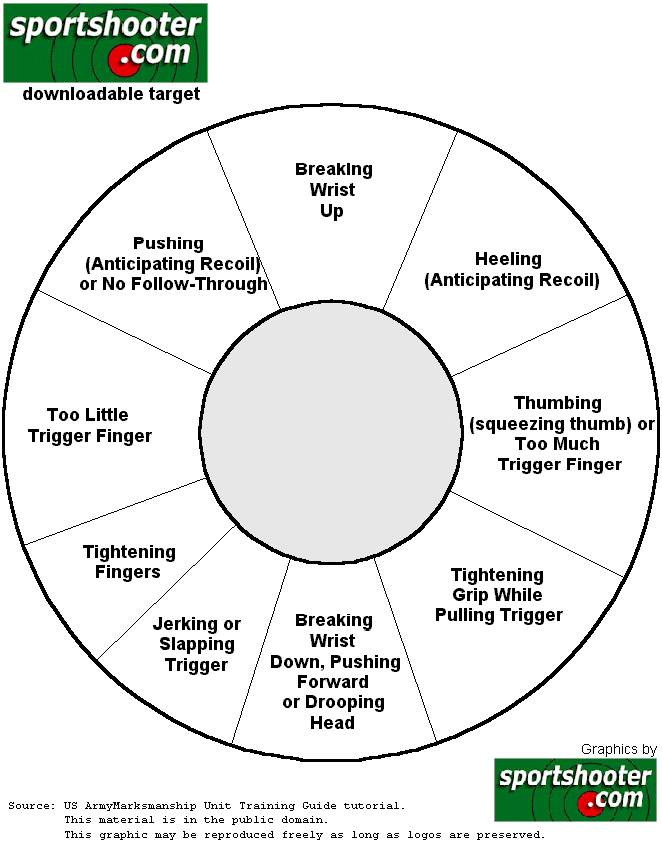
Down and left with a right handed shooter is trigger jerk instead of smooth, straight back pull.
One thing we do to break this habit is " dummy rounds random in a mag so the shooter can see the movement of the gun.
Another thing is to look at how much of your finger you are using on the trigger.
Down and left, you probably have too much of your finger on the trigger. Try using the end of your finger and keep the rest out. It will feel awkward at first but you should see closer to center groups.
Check your grip. You will probably find your left hand is squeezing tighter than your right as you pull the trigger. Try shooting one handed to eliminate this possibility.
Hope these work
Down and left with a right handed shooter is trigger jerk instead of smooth, straight back pull.
One thing we do to break this habit is " dummy rounds random in a mag so the shooter can see the movement of the gun.
Another thing is to look at how much of your finger you are using on the trigger.
Down and left, you probably have too much of your finger on the trigger. Try using the end of your finger and keep the rest out. It will feel awkward at first but you should see closer to center groups.
Check your grip. You will probably find your left hand is squeezing tighter than your right as you pull the trigger. Try shooting one handed to eliminate this possibility.
Hope these work

To echo what some have already said:
- slow it down
- bring the target closer start at the 10 yard line, be successful with that, then go further out.
- mix dummy rounds or load unknown number of rounds.
- grip should be firm like you are holding a bird from flying away, but loose enough so that you're not squeezing it to death
- bring the gun up to you - don't bring your head down to the sites.
- arms straight
- both eyes open
- target should be fuzzy focus, with sights aligned
- slowly squeeze (don't slap) the trigger, until you feel its just at the point where it will fire - thats called bringing in the slack
- then squeeze, the shot should suprise you.
- experiment with your finger tip, or the pad, or the joint
- adopt a modified weaver stance, or something that feels comfortable to you, don't lean back, lean forward instead if you must.
- the grip should be hand over hand, with thumb over thumb, and pointed towards the target.
- For me I came from a 1911 world, so my habit is to use my weak hand pointer finger and bring it across and infront of the trigger guard.
- Try 3-5 shot groups. Their may be impetus to try to shoot faster and further right away, but be patient and work it, until you are consistent. If your groupings are tight but off the mark - consistently, it means something with your sights.
- When you're not at the range, practice dry firing, bring up the gun until the sight picture aligns. close your eyes, take 3 or 4 deep breaths open them, still there? then try closing your eyes, bring the gun down, bring them up again and realign the sights. do this alot. this is conditioning muscle memory.
- These are just some things you can do by yourself. Its much better to have an experienced shooter observe you.
I wouldn't bother with the 22 conv kit. It may save you money if thats all you're going to shoot, but it will do you no good for recoil control, flinching, or any other newb issues or bad habits you may have with the 9mm.
Personally I also, would not mess with the springs, and disconnect. Stay stock. Just do a 25 cent trigger job. (google 'trigger job glock')
Don't remove the metal, just polish the surfaces until smooth.
Personally I also, would not mess with the springs, and disconnect. Stay stock. Just do a 25 cent trigger job. (google 'trigger job glock')
Don't remove the metal, just polish the surfaces until smooth.


sillymike
CGN Ultra frequent flyer
There's no real secret to shooting pistols...
- Focus on the front sight
- Slowly squeeze the trigger...
I know this might sound a little silly... bet getting better hearing protection also helps many people shoot better. It seems like people are more sensitive with noize then that are with recoil.
- Focus on the front sight
- Slowly squeeze the trigger...
I know this might sound a little silly... bet getting better hearing protection also helps many people shoot better. It seems like people are more sensitive with noize then that are with recoil.

I believe that, I've noticed myself do it when I thought there was more rounds, but it's not like my technique changed when I shot a mag or two through the 1911.
It's more about your anticipatory flinch than the gun at all. I'm still pretty new myself but one thing I've learned is that flinching comes and goes. And when we're really new it's mostly there. And it doesn't matter if you've shot a big hand cannon in the recent past or not you can still flinch your 9mm. And if you're flinching then there's no way it'll be accurate. It's also amazing how many people snatch at the trigger instead of squeezing it smoothly and by doing so pull the gun out of position as the trigger breaks. The best advice that I've seen from a couple of sources is that the idea is to squeeze until the gun going off surprises you. If you anticipate the discharge then you're setting yourself up for a flinch as you automatically try to compensate for the muzzle lift.
For myself I found that the best teacher for learning to avoid all these troubles was to shoot a magazine or two of .22 then immediately follow up with a magazine of center fire. Then back to the .22 again. The lower recoil and noise of the .22 allowed me to concentrate on no movement at all other than the trigger finger and to develop a nice follow through on the trigger. I found that taking these habits directly over to a magazine of center fire produced some great results. I don't rely on the .22 as a training aid as much anymore but occasionally if I haven't shot for a couple of weeks I find the flinch coming back with the 9mm and .45. Then it's time for more .22 therapy.
In the meantime until you get a .22 or if you want to do it the hard way with the center fire the trick would be to not rely on the last empty chamber but to get a pack of snap caps. Have someone load the magazine for you with one or two snap caps mixed in with the ammo and then tape your behaviour when you click on a cap. If the gun moves AT ALL when the striker clicks then you're not there yet. When the striker falls on a cap all that should happen is a click. ANY muzzle movement at all and you've still got some flinch.
The other thing is that if you're consistently grouping to the left is put a little more finger through the guard, assuming you're right handed. If left handed then a little less. But only once you're not shooting low due to the flinch.
Doing the trigger will make it a little less obvious but a trigger job isn't in any way a cure for the Dreaded Flinch. That is all yours and it's you that needs to deal with it. Heavy or light, spongy or crisp a good shooter will put the shots directly on target because they practice the basics.
Hey, if it was easy where woudl the fun be in THAT, right?

Just curious but if you use randomly placed snap caps how do you know if you have a misfire? I would be nervous about an open breach detonation and would force myself to wait the 20 or 30 or 60 seconds recommended wait to see if I have a hang-fire... Is this something to be concerned about?
Jeff
Jeff

Just curious but if you use randomly placed snap caps how do you know if you have a misfire? I would be nervous about an open breach detonation and would force myself to wait the 20 or 30 or 60 seconds recommended wait to see if I have a hang-fire... Is this something to be concerned about?
Jeff
You don't. Wait the 20-30 seconds and clear the pistol. The primary reason for using snap caps is to see if you have a flinch. Properly clearing the pistol is the 'added bonus'.... Once you recognize that you are flinching you can start taking measures to correct it and may not have to use snap caps again unless you want to check on your progress.....
Hang fire is also something more worrisome to a flintlock shooter or a cap and ball black powder sort.
When an FTF happens in an IPSC match or during a combat situation you don't see anyone sitting around counting out 20 seconds. If a jam or light strike occurs that slide is being racked back as quickly as the shooter can get that hand up there.
When an FTF happens in an IPSC match or during a combat situation you don't see anyone sitting around counting out 20 seconds. If a jam or light strike occurs that slide is being racked back as quickly as the shooter can get that hand up there.
Hmmm. Two opposing opinions on CGN... That never happens!
Since the question is about a misfire, and the guy who answered my questions name is Misfire I will go with what he said... LOL! Seriously though, if I was in a competition or God forbid a gunfight I don't think I'd be counting the seconds either...
Jeff
Since the question is about a misfire, and the guy who answered my questions name is Misfire I will go with what he said... LOL! Seriously though, if I was in a competition or God forbid a gunfight I don't think I'd be counting the seconds either...
Jeff






















