I got a Giraud Case Annealer, I have a few questions

Clayne_b

Regular
Rating - 0%
0   0   0
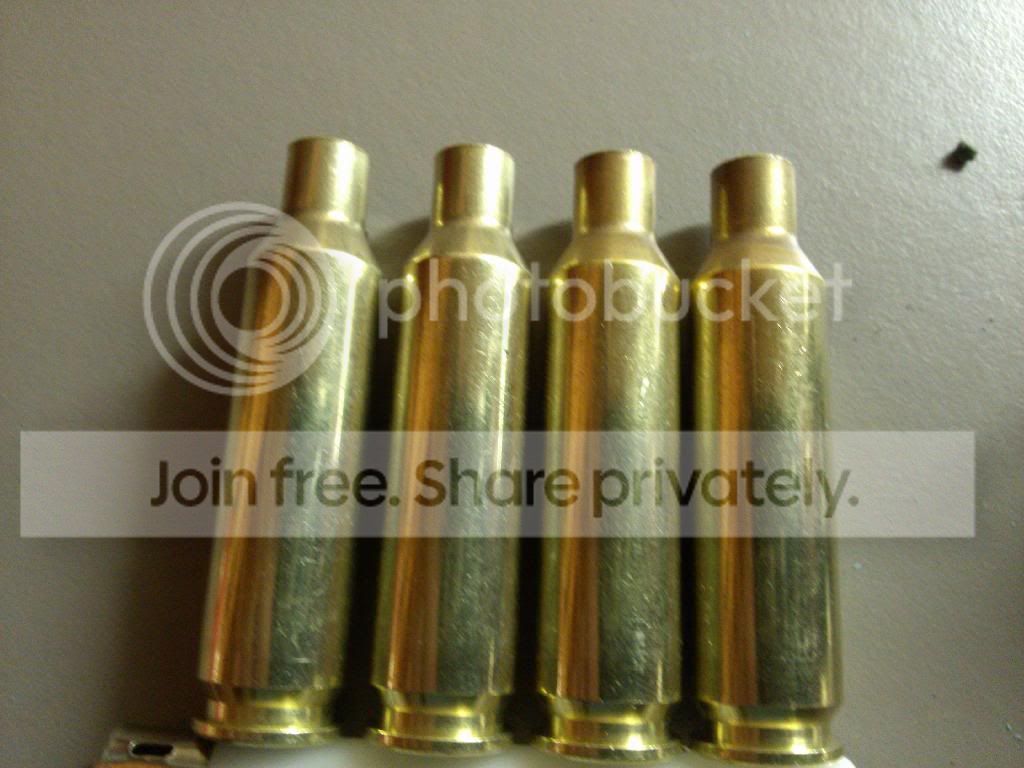
So I am annealing Hornady 6.5 Creedmoor brass.


The 2 on the right have been annealed, The 2 on the left have not been


Here is a video I did with tempelac 750 in the inside of the neck, 425 on the out side of the case body


Tell me what you guys think, If im doing this wrong please tell me, and teach me the way of the ninja!
 
I'm not familiar with the Giraud (other than the trimmer - so I'm jealous), but it looks like your torch position may be too close to the end. You can see in the rotation that the Tempilaq melts from the end in towards the shoulder. You might want to adjust the torch so that the entire neck length melts at the same time, not through the second rotation (catch it all on the first rotation). I like to get the shoulder annealed as well, a bit into the body. I use the 425 for the base of the brass, 650 for the body and 750 for the neck (on a sacrificial piece of brass). I'd say that the neck looks to be annealed (into the recrystallization zone), but the shoulder is not (still in the recovery zone).
 
They don't look like factory annealed Lapua brass.
Sure you've put enough (but not too much) heat to 'em?.

As BattleRife says, if they're cleaned, can't read anneal by surface colour after.

My cases have that bluish line just below the shoulder.

If any red (while in a darkened room) shows while it's in the flame, that case is ruined.

I quench, just to be sure that no heat ever gets to the case head.
 
It looks right in your video, the Tempilaq 750 has melted inside the case neck so they should be good. Too bad we can't get them in Canada, it looks like a good annealer.
If anybody is wondering why here is what the web site says:
Due to ITAR regulations of automated loading equipment, this device is not available for international sale. DO NOT ASK IF YOU ARE OUTSIDE THE USA.
 
Ill make a few suggestions.
First of all this is not my annealer.
I set it up for my cousin in NJ.
Go on ebay and purchase a 20k ohm 10 turn potentiometer and get rid of that crappy unrepeatable speed controller.
Your cost will be around $7.00
The same controller and knob will cost you $30.00 from Mc Master-Carr.

This is the order in which the wires will need to be hooked up.

This is the way the wires were hooked up on the original.

Then go purchase this regulator.
It's a $180.00 regulator for $65.00
http://www.waresdirect.com/products/Commercial-Products/Goss-/Propane-Regulators215905

You will also require a couple of throwaway cylinder adapters and a 1/4"NPT male to female elbow.
Mr Heater # F273755 Male Cylinder x 1/4" male pipe thread
Mr Heater # F273754 Female Cylinder x 1/4" male pipe thread
When you put everything together you will have a setup with much greater adjustment and repeatability.
You will be able to set your flame by the pressure on the regulator while opening the manual valve all the way instead of barely cracked open.
Optimal pressure was achieved between 10-18 psi for .223 and .308 in my testing.
I also found that optimum annealing was achieved when the flame was directed to the junction of the case neck and shoulder.
 
Last edited:
I forgot to mention that the way the regulator is supplied it can be attached to a regular 20lb BBQ tank.
Then all you would need is the male adapter.
Coleman also makes a 5' extension hose for around $30.00 if you want to place the tank on the ground.
 
why do so many people anneal .223?
do the case crack or something? is it to prolong the case life?

Running brass cases through the sizing die, and over the expander ball, during reloading tends to work-harden brass.
So, yes, it is to prolong case life and avoid neck cracks.
 
Back
Top Bottom