I need some help from the big dogs regarding reloading

RSO should be fired before his advice gets someone hurt. The only time what he said is true is with black powder, NOT smokeless. As stated the case head separation is an issue with the rifle and H4831's advice is THE solution requiring no new parts. Once you fire form the cases in this manor, marry them to that rifle and neck size them. This will increase brass life (beyond 1 shot!) as well as potentially improve the accuracy of your handloads. It will lower pressure due to the increased volume. You're on the right track!
 
A lot of Knowlege is on here
Two heads are better than one Lots of it is great --->a tiny bit is BS

thats is why you don't relly on Internet reloading info
You need to double check stuff from a reliable source

if you Tell us your Load
Cal
Bullet type and weight
Brass
Primer
Powder
Min/ max From what reloading book
and What did you Load them too (charge)
and what length you reloaded them to

We could look over your data from a distance

PS from your comments I would Say you reloaded too many for a first try

a shake at the end of reloading is a good way to double check your self ----> Did I really put powder in all those cases
 
As others have stated, your RSO doesn't have an inkling, and it takes 1000 inklings to make a clue, lol.

Powder shaking in the case means squat, since over 75% of all loads, factory or handloads do this.

As also stated, the 303 Lee-Enfield, with its rear locking system and generous chamber, can be hard
on brass, causing the separation you experienced.

Neck sizing will help case life immensely, so avoid FL sizing once they have been fired in your rifle.

You will get the hang of it as you progress. Your 30-30 should be just fine, since it is undoubtedly a commercial
rifle.

Enjoy your new hobby...if you have any questions, just ask.

Regards, Dave.
 
I have read about the 303 british, and I found out that the american made 303 british rounds have a thinner rim than the british military cartridge. This result in an excess of headspace between the bolt and the case. When you fireform your cartridge it overexpand and make it more fragile. If you put a rubber O-ring on top of your case rim and fireform your cartridge it will fix this problem. From there, neck size only and you are good to go for many reloads.
 
What rifle do you have? Lee-Enfield bolts can be threaded in and out. If when your bolt is out of the rifle the bolt handle takes a turn while the bolt head is stationary it can change the headspace.

There are a lot of LE collectors out there and it should be easy to find out more and check it out. With mine my Brother in Law told/showed me. I turned my bolt out as far as it would go and still close on a shell. 1 turn in and you'll have excessive head space.

Please check it out, I don't mind being wrong but better I'm wrong than your rifle unsafe.

With reloading, people (incl me) can chase their tales with powders, case prep, and bullet seating only to find out(like me a month ago) that their scope was loose(or some other rifle related cause).

Good luck, I'm sure with the willingness to chunk out that many loads your loading endeavors will pay big dividends.

Willy
 
You have a classic case (pardon the pun) of incipient head separation....very common on the 303 British Lee Enfield with the rear locking lugs.....I know of two other instances from two different 303's to experience this.......I recommend neck sizing only for this rimmed case....this will minimize the case/head separation and increase case life......Look for the bright ring forward of the case webbing....this is the indicator of incipient head separation.....There is nothing wrong with powder not completely filling the case......Consider IMR3031, IMR4064, and IMR4895 as powders for the old 303 British.....

100% correct. RSO knows nothing OP. Fill that case all the way up and you may never shoot again.
 
You should have the head space for the rifle checked. It could be that you have too much room between the bolt face and the barrel where the case rim sits. When you fire off the round the rear area of the case is unsupported and is broken off.

The reason you have not had this happen to factory loads is because they are fresh and have not gone though a cycle of this yet. Check the rest of the once filed casings to see if there is some damage or bulging.
 
i agree with the range guy, if you can hear shaking of powder in your bullet, go home and remove the bullet and fill up the case so there is no shaking. That is the only thing you need to know about reloading. buy the one kind of gun powder and fill it, so that there is no shaking, then come back and shooting. this is the secret all the pros have been keeping from us.

haha what an idiot, was he saying it like a guess or like a fact?

welcome to the reloading world, i am fairly new myself ( been a year now ) but i thoroughly enjoy it, and as the time goes on you definitely get more experience by trying new things and running into new things, and the best part is there is plenty of people online (youtube and here) that have good answers, just make sure to verify info ( i.e. not listening to your dumb ass RSO )

also, have fun shooting your 30/30
 
I started reloading .303 with those jacketed boattails. Shot well, but expensive for just casual shooting. I've got some nice gas checked hard cast lead, but I have not had a chance to try them out yet - I too have been spending a lot of quality time with my '94 in 30-30 reloads - lots of fun.

Seems like .303 and 30-30 are popular calibers for newer reloaders. We should form a support group.
 
Thanks again for all the input.
To answer a couple of the questions asked. The bullets were S&B and PU fired once by me through one of two of my Enfields. A 1942 (savage made) No.4 mark1 and a 1919Parker Hale sporterized SMLE mark III.

My recipe was
2.212 case trim
2.945 OAL
174gr Hornady FMJ/BT 3131
IMR 4064 at 37.0 gr
Winchester Lg rifle primers


And yes I did reload to many on my first go round. I had a range day planned with 4 friends from work that had never fired a lever rifle or a .303 so I wanted to give them as much ammo as possible to enjoy the day.
 
Take a new or full length resized case and place a fired spent primer in the primer pocket just using your fingers.

303primer_zpsae8fdb45.jpg


303primera_zps612343f9.jpg


Now chamber this test case and slowly close the bolt, then eject the case and see how far the primer is protruding.

The amount the primer is protruding from the rear of the case is called head clearance or the "air space" between the rear of the case and the bolt face.

hedspace-b_zpsce06e3e4.gif


If you have a set of vernier calipers you can measure the case before you put the primer in the primer pocket and after you seat the primer by closing the bolt. The difference in these two case measurements is your head clearance in thousandths. If you add your rim thickness to your head clearance this would be your actual headspace reading.

303gauge_zpsb1e333a7.jpg


If your cases had a case head separation after the first reloading your Enfield rifles headspace is "WAY OVER" the military maximum of .074. You need to do the above test to determine if your Enfield rifle can be brought back to headspace standards. Sometimes a new bolt is required to get the rifle into headspace limits with the longest No.3 bolt head you can find, failing this your rifle is a wall hanger.

You can fireform your cases by using a small thin rubber o-ring placed around the rim. This will hold the case tightly against the bolt face when fired and prevent the case from stretching and thinning.

o-ring_zpsfc086c19.jpg


When you neck size only, the cases will headspace on the shoulder and not the rim and the shoulder of the case will then hold the case against the bolt face.

zeroheadspace_zpsbaf7579c.jpg


And when you go to the range again and see the RSO ask him to shake his head and see if your hear anything rattling around. If you don't hear anything then you will know his head is empty and needs reloaded with more gray matter, acorns, rocks or anything handy.

Empty Brain Syndrome

empty_brain_zpse97dc2f2.jpg
 
bigedp51 thanks for that post with the illustrations. i'm new to reloading this calibre as well and that explains it better than I've seen as yet.
one question, the small o-ring to ride the rim, is there something that you (anyone) suggest? thickness etc??
I know someone said "hair thing" but my gf's would be too big in diameter to secure against the case.
thanks for your help.
 
Where did u get that load recipe? Seems below minimum as a 180g takes over 41g..Curious. You may be experiencing detonation instead of ignition...]]
ps Your RSO is full of BS

Unfortunately, not all advice on the internet is accurate. With minimal research, I have determined that maximum load of that powder is 41.5gn. In 8 different books. Minimum load is 37.0.

So, are you trying to tell us that a minimum load will detonate instead of ignite? Love the advice...esp when it's NOT.

Most people start 5% BELOW minimum when starting with a new cartridge in a new rifle and many of us shoot reduced loads with the same powder we shoot maximum loads with, how the heck can we do that? Oh yeah, by not reducing the loads below 50% of the min weight, or did you miss that part of the class? Luckily, you weren't around for those detonations.
 
Thanks again for all the input.
To answer a couple of the questions asked. The bullets were S&B and PU fired once by me through one of two of my Enfields. A 1942 (savage made) No.4 mark1 and a 1919Parker Hale sporterized SMLE mark III.

My recipe was
2.212 case trim
2.945 OAL
174gr Hornady FMJ/BT 3131
IMR 4064 at 37.0 gr
Winchester Lg rifle primers


And yes I did reload to many on my first go round. I had a range day planned with 4 friends from work that had never fired a lever rifle or a .303 so I wanted to give them as much ammo as possible to enjoy the day.

My primary concern was that you had purchased or picked up someone elses crappy brass and were using it.
 
The part that really tweaks me is that it wasn't until post 15 when the OP's question was answered. How the he!! does knowing the cartridge data help anyone determine the solution to a case head separation? As far as I am concerned, not many others here were any more informed than the RSO. One came close, though (incipient separation is what is happening with the OP's cases that show a "ring" around the case near the case head and the next firing will separate it). That could be because they haven't spent time with a .303Br.

Reading the the OP's second line of his second paragraph and I knew the answer. Exactly what H4831 posted. You did not need ANYMORE data. NOT a case of incorrect powder charge, insufficient ignition or detonation, incorrect powder, etc., simply the excessive "head-space" issue endemic to .303s.

One thing, you will need several o-rings. The extractor tends to chew them up, especially if it is new.

OP, enjoy your new hobby. Corroborate the advice you receive with several sources BEFORE YOU IMPLEMENT IT! High post counts do not necessarily translate into knowledge. While at one time, I was new here and was intimidated by high post counts, but I rapidly found out that they meant nothing. Read entire threads, absorb information from numerous sources, THEN make some decisions.

Ted
 
We are now getting something closer to the "full story" of your loading venture.

let's help you learn more from it.

You have 2 different rifles in the same caliber. Henceforth, treat them as individuals. If you shoot factory fresh ammo in them, keep the brass segregated and dedicated to the rifle it was shot it. This will make a big difference in future brass sizing. And yes, for that first firing, use the rubber o ring. I have never found a good cheap source of the rings. Have not yet tried my main gadget suppler- the Dollar Store.

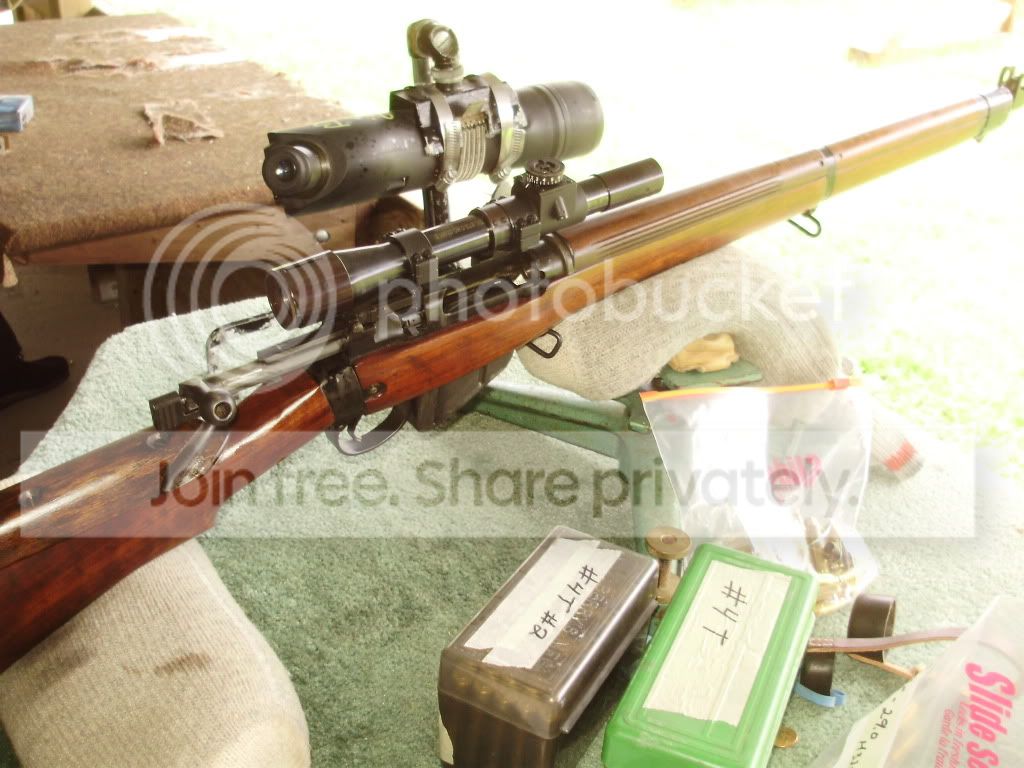
I buy 50 round plastic ammo boxes for rifle ammo, and put a label on the box indicating which rifle it is intended for. Here is what this set up looks like. You will see I have ammo out for two different 303 rifles.

4T27.jpg


You can neck size your brass with your full length sizer die, by backing it off. You want to be sure the die does not touch the case shoulder when it sizes. When you partially size a case you will see a mark on the neck, showing you how much of the neck got sized. If the case was full length sized, the neck would get sized all the way down to the shoulder. if you size only half way down, the should er would probably not get touched.

I have reloaded 303 Brit thousands of times and never had a case head separation. If you had a separation on the first re-load I would be concerned about a gross headspace issue. The bolts should be serial numbered. Make sure you have not swapped them.

The trick of seating a primer with the bolt is a good one. If one rifle seats the primer almost flush and the other lets it stick half way out, you know you have a problem.

Your bullet choice was excellent. The flat base round nose ha the best chance of shooting well in a 303. Your powder choice and powder charge was also excellent.

Enjoy the sport.

 
Back
Top Bottom