I weighed some Peterson SRP brass...

PGW Steve

CGN Regular
Rating - 100%
46   0   0
For giggles I picked up some SRP brass for my .308, two boxes of the same lot number, W1TL0069. I weighed them all on a calibrated FX 120i and wrote the weights on each with a sharpie and then put the data into MS Excel.

Min 178.0
Max 181.2
Avg 179.73
ES 3.2
SD .559

As the bottom end, there is a steep ramp from 178 to 179 which has 7 cases. At the top end, there is a jump of .5gr to the last case. Removing the 8 outliers would change the data to:
Min 179
Max 180.7
Avg 179.83
ES 1.7
SD .381

I'm kind of surprised at this given the reputation of this stuff, not to mention the price. I also bought 100 of the .260 SRP's as well, tomorrows weighing project. I'll add the data to this thread.
 
I had bought a box of 50 of each (SRP/LRP) to do some testing a year ago - for 10 round samples (measured in grains):

SRP - AVG 181.5 ES 1.9, INTL Vol AVG 55.2 ES 0.4
LRP - AVG 182.0 ES 2.6, INTL Vol AVG 55.2 ES 0.5

Peterson is slightly heavier than Lapua cases, with just a minor reduced internal volume (0.4gr). Seems to be a bit harder than other brass, so there may be a higher percentage of zinc in the mix. Overall a good quality case (and much better case box than the Lapua). Seems to be a bit of a variation in lots (yours and mine) when I look at the averages, but I see the same in various lots of Lapua as well. All the more reason to build up the loads each time you change a variable like lot number in any component.
 
Thanks for your results Scout!

I just did the .260 SRP batch.

Min 177.5
Max 179.8
Avg 178.8
ES 2.3
SD .472

Next up is to do the water capacity of the highest and lowest in each case type, and perhaps one of the ones that fall in the average range. The .260 batch didn't have as crazy of jumps at either end. If I were to drop off 6 cases at the bottom, and one at the top, the ES would change to 1.6 grains.
 
I never took the time to weigh my Lapua casings,
For those who have how do the OP numbers compare to Lapua?
Got close to purchasing Peterson a few times myself, but now with the new 6.5x47L here i am stuck with Lapua by default...
 
Here's what I got with Lapua .308 for 2 different lots. samples of 10 from 100boxes.

Lot #1 : Dry average weight - 180.0 ES 2.2 (1%)
H20 volume - 56,3gn ES 0.7 (1%)

Lot #2: Dry average weight - 179,1gn ES 1.1 (0,6%)
H20 volume - 56,1gn ES 0.7 (1%)

I did the same for a batch of 1F sako brass picked from a shooter at the range to see how they were volume wise compared to Lapua's. I understand these were not fired in my rifles so there is a small biais here. But just for giggles :

Average dry weight - 176,5gn ES 6,5 (4%)
H20 volume : 57,0gn ES 0.9(2%)

I am not too interested in the brass weight per se. H20 volume and consistency of volume is what I want to know from these test.

Yeah, I am a reloading geek
 
Weight can be an indicator towards volume, heavier brass may have less volume, depending on the composition of the brass from lot to lot. Volume can indicate where they put the extra weight in the brass, or not, somewhat. It's a bit of of an exercise in OCD. But, with a small chamber and larger internal brass volume, it may help with a certain load achieving the optimum powder burn pressures and a few more fps, or not, may also result in your suddenly getting pressure signs if you are running upper end loads, or if you have a large chamber, may need a tad more powder, or not. That's also why they tell you to knock your pet load back a bit and rework it with new or different brass.
 
so prepped brass h2o is more important than weight?

With Quickload you need the case capacity of a fired case from your rifle to get accurate results. If you do not input your case capacity Quickload defaults to the lowest case capacity.

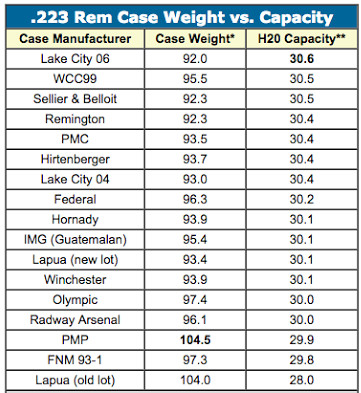
Example below, Quickload will default to 28.0 grains of H2O capacity for the .223, but my Lake City cases have 30.6 case capacity. And with the same powder charge of 25.0 grains of H335 these two cases would vary 6,000 psi in chamber pressure. And these case capacity variations will cause greater variations in the vertical impact the greater the shooting distance.

NOTE, the variations in case capacity has more effect on smaller cases like the .223. And less pressure variations with larger cases with more capacity with the same capacity variations.

LjAQ7L9.jpg


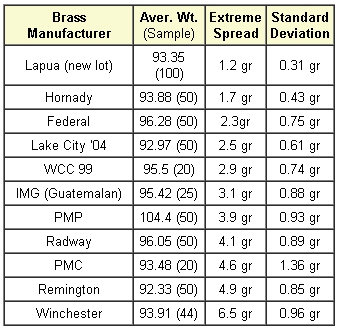
Below you can see the weight variations between the brands of .223 cases. And with high quality cases like Lapua most competitive shooters just load and shoot. But with Remington and Winchester cases you would spend time either weight sorting or checking each case for case capacity. I'm lazy and also a cheap bastard and buy bulk once fired Lake City cases that are above average in quality and uniformity. So if you are not trying to shoot bug hole groups at 600 to a 1,000 yards checking your case capacity may be a waste of time.

PExmCCk.jpg
 
Here's what I got with Lapua .308 for 2 different lots. samples of 10 from 100boxes.

Lot #1 : Dry average weight - 180.0 ES 2.2 (1%)
H20 volume - 56,3gn ES 0.7 (1%)

Lot #2: Dry average weight - 179,1gn ES 1.1 (0,6%)
H20 volume - 56,1gn ES 0.7 (1%)

I did the same for a batch of 1F sako brass picked from a shooter at the range to see how they were volume wise compared to Lapua's. I understand these were not fired in my rifles so there is a small biais here. But just for giggles :

Average dry weight - 176,5gn ES 6,5 (4%)
H20 volume : 57,0gn ES 0.9(2%)

I am not too interested in the brass weight per se. H20 volume and consistency of volume is what I want to know from these test.

Yeah, I am a reloading geek

Yep... volume matters... weight, not so much.

Jerry
 
Back
Top Bottom