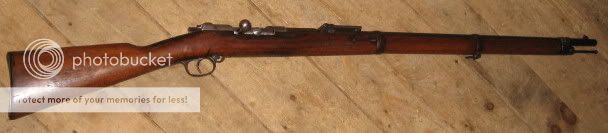
IG mod 71/84 single shot ???

longsault22

New member
EE Expired
Rating - 100%
3   0   0
Location
Long Sault
i am trying to find out the make model of this rifle. the stamping on it are as follows, ig mod 71/84, on the back of the bolt stamped 35, on the chamber 1476 and then 3 designs up the chamber, and behind the bolt a little faded looks like 1866. the only sight on the rifle is a bead sight at the nose.I can take more pictures if needed. i'm trying to find the value of this rifle for my father.

http://s926.photobucket.com/albums/ad110/longsault22/?action=view&current=Jan2010178.jpg&newest=1

http://s926.photobucket.com/albums/ad110/longsault22/?action=view&current=Jan2010176.jpg&newest=1

http://s926.photobucket.com/albums/ad110/longsault22/?action=view&current=Jan2010174.jpg&newest=1

http://s926.photobucket.com/albums/ad110/longsault22/?action=view&current=Jan2010180.jpg&newest=1

http://s926.photobucket.com/albums/ad110/longsault22/?action=view&current=Jan2010182.jpg&newest=1

http://s926.photobucket.com/albums/ad110/longsault22/?action=view&current=Jan2010.jpg&newest=1
 
Last edited:
Mauser

Your shotgun is a custom built job.

It started out from the factory as a military tube magazine fed bolt action repeater rifle in cal .43 Mauser.

IMG_0088.jpg


Germany's first repeating rifle, introduced in 1884 which put Britain into a spin as their army was equipped with Martini single loaders. Brits adopted the Lee Metford bolt action shortly afterwards in 1888.

The three designs that you mention are post 1898 commercial Leige proof markings done in Belgium, but civvy shotgun proofs are not my forte. Most likely that was where conversion was done. The rifle was made obscolete in 1888 with the introduction of a new Mauser model. A great many were placed into war stocks to be released years later to the surplus market, brand new. Perhaps somebody scooped up a bunch and converted them for sale to the public?

As for a value? Hmmmm, looks to be well made. My guess (and only a guess) would be around the 200-300 mark.
 
Last edited:

Well, the markings that I can see from bottom to top are:

Crowned oval containing ELG, the post 1893 Belgian proofmark

Diamond containing 12M over C, the 1898 to 1924 nominal gauge for black powder shotguns.

Candlestick type thing. The Perron, indicates the breech has been proofed when used after 1853.

Star over UA, controller of proof's mark. Not an controller of proof familiar to me.

Could the 1476 actually be a 12-76? possibly in a fain open ended oval? That would mean a 12 gauge bore with 76mm (3") chambers. That's a proof that came in in 1924. That would date the re-work on this gun to 1924 pretty conclusively. Or it could be something else entirely.

HTH.

J
 
Don't feel bad, they converted alot of nice old Military guns like your 71/84 into shotguns, and while they may be more useful, they aren't a real nice old collectible anymore. I've seen these old conversions priced alot lower then $300!!
 
hey thank you guys very much. I love how much knowledge you cgn guys have in a well rounded fireamrs world. As for my father he just wanted to see if the rifle was going to be the funds for a new project, i think he is just gonna hang on to this old girl.

thanks again.
 
There was a thriveing industry c1890-1930 converting obsolete military rifles to shotguns, especially in Belgium. ALFA 1911 catalogue shows Mausers, Chassepot, Albini, Gras and others converted to shotguns. There has been a converted Chassepot for sale at $90 at local gun shows for a long time.
 
It's funny that this post came up now. I just had a guy over to get a similar shotgun verified that was built up on a Gew 88. The markings on the barrel threw me because it looked like a Belgian proof for 12 guage but it is definitely in .410. One other thing I found odd was that there were no markings to indicate who did the conversion other than a series of dashes like this "\ / / /" on the bottom of the barrel, bottom of the receiver, bolt head and underneath the trigger guard of the stock. I would be a little leary on shooting it since the barrel would turn back and forth by hand. It looks to have had the original barrel cut off, drilled out, and the new barrel threaded into the stub. I wasn't able to find anything in the FRT that matched it.
 
One other thing I found odd was that there were no markings to indicate who did the conversion other than a series of dashes like this "\ / / /" on the bottom of the barrel, bottom of the receiver, bolt head and underneath the trigger guard of the stock.

those are assembly marks and usually are a roman numeral "chopped in" with a cold chisel. It was to allow a lot of small parts from several guns to be case hardened or blued in one batch then sorted out to match their appropriate guns.

cheers mooncoon
 
Back
Top Bottom