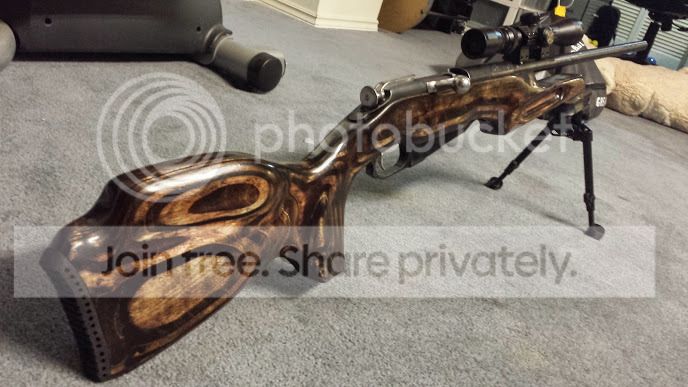
Interesting behaviour with my reloads

Just a thought but if you haven't sporterized the wood I'd suggest that the insulation of the barrel by the full wood lower and handguard means that 10 seconds may not be enough waiting time to let the heat soak away very well. Perhaps open up the time between shots to a more leisurely 20 or even 30 seconds.

It may also be that since you say the PPU bullets are no great shake that they favour a lower power charge. If things go to hell with the stronger charges perhaps look at options for a lower pressure load with a different powder for THESE bullets.
 
Thanks! Btw, IMR 4895 load data and H4895 is not interchangeable. Completely different powders. The 60% rule only works with H4895.
As Sunray pointed out, the 4895's are very very close. I swap load data from starting loads sometimes if I can only find IMR data (I use mostly H). Not all the powders with the same numbers can be swapped in this way; you have to know which ones are closer than others. 4198 and 4895 are very close and pretty safe to swap data at starting loads. The 4831's on the other hand are not nearly as close and I never swap data between those two. You can use the burn rate chart to estimate but I prefer to look at published load data from the same source that lists both powders and compare velocities and pressures at specific loads.

I also tend to not use the max load data and instead chronograph my loads and use the max published velocity as a stop point instead of the load weight they recommend. Sometimes this takes me a little above the max published number, sometimes I hit the "max" velocity before the max charge weight.

The Hodgdon data does say the 60% rule is for H4895 but if you look around on Google there are countless people that have used the same rule for IMR4895 for decades with no problems. Hodgdon has never come out and said not to do it with IMR but they don't support it either. I've tried it with both H and IMR and it worked great, produced enough pressure to form a gas seal, no unburnt powder, and decent accuracy.
 
Oh no ... as far from original wood stock as possible... the barrel is "very" free floated :)
Been doing lots of research today and found multiple references to bullets with small bearing surfaces preferring lower powder loads.

mosincustom_zpscf6ugkst.jpg


Just a thought but if you haven't sporterized the wood I'd suggest that the insulation of the barrel by the full wood lower and handguard means that 10 seconds may not be enough waiting time to let the heat soak away very well. Perhaps open up the time between shots to a more leisurely 20 or even 30 seconds.

It may also be that since you say the PPU bullets are no great shake that they favour a lower power charge. If things go to hell with the stronger charges perhaps look at options for a lower pressure load with a different powder for THESE bullets.
 
Last edited:
Thanks for the suggestions. I think I will give this another go.


To answer one of your questions, 4895 is a very good powder choice. It is not a "slow" powder.

Groups must be statistically valid. Shooting one test does not mean much. The "good" group might be a fluke.

Clean the barrel with a good copper solvent. I wet it down and leave it over night, muzzle down on a paper towel pad. might need more than one over-night treatment to get clean.

At the range, fire a few shots to zero the scope, warm the barrel and foul it.

Then shoot the test, starting at 42 gr, in 0.5 gr increments. Make sure the barrel cools between groups.

If the gun tells you it prefers the mild load, don't argue with it.
 
Thanks for the info. I'll remember that.

The Hodgdon data does say the 60% rule is for H4895 but if you look around on Google there are countless people that have used the same rule for IMR4895 for decades with no problems. Hodgdon has never come out and said not to do it with IMR but they don't support it either. I've tried it with both H and IMR and it worked great, produced enough pressure to form a gas seal, no unburnt powder, and decent accuracy.
 
ok guys, here are the targets. Each group is circled and marked with the number in which order it was shot and group size measured from center to center.

Edit: Just realized that the images are not very readable ... group one is 43gr of IMR 4895, each group after that is one grain more. So group 5 is 47gr. Now that I look at it ... group 4 doesn't seem bad. Quite possible I pulled one shot there. That's 46gr of IMR 4895.

673128da-2e42-495c-9fc4-634dd81abcd7_zps675k7kml.jpg


e18c8268-9173-42d9-b4ef-3e4af618826e_zpskwtx7jyr.jpg
 
Last edited:
This is an OCW-style analysis, using the centre-points of your groups.

Well the good news is that you seem to have a nice even rise in the the vertical centre-points of your groups. The bad news is that there are no really obvious nodes. You might try a second test where you step in smaller increments and investigate the area between groups six and seven.

(BTW I screwed up the powder volume on group seven but it doesn't matter for the calculation)

yJdytOS.png
 
Really cool analysis! Which software are you using and why groups 6 and 7? Those seem to be the worst ones.
Pardon my ignorance since I am a bit new to this game, but based on these results, wouldn't it be better to explore 42.5 - 43.5 gr and 45.5 - 46.5gr ranges in 0.1gr increments?

Thanks!


This is an OCW-style analysis, using the centre-points of your groups.

Well the good news is that you seem to have a nice even rise in the the vertical centre-points of your groups. The bad news is that there are no really obvious nodes. You might try a second test where you step in smaller increments and investigate the area between groups six and seven.

(BTW I screwed up the powder volume on group seven but it doesn't matter for the calculation)
 
Last edited:
This is custom software.. it's not done yet and one day I'll release it when I get off my duff and finish it properly.

OCW works by finding a place between two or three charge weights that minimizes the difference between the centre-points of the various groups. The analysis software plots all the holes in your all your groups, finds the centre-point for each group, then figures out the set of N that has the least vertical dispersion between them. In this case, I used N=3 for the analysis. In theory, because you have such big jumps in powder charge, I could have used N=2 and you would still have wound up trying to find a sweet spot that varied by an entire grain of powder.

In any case, you can see by the left-hand chart (and on the centre-point plot on the top right) that groups 6 and 7 have the least vertical dispersion between their centre-points.

Remember, the point of OCW isn't to find the smallest group. It's to find a 'node' where your rifle is relatively insensitive to change-- so when you have minor variations in powder amount or case volume or seating depth, the point of impact isn't overly affected.

I'm not sure why you would test 42.5 gr since it's not on the target anywhere.. 45.5 gr - 46.5 gr has a small group size but a very large difference in centre-point for the group.
 
Gottcha! So basically your software would suggest a load which would be more "reliable" or "usable" in conditions that can vary to a certain degree instead of going for a load that will produce the smallest group but only in very specific conditions.

While looking at the targets, groups 1 and 4 look the smallest. Group 1 is 43gr of powder, so I am thinking to load some rounds in 42.5 to 43.5 range with 0.1gr increments and explore that range. Now that I look at it again, probably more like 42.5 to 43.
Group 4 is 46 grains of powder, so I'd explore 45.5 - 46.5 range.

Though I am seriously considering redoing my test from scratch and going with 0.5gr increments this time.

Would you mind running another set of targets through your software for me? I have another load that I am working on.

Thanks for your help!

This is custom software.. it's not done yet and one day I'll release it when I get off my duff and finish it properly.

OCW works by finding a place between two or three charge weights that minimizes the difference between the centre-points of the various groups. The analysis software plots all the holes in your all your groups, finds the centre-point for each group, then figures out the set of N that has the least vertical dispersion between them. In this case, I used N=3 for the analysis. In theory, because you have such big jumps in powder charge, I could have used N=2 and you would still have wound up trying to find a sweet spot that varied by an entire grain of powder.

In any case, you can see by the left-hand chart (and on the centre-point plot on the top right) that groups 6 and 7 have the least vertical dispersion between their centre-points.

Remember, the point of OCW isn't to find the smallest group. It's to find a 'node' where your rifle is relatively insensitive to change-- so when you have minor variations in powder amount or case volume or seating depth, the point of impact isn't overly affected.

I'm not sure why you would test 42.5 gr since it's not on the target anywhere.. 45.5 gr - 46.5 gr has a small group size but a very large difference in centre-point for the group.
 
The crown is perfect. The barrel slugged at .311.

Mounting a scope on this gun was a bit of a challenge, but the mount is solid. I have over 300 rounds through the rifle since I mounted the scope and no issues.


how does the crown of the barrel look? and how did you mount the scope? Does a bullet easily fit in the muzzle?
 
Gottcha! So basically your software would suggest a load which would be more "reliable" or "usable" in conditions that can vary to a certain degree instead of going for a load that will produce the smallest group but only in very specific conditions.

Pardon me.. I got this thread mixed up with another in which OP claimed to be familiar with OCW.

The OCW, or 'optimum charge weight', method uses groups show in a 'round robin' sequence and looks for the centre-point of each of the groups, then tries to find two or more groups where the center of the group is the closest, vertically, when compared to all the other groups.

'Round robin' means you fire one round from each group before moving on to the second round in each group, etc.

The purpose of OCW (and ladder testing, for that matter) isn't to find the smallest group. It's to find a charge weight at which your rifle is insensitive to small variations in the amount of powder. This means that you will get more accuracy/precision when other things tend to vary (i.e.: bullet weight, case volume, primer power) or when you don't measure out your powder one kernel at a time.

By all means post some more target and I'll run them through the software.
 
I understand now. Thanks.

The OCW, or 'optimum charge weight', method uses groups show in a 'round robin' sequence and looks for the centre-point of each of the groups, then tries to find two or more groups where the center of the group is the closest, vertically, when compared to all the other groups.

In this case the results from these targets would not be accurate because I did adjust the scope for elevation a couple of times between the groups in order to ensure I keep all the shots on paper.


Below are the targets shot with a different load I was testing. This is IMR TrailBoss with 123gr Berry's plated bullets. Same rifle, shot at 60 yards. Each group is numbered as circled as before. Group one started with 13gr of powder, using 1gr increments. Total of 6 groups, 13-18gr of powder. I definitely adjusted for windage but I can't recall if touched the elevation knob on the scope while firing these ones.

20150305_073729_zpswyvuoiov.jpg


Please ignore the bottom two groups on this target.
86d141dd-e755-480b-9be7-6e8165381195_zps6rpqbap3.jpg


Thanks in advance!
 
Last edited:
In this case the results from these targets would not be accurate because I did adjust the scope for elevation a couple of times between the groups in order to ensure I keep all the shots on paper.
.. I definitely adjusted for windage but I can't recall if touched the elevation knob on the scope while firing these ones.

Oh.. honestly. if you adjusted the elevation on your scope, or if you can't remember whether or not you did, you should probably just throw these targets out and repeat the test. You can still pursue the whole tight group thing but from a point of view of OCW or ladder test they're going to be misleading and may lead you down the wrong path of load development..
 
Got it. Thanks for all your help, especially HeavyTread.

Let's consider this case closed then. I will repeat the IMR 4895 test with 0.5gr increments and no scope adjustments this time.
 
Sure.. repeat the test and post results, and I'll be more than happy to do the same analysis. A few points to consider:

* When you take the pic, try to make sure you hold the camera straight on to the target. Otherwise the scale will change at different parts of the pic
* If you use more than one physical piece of paper to shoot the groups, try to make sure they are all the same target type. The Silverdale targets you're using are perfect, since they have known 1" divisions and allow you to shoot up to 5 groups per target.
* Shoot from the most stable platform you can. If you're shooting off the bench at Silverdale, forget your bipod and use either a lead sled, big heavy front bag (like a Caldwell Tack Driver) or use the carpeted support blocks they have there. Try to use a rear bag as well. You basically want to eliminate yourself from the equation as much as possible.
* Shoot round robin, so you shoot 1 round from each group in succession, then pause and let your barrel cool a bit, then continue with the next round on each target
 
Hey HeavyTread, followed all your advice and taking you up on your offer again :) Here are the results:

The temperature was just above zero which is 7 degrees warmer than last time and what a difference. There's absolutely no soot on any of the cases with starting load. Zeroed the rifle in with 20 rounds loaded with 46gr of powder, then proceeded with testing. Funny enough, 1st sighter group was about 3", but then they tightened up to about 1.5" which is consistent with the later results.

Total of 13 groups. First group is with 42.5gr of IMR 4895, and I went with 0.5gr increments this time, so group 13 is 48.5gr powder.

mar12-1of3_zpsctncwilh.jpg


mar12-2of3_zpsineh2snz.jpg


mar12-3of3_zpsoh0nangk.jpg


Thanks in advance!


Sure.. repeat the test and post results, and I'll be more than happy to do the same analysis. A few points to consider:

* When you take the pic, try to make sure you hold the camera straight on to the target. Otherwise the scale will change at different parts of the pic
* If you use more than one physical piece of paper to shoot the groups, try to make sure they are all the same target type. The Silverdale targets you're using are perfect, since they have known 1" divisions and allow you to shoot up to 5 groups per target.
* Shoot from the most stable platform you can. If you're shooting off the bench at Silverdale, forget your bipod and use either a lead sled, big heavy front bag (like a Caldwell Tack Driver) or use the carpeted support blocks they have there. Try to use a rear bag as well. You basically want to eliminate yourself from the equation as much as possible.
* Shoot round robin, so you shoot 1 round from each group in succession, then pause and let your barrel cool a bit, then continue with the next round on each target
 
Back
Top Bottom