Interesting Case Separation

Sorry, but reflects a significant basic reloading error- an incipient case head separation. In multiple firings and commonly improperly adjusted dies for full length resizing, the brass stretches and flexes; creating a thinning and soft ring that will eventually break loose. Often, prior to a separation the brass will show signs that it is getting ready to fracture. Have a search on the net, or read the content in a published loading manual- there are some good tutorials about how to recognize the problem developing before a full case separation in the field ruins your day.

Lol, tiriak would be the last person I would suggest of making a basic reloading error. ☺
 
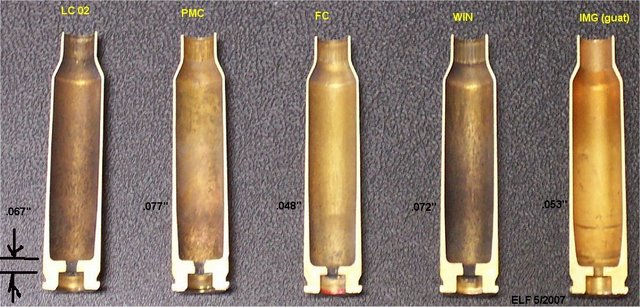
Note where the separation is - nearly half way up the case. Almost invariably, a separation, or incipient separation - is much closer to the head.
 
TS is a retired gunsmith... he's pretty well versed on the subject.
He was just sharing his experience, which is appreciated by some of us at least.
Even when I section cases I usually section a 1/2 inch "L" portion out of the head to check condition of a batch of well used brass, I would never have considered checking for seperation mid case like that one split.

And my point is a case can stretch in a AR15 and M14 type rifle even at minimum shoulder bump. This is because the bolt is yanking on the case rim when the case is still gripping the chamber walls.

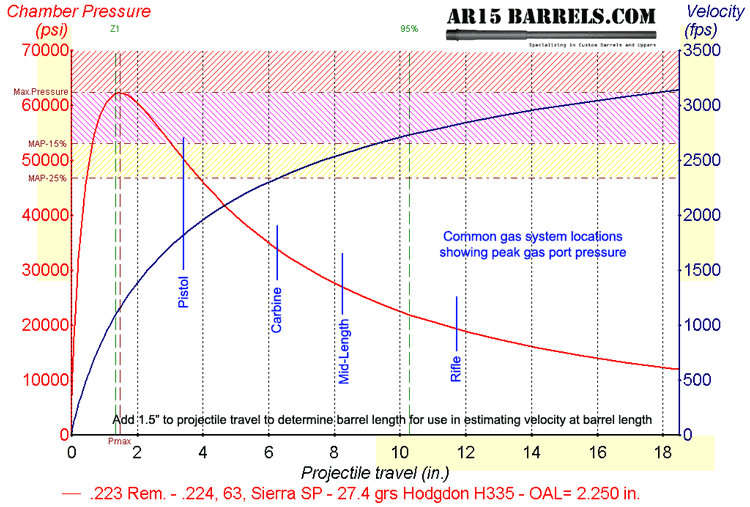
And this is why gas operated rifles have a range of powders that will give the correct range of port pressures for operation.

"BUT" a carbine has a higher port pressure than a rifle length gas system. And why I chose a mid-length gas system when I built my carbine.

4UIZgzj.gif


Bottom line, the closer the gas port is located to the chamber the higher the port pressure will be. And the harder the bolt will be yanking on the case rim.

And my point being the same cartridge fired in a bolt action "might" not have had a case separation. And measuring a fired case can sometimes fool you because it is longer than the chamber and requires more shoulder bump.

A example of this is the port locations on the M1 Garand and M14 rifles. And the M14 rifle can cause the case to stretch when fired, and a Hornady cartridge case headspace gauge can give you a false reading on a fired case.
 
Note where the separation is - nearly half way up the case. Almost invariably, a separation, or incipient separation - is much closer to the head.

This is true with a bolt action "BUT" on a gas operated rifle there can still be pressure in the barrel when the bolt begins to move to the rear. And the case will stretch higher up the case where the brass is softer and still gripping the chamber walls. Another problem with a carbine length gas system is the rifle takes more of a pounding than a rifle length gas system due to the higher port pressures.

A case fired in a semi-auto should be .003 to .005 smaller in diameter than its fired diameter. This allows the case to spring back from the chamber walls and eject reliably.

And commercial .223 cases are made of softer brass and will stretch more than military cases.

nqhNKyV.jpg
 
Probably the best example of a gas operated firearm trying to open while pressure is still high can be observed in the AG42B.

This particular AR has a rifle length gas system. .223 chamber, accepted SAAMI GO gauge, not the NO GO. RCBS FL die, shell holder contacting die, but no cam-over.
This separation was only experienced with this one lot of practice ammunition.
No separations, or incipient separations were observed with this rifle/barrel with either commercial cartridges or other batches of handloaded ammunition. Most of my .223 handloads were assembled using Winchester range brass previously fired in duty carbines. Other ammunition has been prepared using ex-military brass.
This barrel has since been retired. It consistently grouped no larger than 1 1/2 minutes with 69gr SMKs. After considerable use, groups were consistently exceeding 2 minutes, and throat erosion was apparent.
At any rate, I thought the photos might be of interest, particularly the shot of the extra-long case.
 
Somebody posted similar separations here not too long ago from a bolt gun, I'll see if I can find it. It was S&B or Hornady brass in a common cartridge IIRC, 2nd or 3rd loading.
 
How do you think they test the cases for the correct hardness after manufacture.

My buddy CatShooter did the testing after a argument over which brand of brass was the hardest. And CatShooter manufactures and test ammunition for the government and why he has a Rockwell hardness tester.

And there is no give or flex when the case is tested just above the extractor groove below.

ohI86Bf.jpg

Well, in the picture on that page, definitely measuring more than 1/16" above the chamfer leading into the extractor groove. And the anvil on the other side of the tester is more than half supporting the case over the hollow part.

I really don't care how anybody tests anything, you'll get hardness reading variations that don't represent the true material hardness by measuring that way. I ran a hardness tester for a lot of years in the last machine shop I worked at. We were testing steel, so Rockwell C scale with a diamond indenter, but the principle is the same. I would get significant variations on solid material just by the way it was positioned. If it wasn't solid, I couldn't rely on measurements at all.
 
If not an error, and produced deliberately under strictly controlled conditions...

Nobody said he did it on purpose. The message was that the OP is an experienced reloader who does not need your preachy "insight" to understand what is going on. He knows what causes it, and if he is worried about it, he knows what needs to be done to fix it. But it seems he's also likely wise enough to simply trash the batch of brass and not trouble himself further.
 
I apologize if my posting offended anyone, I always try to write my posts so even new reloaders will understand.

If my posts are reruns for the more experienced reloaders then just skip over them.

If you are still offended with my posts it just means your underwear is far too tight..:evil:
 
As mentioned, a brass brush shoved into the back of the stuck case will usually pull the case out.

I once had a separated case that would not come out this way. So I took a sized empty case and painted some epoxy on it, inserted it into the separated case (much like your photo) and then closed the bolt extractor onto the empty. Once the epoxy hardened, the bolt pulled the case out easily.
 
Lol that looks pretty funny. At first I thought it was something with a really long case, like a 7stw or something lol

At least it ejected easy. I still dread the day I get one of these in my Enfield...


I did with an Enfield many years ago using reloads from an original Lee Loader. It separated near the neck and I was shooting at a moose at the time.
Fortunately the second round was not required but it was a bit confusing at the time as to why it would not chamber.
Being in a camp way back in the bush screwdrivers were used to dig out the stuck brass.
I retired that rifle at the end of the week as I was not sure that the chamber was not expanding. Not likely but at the time there was not a lot of experts out there. Most gunsmiths were just guys that fixed guns more often than the average guy. Some were good and some not so.
 
Just seen this with a bolt gun last week, and again winchester brass. Makes me wonder if winchester thinned the case walls to much on an entire lot of brass, experienced reloaded setting the shoulder back 1 thou when sizing, remington 700 VSSF rifle
 
I've had that happen a few times in my VZ58 with American Eagle 223 brass reloaded once. I never investigated properly the issue but I suspect the brass was not good. The gun was sent to warranty and it came back with no issues found and headspace were good. My load was 55gr FMJ bullets seated at the cannelure and 24gr of varget.
 
Back
Top Bottom