Interpret My Test Results! R700 .223 Rem Development *5x5 Groups!*

Lots of great discussion - thanks again everyone! A friend of mine just picked up another pound of 4320 for me but I phoned and do have the option to exchange it. I'm thinking I might take a drive to the store to make an exchange and pickup some different bullets to try. I'm still working through a bag of the 55gn SPs and a box of CCI400s so with that in mind:

What does everyone think my best option for powder will be? I'd like to get something with proven accuracy and resistance to temperature/weather variance that would shoot match bullets well. It would be nice if this powder also shot the 55gn SPs well. Throughout the thread a few powders have been mentioned: Varget, H-4895, Benchmark, 8208 and RL15. Is there an order of preference for me with these in case the dealer is out of a particular type? I'm also interested in getting into .308 if one of the options would be well suited for that as well.

What bullet would be best to get me into sub 0.75" groups at 100m? I'm content to do my longer range plinking with the SPs and will reserve these new bullets for shooting targets. I've read that the 12 twist will stabilize up to around a 62gn bullet so I think my range is 50-62gns and we've had the Hrn V-max, SMK and Bergers mentioned. Will varmint bullets in this range get me closest to the accuracy that I'm looking for? The 53gn V-max has a really high BC (for .224) at 0.290 but I've read that it is inconsistent - would the 55s be better or something in the HPBT variety? How many should I buy to see if they will shoot - will a single box of 100 tell me what I need to know?

I will start using my necksizing die. Initially I thought I was having pretty good results with FL but always had a flyer in 5 shot groups, which is what got me back into the development process again. I've also been on the fence about continuing with 4320, so making a change is fine.
 
Last edited:
Ron - If this is true then you are going to have a hard time explaining to Issac Newton and generations of ballisticians why higher velocity has nothing to do with time-in-flight, the force of gravity and bullet drop :p. Won’t the scope makers be surprised when you convince them that those pesky elevation turrets are wasted effort.

Actually Issac Newton would have no trouble understanding it at all. He would just say, "It is quite obvious the POI will be lower if the muzzle is pointing lower when the bullet exits, and of course if the muzzle is pointing higher impact will be higher". There is more going on than velocity here. The barrel is vibrating.

Trolling aside, I think most would agree that velocity will, in general, affect vertical POI – even your own graphs show this. If you read the original article on Audette (the originator of the ladder method) in the 1998 Precision Shooting reloading guide, you will see that Audette showed that stability bands existed where powder load (and chamber pressure) did not increase velocity as would normally be demonstrated. See the link below.
http://2poqx8tjzgi65olp24je4x4n.wpe...audettes-20-round-string-load-development.pdf

I would suggest you read that article again. What Audette said was that "in certain areas a small increase in powder charge did not necessarily result in a corresponding rise in point of impact on the target." He said nothing about velocity. The author of the article, then took that statement and went down a rabbit hole with his theory that the cause was increasing powder did not increase velocity. He did a 20 shot test and I would suggest invented the conclusion that his theory was correct. There will always be some variation in velocity vs powder charge due to many things. I think his plot is just an illustration of those many things, totally unrelated to the point of impact issue. I think most now agree that within limits more powder means more pressure and means more velocity when you eliminate the noise. When you do a ladder test you are not looking for a spot where you add more powder and don't get more velocity. You are looking for a spot where you add more powder, get more velocity, but DO NOT get more POI elevation. I saved the link to that article. I find it interesting in that I would suggest we have come a long way in understanding what really happens. If you want to see what more modern thinking is I would suggest poking around the Varmint Al site.

These stable velocity bands are what lead to a lack of vertical POI shift (i.e. a cluster of shots) when shooting a string of ladder loads. I think history and other loaders would agree with my interpretation of a ladder test (i.e. Incremental Load Development Method). Here are more links that explain the methodology.
http://www.6mmbr.com/laddertest.html
From the link:
http://precisionrifleblog.com/2012/07/13/creighton-audette-ladder-testing/

You have a different take on a ladder test and it may work for you better than what is commonly understood as a ladder test - but it isn’t the same. Your insistence that one not look for the “best group” in a ladder test is a red-herring since you are confusing shooting groups with looking for "a cluster of consecutive shots showing similar points of impact (POI)" i.e. where there is little vertical dispersion due to varying velocity.

No. As above the point of impact flattening out is not because velocity flattens out. It is because the barrel direction is changing. If you plot POI vs velocity, that becomes very obvious. And that is why you use velocity not powder charge. The word "cluster" I think gets us into semantics and the specifics of the test. I like to shoot each shot at a different target. I am not looking for a cluster, only vertical POI. Yes, if you shoot all shots at the same aim point then a sweet spot should be identified by a cluster if you must in the vertical direction. That is not a cluster like in a small group.

Well I think that we’re discussing if your opinion is well grounded. If you read Dan Newberry’s website, when he was developing the OCW method he saw it as an improvement of the ladder test (the one most others understand to be a ladder test – not your own unique take). So maybe the guy who was developing OCW was wrong about his own thinking – I’ll leave that others to decide. Link below:
http://optimalchargeweight.embarqspace.com/

I have tried to read the Newberry website several times and give up each time. I'll be frank. The only part that makes some readable sense is the actual procedure. That is why I call it a well organized trial and error method. There is no basis for the method other than shoot a bunch of groups and see which one you like. He does not measure velocity and that is the critical parameter of interest.

All that being said, I have yet to find a good theory as to why these well documented velocity bands would occur in a load ladder. Everything that I have seen on chamber pressure variances with powder load show that pressures rise smoothly with increasing charge in the range of “acceptable” pressures. Why either pressure increases would plateau even with increasing charge weight (in these narrow bands), or increasing pressure would fail to translate into increased velocity (again only in these anomalous bands) is mysterious. I hope Ganderite pops into this this thread since he used to work for a powder manufacturer.

This is your main area of confusion. There is no mystery. There are no velocity or pressure plateaus other than measurement error. The plateaus and even slight dips, are in point of impact, even though pressure has gone up, and velocity has gone up. You will find your good and actually very simple answer at the Varmint Al site. It is all about the direction the barrel moving and where it is pointing when the bullet exits. As I have said numerous times, fast bullets exit early, and slow bullets exit later. If the barrel is moving up then fast bullets get pointed lower, and slow bullets get pointed higher. That is where the self correcting plateau or even dip comes from.

Last here is a graph I have done to correlate powder charge to velocity. You can see it is far from precise, and I would suggest that the deviations would be the result of many factors which we all try to control, but don't, and simple measurement error. If you look at the computer best fit curve, you can see it is very smooth, and constantly increasing. If you were to go looking for flat spots in the raw data, like the author of your article did, all you would do is go down a rabbit hole just like he did, and start the fabrication process. The other thing this graph clearly shows is that when you use powder charge as a proxy for actual velocity, you are introducing a huge error in your data, and resulting conclusions. Again, that is why you plot POI vs velocity, not powder charge.

fpsvsgrains.jpg
 
Lots of great discussion - thanks again everyone! A friend of mine just picked up another pound of 4320 for me but I phoned and do have the option to exchange it. I'm thinking I might take a drive to the store to make an exchange and pickup some different bullets to try. I'm still working through a bag of the 55gn SPs and a box of CCI400s so with that in mind:

What does everyone think my best option for powder will be? I'd like to get something with proven accuracy and resistance to temperature/weather variance that would shoot match bullets well. It would be nice if this powder also shot the 55gn SPs well. Throughout the thread a few powders have been mentioned: Varget, H-4895, Benchmark, 8208 and RL15. Is there an order of preference for me with these in case the dealer is out of a particular type? I'm also interested in getting into .308 if one of the options would be well suited for that as well.

Varget! It works very well in .308 too. H4895 would be a second choice. Works very well in the 308 too.

What bullet would be best to get me into sub 0.75" groups at 100m? I'm content to do my longer range plinking with the SPs and will reserve these new bullets for shooting targets. I've read that the 12 twist will stabilize up to around a 62gn bullet so I think my range is 50-62gns and we've had the Hrn V-max, SMK and Bergers mentioned. Will varmint bullets in this range get me closest to the accuracy that I'm looking for? The 53gn V-max has a really high BC (for .224) at 0.290 but I've read that it is inconsistent - would the 55s be better or something in the HPBT variety? How many should I buy to see if they will shoot - will a single box of 100 tell me what I need to know?

I believe Berger is your best bet for target. 55 grain Target bullets is a good start. Berger claims their varmint bullets are made to the same standards as their target bullets, so you could try them too, depending on what is available. When you determine your best velocity for your gun you may want to go heavier or lighter. For best accuracy at 100-200 yards stick with flat base. Also your 12 twist is going to have trouble stabilizing a boat tail.
 
I am afraid all this chatter is somewhat foreign to my methodology.

I am familiar with the ladder test. I even discussed at one time with Creighton Audette. We were on competing Palma Teams in England.

The OPs test was with soft point bullets. These are better than FMJ, but not match. Why not run with match bullets to take bullet quality out of the variables?

And 3 shot groups mean nothing. I do preliminary sampling with 5 shot groups and test with 10, to find what I suspect is a good load, which I then confirm with 20.

I can't comment any further.
 
Just returned from my local store with some Varget and 53gr V-Max projectiles to try. Unfortunately no match grade bullets were available lighter than 75gr, which I would be unable to stabilize with my 1 in 12 twist. Next time I'm away and can visit one of the larger stores, I will look to pickup some Berger FB Targets or the 52/53gr SMKs.

Stay tuned for more results as I'm able to get out and shoot.
 
Just returned from my local store with some Varget and 53gr V-Max projectiles to try. Unfortunately no match grade bullets were available lighter than 75gr, which I would be unable to stabilize with my 1 in 12 twist. Next time I'm away and can visit one of the larger stores, I will look to pickup some Berger FB Targets or the 52/53gr SMKs.

Give Jerry Teo at Mystic Precision a call for Berger bullets. Or if you want to try Lapua, call Peter Dobson at Hirsch Precision in your end of the country...
 
Made it out to the range today to fire a few rounds. Decided on the Dan Newberry OCW Test as I did not have access to a chronograph and these loads will mainly be fired at 100m anyway. Forgot to clean my rifle before firing the test with the 55SP bullets and it was sufficiently fouled to affect accuracy. Not sure how much that will have impacted the results but thankfully I remembered and cleaned before the V-Max test. They shot much better than the SPs, with 9 of 10 loads shooting sub-MOA.

Quick notes: 100m, 6 degrees, gusts up to 15km/h, Caldwell Rock rest, both tests loaded 0.010" off the lands, neck sized w/Lee collet, Varget powder.

Hornady 53gn V-Max OCW Test (measured w/OnTarget)
Hornady 55gn SP OCW Test (measured w/OnTarget)

Have a look and see what you think - I'm leaning towards ~24.1gns or ~25.2gns on the V-Max and 24.9gns is all I see for the SPs. All input is appreciated!
 
Made it out to the range today to fire a few rounds. Decided on the Dan Newberry OCW Test as I did not have access to a chronograph and these loads will mainly be fired at 100m anyway. Forgot to clean my rifle before firing the test with the 55SP bullets and it was sufficiently fouled to affect accuracy. Not sure how much that will have impacted the results but thankfully I remembered and cleaned before the V-Max test. They shot much better than the SPs, with 9 of 10 loads shooting sub-MOA.

Quick notes: 100m, 6 degrees, gusts up to 15km/h, Caldwell Rock rest, both tests loaded 0.010" off the lands, neck sized w/Lee collet, Varget powder.

Hornady 53gn V-Max OCW Test (measured w/OnTarget)
Hornady 55gn SP OCW Test (measured w/OnTarget)

Have a look and see what you think - I'm leaning towards ~24.1gns or ~25.2gns on the V-Max and 24.9gns is all I see for the SPs. All input is appreciated!

The real experienced guys will chime in I am sure...

From what I see between the two results is 25.4 from the first rounds of testing and 25.5 from the second set are the least vertical dispersion, even though the first test it includes the one that felt "funny". From my limited experience, if these were results from our rifles, I would concentrate there. From my perspective it's indicating that at that amount of specific powder, irrelevant of 53 or 55 gn bullet, can produce repeatable results...and provided within safe charge limits for your rifle.

(here there is no mapping regarding horizontal variance. Windage is not applied)

For what it's worth, we also use the OCW method because we don't own a chrony. We just developed loads via OCW at 200 for hunting next weekend for two savage 7mm-08's. Rifles are similar yet different. The same logic as above was applied for sight in a 100 and for the first time ever we clover leafed. Again...this is from our experiences here. Others that are really experienced I sure will provide their knowledge. I am sharing what we've learned because we've had great results and this is our second season of reloading. My son and I can hardly wait to try in the field

Good luck, regards
Ronr
 
Ron - some great insight, thank you. I hadn't thought to look at the two tests beside each other but you're right, there is definitely a connection. I'm a CAD guy by profession and am currently plotting the group centers against the horizontal aim line to post. The drawing will also show horizontal dispersion through the distance between group centers.

Surprisingly, on the V-Max test I'm now inclined to believe that 23.9gns is actually the OCW. It gives the best mix of all the requirements: consistent POI with charges on either side, almost no vertical dispersion from the string of charge centers (23.6-24.2) and a bughole to boot. If looking only at the vertical, there is another node at 24.8-25.4 but with large horizontal POI variance and vertical thereafter, from 25.4-26.0gns.

*edit* Here is the curve I was talking about. There are two definite flat spots with no vertical but if you look at the horizontal aim line, you'll see that charges on either side of center do not have even spacing, which shows horizontal dispersion. It's easier to spot the horizontal on the actual targets. I suppose it could also be said that we're not only looking for vertical dispersion between charges but within the groups; I'm sort of mixing methods here.

*edit 2* Added 55SP test and sort of lined up the charges so the curves can be compared against eachother. Looking at this way - 25.X is a flat spot for both bullets in terms of vertical dispersion.

55SP vs. V-Max Vertical Dispersion Curve
 
Last edited:
Ron - some great insight, thank you. I hadn't thought to look at the two tests beside each other but you're right, there is definitely a connection. I'm a CAD guy by profession and am currently plotting the group centers against the horizontal aim line to post. The drawing will also show horizontal dispersion through the distance between group centers.

I'm a CAD guy as well. :cool:

I started graphing and plotting everything to support the multiple results from OCW runs at the range, because that's in our nature as CAD guys. We had more range sessions because we're trying to improve our shooting techniques as well. What I found is that we chased our tails for a bit over analyzing. Therefor horizontal dispersion was removed because it seemed to affect the data just enough to cause doubt. Kiss principles were applied, and only the common denominator ( as I understand it to be ) was tracked and graphed. This being the vertical relationship within that specific powder charge. POI shift from aim point, horizontal variance not included. We adjust optics afterwards, in this case for hunting.

25.x is where I would continue, FWIW, and change to .1 gn. resolution. Reapply to graph and see what you get. Similarly to any other node you deem worthy of exploring to try.

I would recommend Mystic Precisions site for his take on the OCW. His techniques regarding the "process" of achieving repeatable accuracy really resonates on this end and is proved with the best results ever for ourselves.

Again, this from my perspective and experience as a sophomore reloader.

Good luck.
Regards
Ronr
 
Ron - thanks again. I loaded a "mini-OCW" around the nodes for both bullets at 0.2gn increments. One at 25.X for each and one around the lower node for V-Max. Will report back with results on the weekend. Cheers!
 
For those who may still be following this thread - I completed another "mini-OCW" test yesterday at the range, this time in 0.2gn increments around the nodes. The lower node for the V-max showed some POI shift 23.8-24.2gns and the upper group opened up to 0.63MOA. Vertical was minimal in this range BUT the results from the upper node, 25.2-25.6 were very good. Very little POI shift between the groups and they nearly had all 3 rounds touching. I'm going to load a seating test at 25.4gns to see if there are any further gains to be found, then follow-up with a 5X5 test target. The 3 round groups averaged 0.363MOA in this 3-charge range, so I'm hopeful that 25.4gns with careful prep will get me to the 0.75" challenge. Changing to a higher quality bullet (still not match grade) seems to have had an immediate impact on my results.

The Hornady 55SPs performed well with some nice groups but not as consistently as the V-Max. I'm going to load them at 25.4 as well, which is showing low vertical dispersion, then do a seating test and leave them alone. Somewhere close to MOA performance (+/-) seems like the limit for these and I will be happy to hunt or plink with them.

I haven't taken the time to edit and post photos but could do so if people are interested in seeing the results. Hopefully I'll have a successful challenge target to post sometime in the near future.
 
I think to get some value out of the Ladder Test you need to shoot 200 meters, and ideally with a chronograph. In any case, it sounds like you are getting some pretty good groups. And if you can find them, I would still recommend trying some Berger Flat Base 55 grain target bullets.
 
Lots of great discussion - thanks again everyone! A friend of mine just picked up another pound of 4320 for me but I phoned and do have the option to exchange it. I'm thinking I might take a drive to the store to make an exchange and pickup some different bullets to try. I'm still working through a bag of the 55gn SPs and a box of CCI400s so with that in mind:

What does everyone think my best option for powder will be? I'd like to get something with proven accuracy and resistance to temperature/weather variance that would shoot match bullets well. It would be nice if this powder also shot the 55gn SPs well. Throughout the thread a few powders have been mentioned: Varget, H-4895, Benchmark, 8208 and RL15. Is there an order of preference for me with these in case the dealer is out of a particular type? I'm also interested in getting into .308 if one of the options would be well suited for that as well.

What bullet would be best to get me into sub 0.75" groups at 100m? I'm content to do my longer range plinking with the SPs and will reserve these new bullets for shooting targets. I've read that the 12 twist will stabilize up to around a 62gn bullet so I think my range is 50-62gns and we've had the Hrn V-max, SMK and Bergers mentioned. Will varmint bullets in this range get me closest to the accuracy that I'm looking for? The 53gn V-max has a really high BC (for .224) at 0.290 but I've read that it is inconsistent - would the 55s be better or something in the HPBT variety? How many should I buy to see if they will shoot - will a single box of 100 tell me what I need to know?

I will start using my necksizing die. Initially I thought I was having pretty good results with FL but always had a flyer in 5 shot groups, which is what got me back into the development process again. I've also been on the fence about continuing with 4320, so making a change is fine.

Varget, neck size only, I do .015 of the lands and if that doesn't work I move in or out. Very seldom do I have to move the seating depth. I like cci br 2 primers. Stick with 300 or whatever the furtherest you will shoot on a regular basis for you ladder test distance.

Of course as Jerry mentioned, start from a good benchmark( torqued action /scope screws, repeatable rest, etc.)
 
Thank you, gents! I've put ladder testing on the back burner for now as I don't have access to a chronograph and have been using the Newberry OCW method again. 100m round-robin testing (organized guess and test). Hopefully the 3rd grouping results will translate to nice 5rd groups at 100m (what I'm looking to do with target bullets).

The SPs have been holding ~MOA out to 400m; I was hoping to push it to 5-600m but the bullet goes subsonic just past 400m so accuracy drops off. Where I can't load heavier bullets for a 12 twist, I'll wait a while and eventually pickup a .243 or .308 for longer range work.
 
Yes, a 12 twist is limiting for distance. Probably the best you can do in the Berger line is the 64 grain flat base varmint, with a BC of 0.287.
 
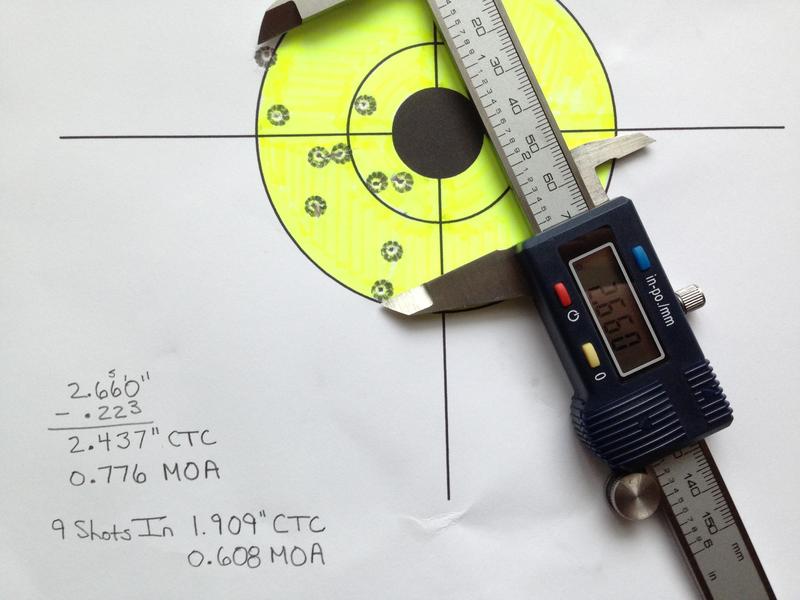
Made it out to the range today to complete seating tests for the 53gn V-Max and 55 SPs. V-Max bugholed @ 0.005" jump, so that's what I will seat at from here out. The SPs did not have a strong showing today on the seating test, however they shot quite well on the long range. I completed the 300 yard (shot at 300m), 10 round MOA challenge on my first attempt, achieving a 0.75MOA 10 round group:

kwZCSax.jpg


As much as I would love for the SPs to shoot better than this, I think their potential is maxed out at 0.75MOA.
 
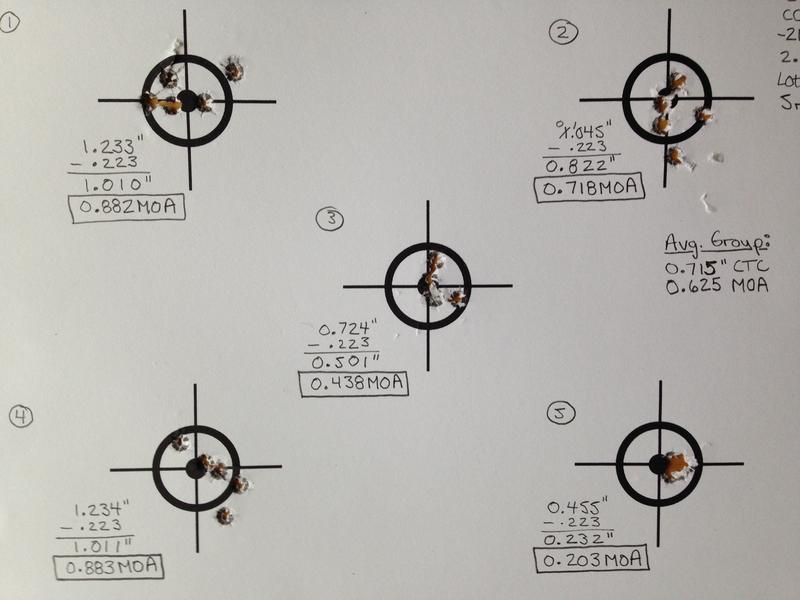
Was able to get out to the range this morning to re-do some "final" testing that I attempted a week ago. I knew I shouldn't have bothered with it as soon as I got to the range but pressed on anyway (40km/h winds, I found out after) and the results were totally inconclusive. Today the conditions were better with max gusts of only 10km/h and I was able to shoot from our heated building instead of sitting outside. Here is my "finalized" 53gn V-Max load; 5 groups of 5 rounds at 100m.

EM1bLZZ.jpg


This is the first time I have ever fired a 5-round cloverleaf with this rifle. I was really impressed with myself! Now I get to claim my rifle shoots 0.25MOA "all-day," finally. Haha

I think there is still something going on with the cold here but overall the results aren't too bad. I'm pleased with 3 of the groups and the other two I can't really explain. It was -21 Celsius outside (at time of firing) and I had the building up to +15 Celsius with my barrel sticking out the window so there was a ton of mirage. As much as I would love to complete the factory rifle 0.75" challenge, I don't think it's going to happen in the middle of winter. Maybe in the spring or early summer when I can shoot comfortably without the crazy swings in temperature.

I did take the loads over to the long range to try the 10rds @ 300yds challenge again. If not for 1 shot that I surely messed up, I would have been in the sub-2" club.

U8ShtDl.jpg


All in all, it was a great day and I'm looking forward to dialing in these loads even more in the spring.
 
Last edited:
Back
Top Bottom