












































You are using an out of date browser. It may not display this or other websites correctly.
You should upgrade or use an alternative browser.
You should upgrade or use an alternative browser.
Iowa Class Battleships and the 16" gun
- Thread starter archerynut
- Start date

the battleship was made obsolete the day Billy mitchel sank one with the airplane demonstration in the 20's. It just took WWII to cement that fact.
So true, he saw it coming...and no one listened.

- Location
- your wife knows...
The days of the battleship were killed by the airplane and buried by the missile.
But nothing says "F*** YOU" like a broadside of 9 16" guns.
But nothing says "F*** YOU" like a broadside of 9 16" guns.

I toured the "Mighty Mo'" before she was re-commissioned the first time, and it really is as awesome as everyone else says.
Think about armour averaging 380mm (15") thick on the sides of the ship!
As for the ease of sinking one, really, I don't see them being any easier or bigger a target than an aircraft carrier.
I was once told that the (then newly re-commissioned) USS New Jersey could put more ordinance ashore in 3 hours than the USS Nimitz could in 24 hours.
And a careful look at the "fall of shot" chart will tell you that even using 'dumb' ammo, at 16 miles away you might not be shooting at individual buildings, but the city block is toast.
Currently they are experimenting with prcision guided munitions in 155mm arty, and if they can fit that into a 6" shell, they can do it to a 2000lb, 16" shell too.
Think about armour averaging 380mm (15") thick on the sides of the ship!
As for the ease of sinking one, really, I don't see them being any easier or bigger a target than an aircraft carrier.
I was once told that the (then newly re-commissioned) USS New Jersey could put more ordinance ashore in 3 hours than the USS Nimitz could in 24 hours.
And a careful look at the "fall of shot" chart will tell you that even using 'dumb' ammo, at 16 miles away you might not be shooting at individual buildings, but the city block is toast.
Currently they are experimenting with prcision guided munitions in 155mm arty, and if they can fit that into a 6" shell, they can do it to a 2000lb, 16" shell too.
I was in the Canadian navy in the eighties. we were shooting at targets in the Hawaii Islands. It was awesome watching those sixteen inch guns firing and then watching our pop guns go off. I believe it was the new jersey we were out with. It had over one foot of steel plating on it’s sides. Rockets would bounce off. I’m not sure if they scrapped it or returned it to it’s floating museum state. I do know that they did periodically update these old battle wagons as best they could. I know there was a claxon on board that sounded off when a missile would be coming cruising down the corridor( they were on a rail overhead in a ad hoc kind of configuration) when you heard the horn, you hit the deck!. I’m sure the cost of continuing to update these old ships is astronomical, but you could never afford to build them again either.
Last edited:

NavyShooter
CGN Ultra frequent flyer
- Location
- XMU Local .303
The problem with comparing the amount of firepower capable of being delivered by a battleship in 24 hours with that of an aircraft carrier is the magazine capacity...
An Iowa carried approximately 1220 16" rounds in it's magazines.
At a reduced rate of fire, of 1 round per gun per minute (max ROF is about 1 round per gun per 30 seconds) you'll fire 9 rounds per minute.
That translates to 135 minutes of continuous fire, or just over 2 hours.
Then the battleship will have to depart station, head into port, re-ammunition, before steaming back to it's station.
An aircraft carrier? Yes, they can run out of bullets and bombs too, but they have the ability to conduct UNREP or Underway Replenishment (Replenishment at Sea/RAS in Canadian Service) in order to transfer more ammo/fuel/bombs/etc with their fleet train.
So, while the battleship might be able to deliver devastating fire for a couple of hours, a Carrier can stay on-station and deliver continuous bombardment for days.
The Battleship is a supreme feat of engineering, with impressive armour, and armament, but it's capabilities have been eclipsed by newer technologies.
I've been aboard several battleships, from the USS Texas, the USS Missouri, the USS North Carolina, I've seen the New Jersey, and the Arizona. I find them to be magnificent ships, but there are newer, better means to the same end.
NS
An Iowa carried approximately 1220 16" rounds in it's magazines.
At a reduced rate of fire, of 1 round per gun per minute (max ROF is about 1 round per gun per 30 seconds) you'll fire 9 rounds per minute.
That translates to 135 minutes of continuous fire, or just over 2 hours.
Then the battleship will have to depart station, head into port, re-ammunition, before steaming back to it's station.
An aircraft carrier? Yes, they can run out of bullets and bombs too, but they have the ability to conduct UNREP or Underway Replenishment (Replenishment at Sea/RAS in Canadian Service) in order to transfer more ammo/fuel/bombs/etc with their fleet train.
So, while the battleship might be able to deliver devastating fire for a couple of hours, a Carrier can stay on-station and deliver continuous bombardment for days.
The Battleship is a supreme feat of engineering, with impressive armour, and armament, but it's capabilities have been eclipsed by newer technologies.
I've been aboard several battleships, from the USS Texas, the USS Missouri, the USS North Carolina, I've seen the New Jersey, and the Arizona. I find them to be magnificent ships, but there are newer, better means to the same end.
NS

RememberTheSomme
CGN Ultra frequent flyer
- Location
- Nova Scotia
The Royal Navy scrapped it last Battleship HMS Vangard in 1960. Deemed obsolete and to costly. The Iowa class BB's are awesome and amazing.
HMS Vangard Built 1941 commissioned after WWII, The last of the Fast Battleships built.

And what a balanced looking ship she was. Not impressed with the 15"/42 selection, but they had it on the shelf so thats what she got.
The British people were so sick of war and the machines of war through the 40s and 50s and economy ruined, they let national treasures such as HMS Warspite, go to the breakers,.......what a loss. What a ship for a memorial to all big gun ships that flew the White Ensign, tied up on the thames. Well at least they kept HMS Belfast, but a crusier,...well such is life.
Purple I had a chance to tour the Massachusetts, I see you got to visit a Washington class as well. Loved the picture of my wifes arm extended to show the conning tower door's armour thickness , even on the South Dakota's, it was impressive. The sub division was staggering, so many boiler rooms and engine rooms to confine damage to a minimum of machinery.
Great ships. Thanks for the post OP!

So why couldn't a BB resupply at sea? Moving the 2500lb shells can't be much harder than shuffling 2000lb iron bombs, can it?...
Then the battleship will have to depart station, head into port, re-ammunition, before steaming back to it's station.
An aircraft carrier? Yes, they can run out of bullets and bombs too, but they have the ability to conduct UNREP or Underway Replenishment (Replenishment at Sea/RAS in Canadian Service) in order to transfer more ammo/fuel/bombs/etc with their fleet train.
NS
And a few "baggies" of powder move the payload a lot more efficently than all the jet-juice you need to burn to get the bomb to the target.
I'm not saying that I think old-style Battle Ships should be making a come-back... But think of the possibilities of mounting a single 16"-50 on a turret with limited traverse, and updated precision-targeted shells.
It would give a smaller ship the capability to deliver a BIG hit at 20 miles away, and with something like discarding sabot ammo, firing a a subcaliber shell at higher velocity, say delivering an 8", GPS guided shell to 30 miles... and the shell would be impacting while the jet was still on the cat (maybe), and you'd have to have awfully good air defence to be able to disrupt that shell.
I know that the Phalanx CIWS is reputed to be able to shoot-down 5" shells, how would it do against a 2500 lb chunk of solid cast iron that just wants to crash through all your decks on its way to making a big divot in the seabed?
NavyShooter
CGN Ultra frequent flyer
- Location
- XMU Local .303
Splatter,
Yes, I suppose it's possible to do a RAS for 16" projectiles at sea, but it would take a lot longer than you think. Consider about 3-5 minutes per pallet load during a Heavy Jackstay, and that's what it would take to move a single shell.
Take the average of that at 4 minutes per round to re-ammo by RAS, and multiply by 1200....that means it would take 80 hours to re-supply, running continuously, just for the projectiles. Supposing they could move 2 at once that's still 40 hours of ammunitioning for 2 hours of shooting.
Presuming they were able to move powder using a seperate station (multi-station RAS hookup) this could be done concurrently....
Going alongside to re-ammo a battlewagon is the most efficient means to do so. You can use multiple cranes, and have storing parties working forward and aft magazines at the same time.
If you want to know about putting a single heavy caliber gun into a "big ship", have a peek at the history of the HMS Furious. Lightly armoured, and armed with only a couple of big guns. Her gun armament was too heavy for her structure, resulting in vibration damage.....so they converted her to an Aircraft Carrier.
Big guns + small ships = not the best combo.
As for CIWS, have a look at the RAM, or Rolling Airframe Missile.
NS
Yes, I suppose it's possible to do a RAS for 16" projectiles at sea, but it would take a lot longer than you think. Consider about 3-5 minutes per pallet load during a Heavy Jackstay, and that's what it would take to move a single shell.
Take the average of that at 4 minutes per round to re-ammo by RAS, and multiply by 1200....that means it would take 80 hours to re-supply, running continuously, just for the projectiles. Supposing they could move 2 at once that's still 40 hours of ammunitioning for 2 hours of shooting.
Presuming they were able to move powder using a seperate station (multi-station RAS hookup) this could be done concurrently....
Going alongside to re-ammo a battlewagon is the most efficient means to do so. You can use multiple cranes, and have storing parties working forward and aft magazines at the same time.
If you want to know about putting a single heavy caliber gun into a "big ship", have a peek at the history of the HMS Furious. Lightly armoured, and armed with only a couple of big guns. Her gun armament was too heavy for her structure, resulting in vibration damage.....so they converted her to an Aircraft Carrier.
Big guns + small ships = not the best combo.
As for CIWS, have a look at the RAM, or Rolling Airframe Missile.
NS

At the Yasukuni shrine museum in Tokyo resides an 18 inch round from one of the Yamato's guns. That is one impressive boolit. If you ever have the chance, make it down to Houston, and take a tour of the Texas. That is one hell of a battleship. They offer hardhat tours that take you to otherwise out of bounds parts of the boat. Like the turrets
The Texas let go nearly 1000 rounds from her main guns during the invasion of Okinawa!
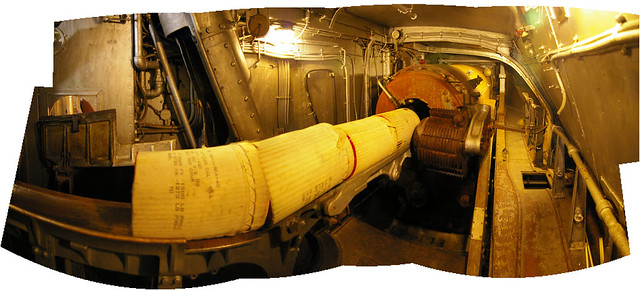
Texas Turret Stitch by mroliverridley, on Flickr
and the steering gears:
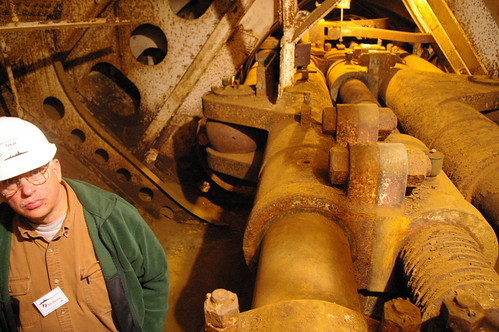
Battleship Texas hardhat tour by mroliverridley, on Flickr
the boiler room:
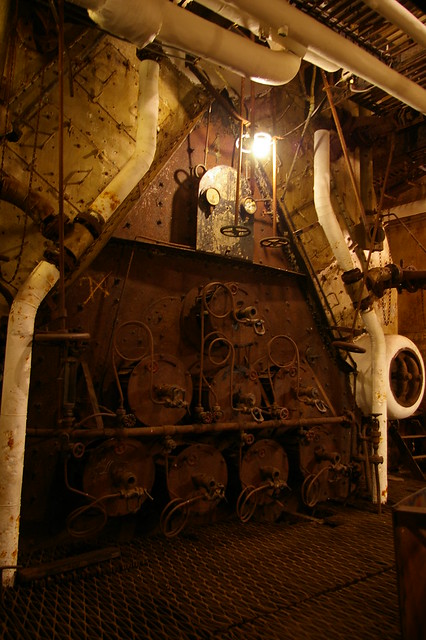
Battleship Texas hardhat tour by mroliverridley, on Flickr
and the magazines with their itty bitty 14 inch shells.
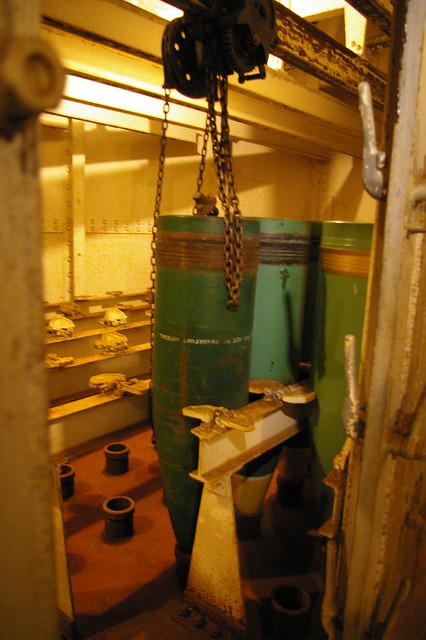
Sorry for the ship ####, but touring the Texas was one of my milsurp grails, and I like to share
The Texas let go nearly 1000 rounds from her main guns during the invasion of Okinawa!
Texas Turret Stitch by mroliverridley, on Flickr
and the steering gears:
Battleship Texas hardhat tour by mroliverridley, on Flickr
the boiler room:
Battleship Texas hardhat tour by mroliverridley, on Flickr
and the magazines with their itty bitty 14 inch shells.
Sorry for the ship ####, but touring the Texas was one of my milsurp grails, and I like to share

Splatter - Could it be done? Certainly. The RN in particular used monitors, small ships mounting battleship turrets, for shore bombardment. It worked. They were popular at the time because they didn't tie up and risk capital ships for (ick) army support and because they were cheaper. Additional cost savings could achieved by mounting smaller-to-scale engines (no fast-moving sea battles to require them, just plod into position and pound).
Consider the following however.
First, the recoil from firing 16" guns is huge. You can't do it from a lightweight ship as it would shake itself to pieces. So you wind up with a small, heavyweight ship.
And it can't actually be all that small, because the turret and guns themselves are huge.
One quite vulnerable (despite its heavy construction) to a lot of other things, meaning it would require a considerable escort.
And essentially suitable for one purpose only. One that has not been required in what - a generation?
The USN actually experimented with a lightweight 8" gun to give destroyers improved shore bombardment capability. It was supposed to put a 30 kg, laser-designated shell close to 25 km with a rate of fire of about 10 per minute.
Eventually, they decided it couldn't be done cost-effectively.
Sorry, but as impressive as these old beasts were, they're about as relevant in modern warfare as a dirigible.
Consider the following however.
First, the recoil from firing 16" guns is huge. You can't do it from a lightweight ship as it would shake itself to pieces. So you wind up with a small, heavyweight ship.
And it can't actually be all that small, because the turret and guns themselves are huge.
One quite vulnerable (despite its heavy construction) to a lot of other things, meaning it would require a considerable escort.
And essentially suitable for one purpose only. One that has not been required in what - a generation?
The USN actually experimented with a lightweight 8" gun to give destroyers improved shore bombardment capability. It was supposed to put a 30 kg, laser-designated shell close to 25 km with a rate of fire of about 10 per minute.
Eventually, they decided it couldn't be done cost-effectively.
Sorry, but as impressive as these old beasts were, they're about as relevant in modern warfare as a dirigible.

...A view of the hatch and armor citadel of the battleship NEW JERSEY (BB 62). The armor protecting the pilot house is more than 17 inches thick at this point.

The next time someone asks about advice on building a secure gun room in their basement, just send 'em this pic.
StuartThe old battleships are impressive but they were made obsolete by aircraft carriers that could launch dive bombers and torpedo planes hundreds of miles from land. In WW2 carrier based air attacks made short work of ANY battleship unfortunate enough to come within range. Even the incredible amount of AA guns on a WW2 battlewagon was no match for a determined air attack by seasoned aircrew. So basically they became floating heavy artillery for land bombardment and a liability for a task force commander because they required air cover, a destroyer screen and even submarines to protect them from attack. The 20 mile range of 16 inch guns didn't mean much when an aerial attack could be launched from a carrier 200 miles away.
Ok, I concede that the big guns are pretty-much useless in a modern war, still I think it'd be a pretty interesting concept, especially in an asymetric conflict...
Let's say the smaller country picked-up a few 16" rifles from a scrap yard... I think I'll drop Tom Clancy a line, see if he likes my idea..
Let's say the smaller country picked-up a few 16" rifles from a scrap yard... I think I'll drop Tom Clancy a line, see if he likes my idea..

I am amazed by the sheer size and awesomeness of WW1 style rail guns also, but with modern technology like the MLRS, their day is done also.
http://en.wikipedia.org/wiki/M270_Multiple_Launch_Rocket_System
http://en.wikipedia.org/wiki/Railway_gun
http://en.wikipedia.org/wiki/M270_Multiple_Launch_Rocket_System
http://en.wikipedia.org/wiki/Railway_gun
Let's say the smaller country picked-up a few 16" rifles from a scrap yard...
OK, let's give Ruruitanistan a pair of 16" guns, with mounts, ammo, trained crew, fire control apparatus and so forth.
Round One causes somebody a lot of problems. So do successive rounds. They also pin-point the guns' location within a few metres - and something that size can neither run fast nor hide well.
By Round 25, the guncrew wouldn't be able to see the sky for the incoming fighters, cruise missiles and attack choppers.
Not much return on investment, frankly.
- Location
- Tucson, Arizona
Well to start with, the analog computers worked just fine when we were shelling Sadass. Upgrading them to transistors would NOT have improved anything.
Keep in mind that those 16 inch guns in WW2 were shelling japanese caves. NOT other ships. You would have needed a nuke to do more damage. And the Aircraft dropping bombs on those caves didn't have any more effect.
The Yamato's 18 inch guns wouldn't have helped either because OUR battleships had RADAR directed guns and the Yamato did NOT!
Keep in mind that those 16 inch guns in WW2 were shelling japanese caves. NOT other ships. You would have needed a nuke to do more damage. And the Aircraft dropping bombs on those caves didn't have any more effect.
The Yamato's 18 inch guns wouldn't have helped either because OUR battleships had RADAR directed guns and the Yamato did NOT!






















