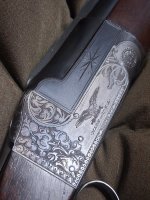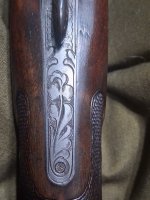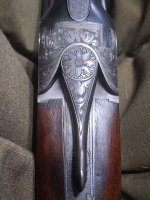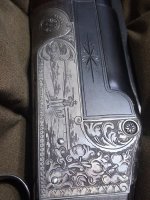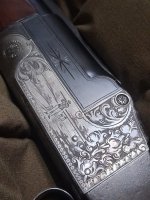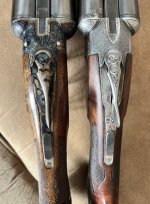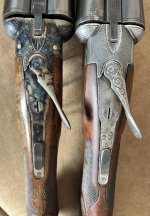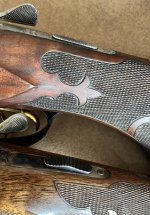
Ithaca 5E & 4E Comparison

the spank

CGN Ultra frequent flyer
Rating - 99.4%
152   1   1

I arrived home late friday night from a 2 1/2 week stint on Vancouver Island to help my father recovering from a surgery and to help him with some decluttering and downsizing. Shortly after arriving home I discovered a box in the living room. I asked my wife what was in the box and she said "I assume a gun you had worked on as it has Chris'(C.J Dawe) name on it".
I was on the road 18+ hours friday including a 2 hour ferry ride and 900 miles of driving to reach home so the box containing an Ithaca 5E Knick SBT I had sent to Chris Dawe to have refinished would have to wait until saturday morning to be opened after I'd had a good nights' sleep.
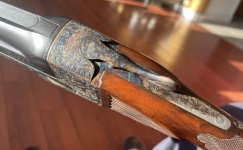
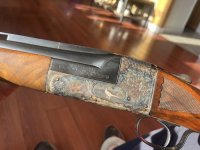
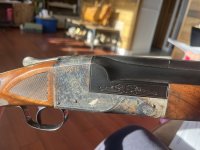
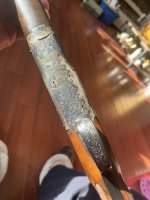
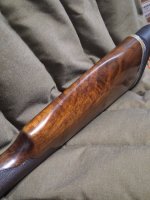
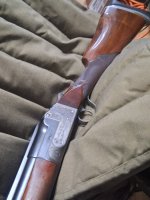
Saturday morning held the same excitement as Xmas morning does for a youngster as I proceeded to open the box containing the 100 year old Knick. To say I was pleased with the restoration of the 5E would be an understatement. What a gorgeous gun! The CCH colours? Wow!! And the ways in which Chris brought out the grain in the wood are truly stunning! What a craftsman!
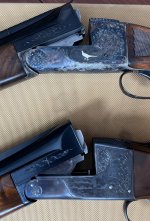
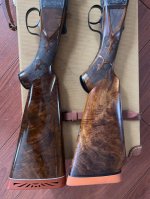
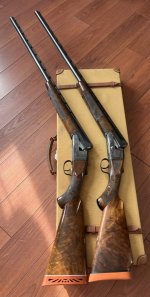
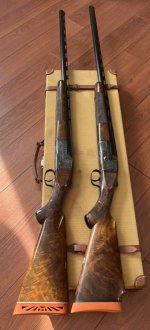
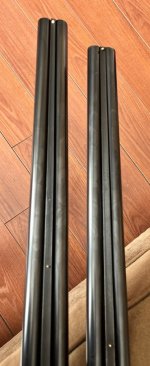
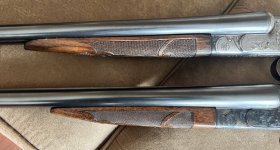
Of surprise and interest to me was when I took out the untouched original 1957 4E Knick SBT I own to compare alongside the 5E was the difference in length and weight of the two guns. The 4E I thought (my memory isn't the greatest at times) was advertised as a 34" bbl gun?
However upon placing the guns alongside each other and confirming with a measuring tape I discovered the 4E is actually a 32" bbl gun and I noticed a significant weight difference in the pair of Knicks.
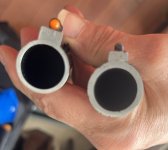
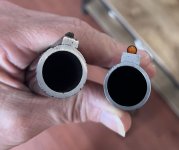
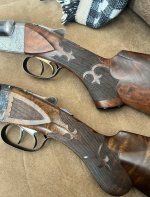
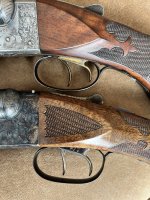
The 5E was made in 1926 and it is easily seen in hand and to a some degree in photos where some of the weight difference lies. The 5E receiver is deeper with a more rounded bottom and the barrel has larger vent rib posts compared to the 4E and you can very easily see a difference in muzzle thickness. I will have to mic the muzzles to verify chokes but the 4E is stamped #3 meaning Imp Mod where the 5E has no stamp but I suspect its Full choke. Most Ithaca SBT's did not have choke stamps indicated on them but there are a few examples that do wear them.
The outer diameter of the 5E barrel appears to be of larger diameter than that of the 4E as well. I suspect the 34" 5E barrel overall may be thicker walled but I cannot confirm until I mic it. I have been told Ithaca offered buyers of these custom built guns a choice of barrel weights and not just a choice of lengths ranging from 30" to 34".
The 4E feels extremely muzzle light in comparison to the 5E with weight balanced between the hands and the gun feels about 1/2lb lighter overall (yet to be confirmed by weighing) where the 5E has a more weight forward (muzzle heavy) feel and balance to it along with a heftier feel all around and especially in the receiver area.
I'm of course a little impatient waiting for the snow to be gone and the clubs I shoot at to be open once again so I can take the 5E out for an inaugural test run and some practice on the traps, especially handicap as the big heavy single has the feel and slower swing characteristics of a long yardage handicap gun. I shot the 4E this past Christmas break while visiting my father in Nanaimo and the 4E has a quicker amd very smooth swing characteristic more attuned to singles(16yd) and short yardage handicap.
Of course the 5E has a ton of head turning appeal, not that the 4E doesn't but the 5E really has that extra bit of awe factor about it and I'd hate to be "that guy" carrying such a classic beauty, once considered to be the king of trap guns around the ranges. :whistle:

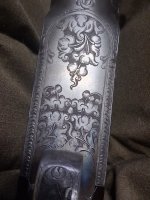
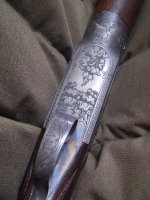
IMG_1994.jpegIMG_1993.jpegIMG_1992.jpegIMG_1995.jpegIMG_2018.jpegIMG_2020.jpegIMG_2012.jpegIMG_2013.jpegIMG_2011.jpegIMG_2009.jpeg
 
Last edited:
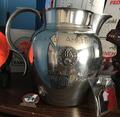
While mine isn't as showy as yours are it belonged to my great grandfather. I have this and his 32" model 12 and his trophy for trapshooting
Apparently he was short and fat with no neck as the stock is hogged put. With the Morgan adjustable pad I can shoot it and ive won a good share of trap events with it. However the bar in the forend thst connects to the ejector broke.
Strangest thing with it is its tight on face but when I dont really pull it into my shoulder it unlocks when fired. It doesnt do it for anyone else but my not so firm hold when shooting premounted it occasionally unlocks. Several local smiths over the years say there's nothing wrong with it
 

Attachments

  • 20260310_185747.jpg
    20260310_185747.jpg
    182.3 KB · Views: 12
  • 20260310_185903.jpg
    20260310_185903.jpg
    119.4 KB · Views: 11
  • 20260310_185922.jpg
    20260310_185922.jpg
    124.6 KB · Views: 10
  • 20260310_185939.jpg
    20260310_185939.jpg
    105.6 KB · Views: 11
  • 20260310_185806.jpg
    20260310_185806.jpg
    152.2 KB · Views: 11
  • 20260310_185759.jpg
    20260310_185759.jpg
    188.2 KB · Views: 12
  • 20260310_185727.jpg
    20260310_185727.jpg
    185.4 KB · Views: 12
  • 20260310_185715.jpg
    20260310_185715.jpg
    131.7 KB · Views: 13
  • 20260310_185711.jpg
    20260310_185711.jpg
    163.9 KB · Views: 13
  • 20260310_185701.jpg
    20260310_185701.jpg
    170 KB · Views: 12
  • 20260310_185652.jpg
    20260310_185652.jpg
    167.8 KB · Views: 11
While mine isn't as showy as yours are it belonged to my great grandfather. I have this and his 32" model 12 and his trophy for trapshooting
Apparently he was short and fat with no neck as the stock is hogged put. With the Morgan adjustable pad I can shoot it and ive won a good share of trap events with it. However the bar in the forend thst connects to the ejector broke.
Strangest thing with it is its tight on face but when I dont really pull it into my shoulder it unlocks when fired. It doesnt do it for anyone else but my not so firm hold when shooting premounted it occasionally unlocks. Several local smiths over the years say there's nothing wrong with it
That's a nice old Flues and you have heritage to go with it! So nice to see it remained in the family and still gets to do what it was built for. I wonder if your unlocking issue would be resolved by handloading low pressure loads if you aren't already? I know my 1927 NID 4E will unlock using modern light target or light field ammo but run low psi loads and not an issue. As ammunition changed and pressures climbed it's plain as day to see those pressures as well as heavier payloads were the main culprits behind these old singles and sxs' we come across that are wobbly on the hinge, have cracked forends and broken stocks because the guns were not made to withstand the ammo being built for them.
 
Last edited:
Its not all the time thst it does it and it only happens to me. When I shoot premounted for trap I dont hold the gun as tight to my shoulder. Yet ive shot skeet for fun with the 4e as singles and it doesnt happen when I shoot low gun because I hold the gun tighter to my shoulder
I load some 2.5" shells to 6500psi or thereabouts for my Damascus guns. Ill try them just for curiosity
The gun it still tight on face and an absolute hammer on crows
 
Its not all the time thst it does it and it only happens to me. When I shoot premounted for trap I dont hold the gun as tight to my shoulder. Yet ive shot skeet for fun with the 4e as singles and it doesnt happen when I shoot low gun because I hold the gun tighter to my shoulder
I load some 2.5" shells to 6500psi or thereabouts for my Damascus guns. Ill try them just for curiosity
The gun it still tight on face and an absolute hammer on crows
I bet! With the combination of bore diameters/ tight constrictions combined with modern plastic shotcups those fixed chokes are absolute target crushers and feather busters. The way my vintage fixed full guns take down geese with nothing more than a 1oz 1200 fps load of #4 Bismuth is an absolute head shaker. A light load of 7 1/2 lead would make a crow look like a black feather pillow exploded!
 
Just went through a 1974 GUN DIGEST they have the 4E priced at $1750 and the 5E priced at $2500 with a $100 stock option big money back in the day Frank. Nice guns my friend.
 
I bet! With the combination of bore diameters/ tight constrictions combined with modern plastic shotcups those fixed chokes are absolute target crushers and feather busters. The way my vintage fixed full guns take down geese with nothing more than a 1oz 1200 fps load of #4 Bismuth is an absolute head shaker. A light load of 7 1/2 lead would make a crow look like a black feather pillow exploded!
Classic crow guns doing it with class ! (y)
 
Here is two more of my 4E's. At a glance from a few feet away the overall appearance does not differ much but in hand when examined a little more closely the differences really jump out at you.
The serial #'s indicate manufacture dates of one year difference. The 12ga is 1927 and the 16ga 1928. Both are two barrel sets with all matching #'s. The 12ga has two forends to the 16ga's one. The barrels on the 16 are numbered 1 & 2 stamped on the forend latch lug, the 12ga are not numbered. The forends differ in length with the 12ga measuring 8 1/16"long from the outer edge of the forend iron to the tip of the ebony insert. The 16ga measures 9 3/16" and the ebony inserts are of differing lengths as well at 1 1/4"(12ga) and 1 5/8"(16ga). According to my measurements both receivers are the identical size in width, depth and length. Though I have not weighed them both guns feel very close in weight and balance even with the differing bbl lengths with the 12ga having bbls of 28"/24" and the 16ga 26"/26".
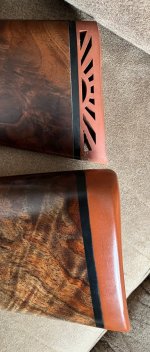
Then we jump into the stocks. The 12ga is a restock. Originally ordered according to a letter from the Cody factory as a straight grip stock a previous owner replaced it with a prince of wales grip stock. I do not have the Cody letter I ordered for the 16ga in my possession as yet but I believe the stock is original. Both guns are wearing replacement recoil pads. The 12 has a period correct silvers and the 16 a non-period correct Ithaca sunburst(bridge trestle) pad. The Ithaca pad was not patented and introduced until 1932.
Moving onto the barrels both have double beads. The 12ga has ivory on both barrel as stated in the factory orders letter and the 16 bbls have the brass front and mid-beads.
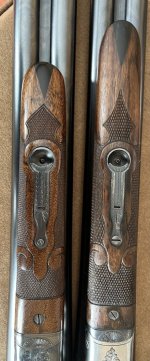
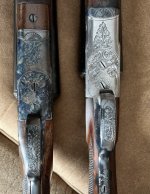
The receivers are where we really take notice. It has been recorded in several publications that Ithaca dropped the cocking indicators on the NID's in 1934 and they were no longer listed in their 1935 model year catalog the 16ga though a 1928 serial # does not have cocking indicators. Special order or possibly a gun made at a much later date from parts previously struck with serial # and put together from inventory several years later? The differences in the engraving range from subtle to very easily seen. The tops of the receivers vary greatly. The 12 ga is engraved where the 16ga is stippled, another feature that started appearing on later models. The engraving in the top levers is vastly different as is the tang and trigger guard engravings. The underside of the receivers is quite different though somewhat similar and lastly the forend latches and screw heads vary too. Another noticeable feature is the shape of the safety. On the 12ga it has a rise in the middle where the 16ga is flat.
The difference in the checkering patterns though overall the same basic patterns varies in the 12ga has a borderline whereas the 16ga does not and l the checkering on the forend of the 16 even varies in shape somewhat.
Lastly one of the more noticeable feature differences comes into play when shooting the guns and that is the trigger spacing. The 12ga(1 1/16") has more distance between the front and rear trigger than the 16ga(7/8").
As a whole when standing or lying alongside each other the guns at a glance almost look identical but up close the differences are quite noticeable. I wonder if that has more to do by the person(s) who worked on them and finished them or if it was more of a design change?

IMG_2334.jpegIMG_2324.jpegIMG_2328.jpegIMG_2325.jpegIMG_2335.jpegIMG_2336.jpegIMG_2327.jpegIMG_2320.jpegIMG_2322.jpegIMG_2329.jpeg
 
Back
Top Bottom