The history of J. & W. Tolley is a long one, but only part of it is relevant to your friend’s gun. James William Tolley was born in 1832 in Birmingham, and his younger brother, William Tolley, was born there in 1834. After serving their apprenticeships and working as journeymen gunmakers, they established their gun-making partnership, J. & W. Tolley, at 22 St Mary's Row, Birmingham, in 1858. It is reported that they first concentrated on making large quantities of cheap guns mainly for the African market, and filling military contracts, but they also produced higher-quality guns. They are said to have made breech-loading guns as early as 1862, but I can't confirm this. They entered a gun in
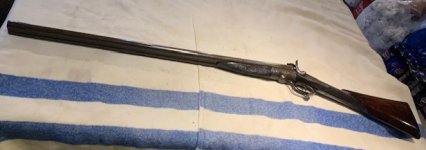
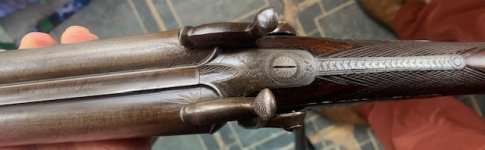
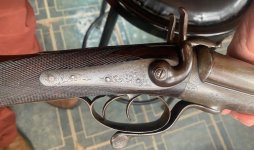
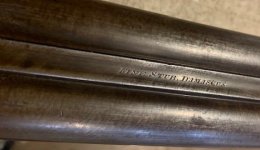
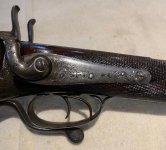
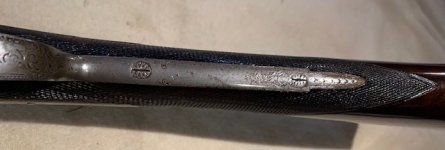
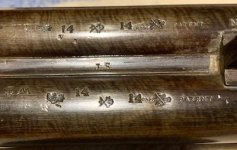
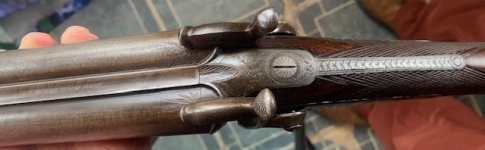
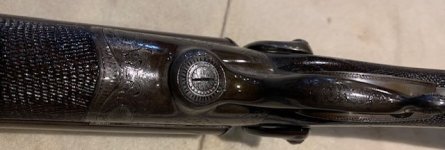
The Field’s public gun trial of 1866, but came last out of 32 entrants. In the early 1870s, the business moved to 19 Loveday Street. In time, J. & W. Tolley would make a name for itself in large-bore waterfowl guns, and receive foreign royal patronage, but that is all much later than this gun, which looks like it dates from mid- to late-1860s. The gun is a basic mid- to lower-grade standard Birmingham pin-fire of the period. It looks like it has a double-bite action of the type that became ubiquitous after Henry Jones’s patent expired at the end of 1862. The barrels are machine-made, and not hand-forged, damascus steel by The Rose Brothers of the Hales-Owen Mills & Forge. They were barrel makers located in Halesowen, Worcestershire, operating between 1860 and 1892. They developed and were known for a patented method for the machine production of damascus barrels. These barrels were undoubtedly cheaper than hand-forged barrels, even given the low wages paid to the craftsmen of the day (most barrel tubes used in better guns were imported from Belgium at the time). The engraving is very basic, as seen on lower-grade guns (though so much nicer than what passes for engraving these days). The bore size is 14, which means the chamber size is either 14 or 12. Since this is from the days before choke boring, it was not unusual to try to improve a gun's shooting qualities by using restricted bores – think of it as choke throughout the length of the barrel. So, it could be a 12 with narrow bores, or a 14, which was a common pin-fire cartridge size at the time.
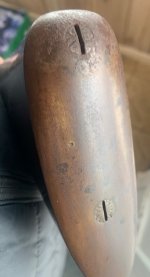
On a positive note, the condition of the gun is not bad, and it does not appear to have been interfered with. A cleaning with anything other than a toothbrush and mild soap, or a rub with a cloth and a bit of olive oil, could seriously kill the value of this gun. Best to leave it alone, and not go anywhere near any of the screw heads. Really.
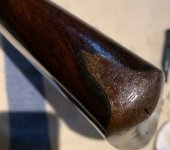
I see that the right-hand hammer is a replacement, possibly a period repair. Other than that, it looks complete, and an honest example of a Birmingham mid-1860s pin-fire of medium-low quality. When new, it would have been a handsome gun, and someone’s pride and joy.
If you or your friend has an interest in pin-fire game guns, you might find the following thread of interest, over in the Shotgun forum, where a number of British pin-fire game guns are discussed:
https://www.canadiangunnutz.com/forum/threads/the-allure-of-the-british-gun.2492672/













































 IMG_7341.jpg35.1 KB · Views: 19
 IMG_7227.jpg36.5 KB · Views: 19
 IMG_7225.jpg69.4 KB · Views: 19
 IMG_7229.jpg37 KB · Views: 21
 IMG_7233.jpg32 KB · Views: 21
 IMG_7335.jpg58.8 KB · Views: 21
 IMG_7338.jpg33.1 KB · Views: 20
 IMG_7342.jpg33.9 KB · Views: 20
 IMG_7345.jpg28.1 KB · Views: 19
 IMG_7227.jpg36.5 KB · Views: 17
 IMG_7337.jpg40.2 KB · Views: 18






















