




































JOE's Museum of Yugoslavian Military Technology

joe6167

CGN frequent flyer
Rating - 100%
7   0   0
Location
Warszawa, Polska
One day I woke up and discovered to my horror that I was actually living amongst The Museum of Yugoslavian Military Technology. I have no idea how it happened. I never set out on that path... but see...

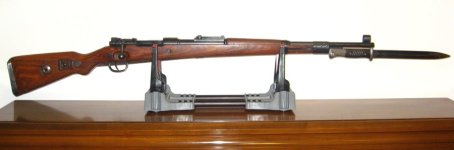
I wanted a K98k, but I couldn't afford a German K98k, but then there was the Yugo M98, made from K98 parts...

Then I wanted a MG42, but I couldn't afford an MG42, but then there was the Yugo M53, made from MG42 tooling...

Then one day I saw the M37... thought it was gorgeous... another Yugo gun, also in 8mm Mauser...

Then I learned about the M76 (Pending)... Giant AK... Yugo take on the SWD... also in 8mm Mauser... If I'm ever gonna get an AK Platform, that's the one to get...

Then I learned about the M56 (Also pending)... the MP40 (which I'll never be able afford), that drank too much moonshine while relaxing in the Balkans...

It turns out these Yugo guns are actually quite fascinating... this wild mix of German and Soviet designs... plus they are prolific... somehow Yugo guns manage to show up all over the world.

Who here among you doesn't have some Yugo surplus kit in your collections?

At any rate, I thought it might be entertaining to share some of my insights on Yugoslavian Military Technology...

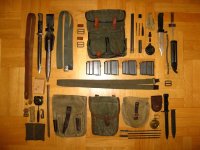
M98/M48, M76, and M49/M56 Gear
IMG_9276.JPG

The M37 (Factory Designation ZB30j), made at Brno in Czech Republic
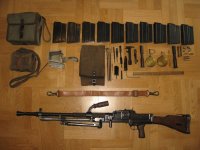
IMG_6709.JPG

The M53, made by Zastava using German Tooling
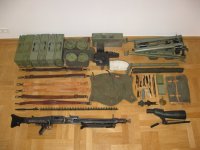
IMG_6900.JPG
 
Zastava was a major exporter and in the 80's and 90's Yugoslavia would make and export ammo to anyone that would pay.

I only have 1 rifle that is stamped made in Yugoslavia and that is a commercial mauser, I believe it was advertised as the Mark X and most were heavier magnum chamberings, mine is a 458WM.
 
The M98 Program

After the end of WW2, the Federal People's Republic of Yugoslavia found itself in dire need of weapons. As a stop-gap solution, it was decided to take the vast quantities of captured German K98k rifles and rebuild them, as the M98 for the first few years after the war, until the M48 entered production.

The process involved completely disassembling every rifle, inspecting every part, removing German markings and applying Yugoslav markings to the receiver, and finally, assembling new rifles from completely random parts. Then they were all put into storage for the next few decades, until they were finally sold on the surplus market.




You get a rifle that, while made from a million random parts, were all inspected, and you're getting an almost essentially brand new rifle. I've long suspected that my rifle came with a brand new post-war barrel, rather than a shot-out barrel from the war. As an added bonus, you get to try and figure out where all the different parts come from, as most small parts still have serial numbers proof marks and Waffenants.

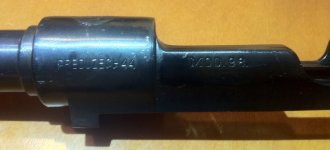
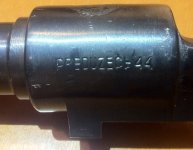
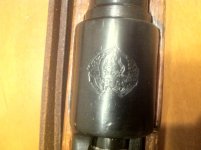
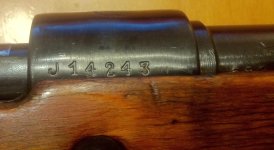
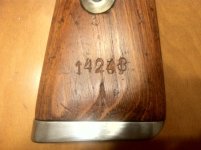
The new Yugoslav receiver markings include the 5-torch Yugo crest (but without the ФНРЈ name) on top of the receiver, "PREDUZEĆE 44" in Latin letters on the left side of the receiver, and a new serial number, with a letter prefix on the right side, while the German "Mod. 98" was left intact. They also added the rifle's new serial number to the butt stock.

PREDUZEĆE 44 translates to "Institute 44", which was the communist name assigned to the Zastava factory during much of the communist era.

What's neat is that the original German receiver markings are still visible under the Yugoslav markings. It's an S/42 receiver, but the last number in the year is cut off, but it's either a 1936 or 1937 receiver.

As you can see in the photos, a second recoil lug was installed behind the trigger.

IMG_1084 - Copy.jpg

IMG_3845.JPG

The original German serial number and proof marks are visible just about the PREDUZEĆE 44.

IMG_3847.JPG

Look closely and you can see the original S/42 and date markings under and below the Yugoslav crest.

IMG_7094.JPG

German proof marks are still visible on the right side as well.

IMG_7098.JPG

The rifle's new Yugoslav Serial Number was also stamped into the butt stock.

IMG_7096.JPG
 
Last edited:
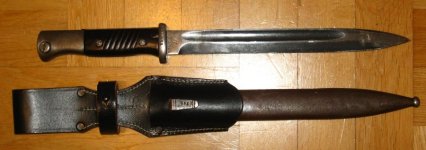
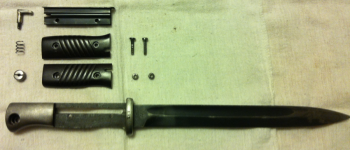
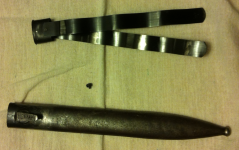
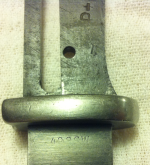
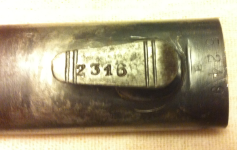
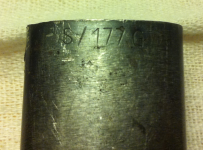
The Yugoslavs did the same to the bayonets as they did to the rifles, and here's a textbook example. Every last single piece of the bayonet and the scabbard are completely mismatched. It must have been fun taking apart all those bayonets...

The frog is a replica.

IMG_9340 - Copy.JPG

1790297175118.png

1790297256353.png

These things are absolutely covered in numbers, proof marks and even a few waffenants... here's a few of them:

img_6038-bayonet-stamps-jpg.1212437


1790297350945.png

1790296992317.png

1790297413194.png
 
Last edited:
One fascinating aspect of all this Yugo gear is seeing the different ways that Germany and Yugoslavia approach the same task.

One great example of this is the cleaning kits that were issued with the K98k, M98 and M48 rifles.

The Germans had their RG34 cleaning kit, with it's stamped metal case, metal pull chain and machined oiler bottle.

Now compare that to the Yugoslav cleaning kit, which comes in such a primitive cloth pouch, they couldn't even incorporate a proper fastener into it... it's literally closed with a piece of string!

I guess that gives an indication of what state Yugoslavia was in after the war.

Imagine being a Yugoslav soldier and you see your kit is just held together with some bits of string? Must have instilled quite a bit of confidence...

...the "string" method shows up in other gear as well...

One interesting component that was included with the Yugoslav cleaning kit, but not with the German kit, was the crown protector, which even has a short section of rifling in it! If you're gonna shoot your Mauser, I recommend getting your hands on one.

IMG_9351 - Copy.JPG
 
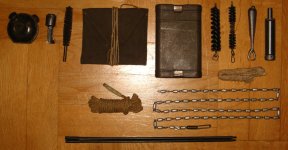
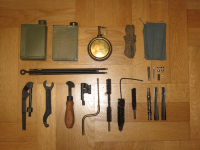
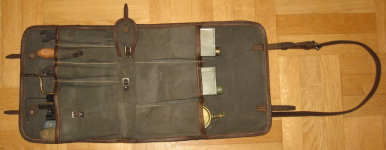
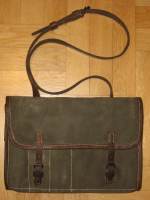
Here's the tool kit issued with the M53 (the post-war MG42). Certainly much more developed than the rifle kit, but they still managed to incorporate at least one piece of string, to close the spare parts bag.

It comes in a pretty sharp looking bag. I wonder if Zastava ever considered branching out into fashion... leather and canvas will never not be cool...

The usual contents include:
-Oil and Solvent Cans
-Oiler
-Bore Snake
-Spare Parts Bag, (including 2x firing pins, ejector, 2x extractors, 2x extractor springs, extractor retainer, 2x Ejector Transfer Bars, [the bolt spring was my own addition]
-3-Piece Cleaning Rod
-Bore and Chamber Brushes
-Cleaning Jag
-Extractor Tool
-Booster Cone Scraper
-Flash Hider Wrench
-Ruptured Case Extractor

Additionally, there would be an asbestos mitt for changing the barrel, and a canvas cover for the receiver.

1790713341863.png

1790713912657.png

1790713994788.png
 
cyrillic no way hope it is Bošnjak/hvratsko
It looks to be Serbian written in Latin letters.

At any rate, there are many useful translation tools out there. Specialized OCR readers for various languages. Google and DeepL kind of suck at translating Serbian weapons terminology, but it will translate all the other words in a sentence, and you just have to use your own intelligence to figure out something that makes sense.

If anyone wants to follow along, I post pages to this group as I translate them.

https://www.facebook.com/groups/210859711788
 
serbian in latin is croat lol or was in the past as well bosnian/bosniak and spoke in whole yugoslavija you had not a choice it was the province you lived in plus the federal one so serbian/croat and cyrillic was not optional lol
 
Joe, if you have not been to the Balkans I 100% recommend going and spending some time. I was in Montenegro and Albania for close to a month last spring. That place is like one big mountainous museum. It’s hard to imagine so many horrible things have happened in such a beautiful place with such amazing people.
 
Joe, if you have not been to the Balkans I 100% recommend going and spending some time. I was in Montenegro and Albania for close to a month last spring. That place is like one big mountainous museum. It’s hard to imagine so many horrible things have happened in such a beautiful place with such amazing people.

Well I have over 2 years in the Balkans..... that's 4 tours ;)

2003, Bosnia and 3 tours of Kosovo 2017, 2020-21, 2024-25. I've traveled through and did R&R in Slovenia, Croatia, Albania, and North Macedonia.

it is pretty country but the people need to sort themselves and their political institutions out.

I've also handled a lot of interesting kit :)
 
Last edited:
serbian in latin is croat lol or was in the past as well bosnian/bosniak and spoke in whole yugoslavija you had not a choice it was the province you lived in plus the federal one so serbian/croat and cyrillic was not optional lol
According to Wikipedia:

"Both scripts were recognized in the Kingdom of Yugoslavia and the Socialist Federal Republic of Yugoslavia. During the latter period, Gaj’s Latin alphabet gained greater prominence, especially in multiethnic contexts, but also to facilitate correspondence with foreign languages such as English, German, and French.

During the period of Socialist Yugoslavia and Federal Republic of Yugoslavia, both scripts were in official use for Serbian. Since 2006 in Serbia, Cyrillic has the constitutional status of "official script", while the Latin script is designated as "script in official use" for minority and practical purposes."


All the translators I use identify the text as Serbian...

Some guns from Zastava have their markings in Latin letters, some have them in Cyrillic... My M98 has Latin letters, My M37 and M53 have cyrillic letters. All the M76's I've seen have Latin letters.
 
According to Wikipedia:

"During the period of Socialist Yugoslavia and Federal Republic of Yugoslavia, both scripts were in official use for Serbian."

All the translators I use identify the text as Serbian...

Some guns from Zastava have their markings in Latin letters, some have them in Cyrillic... My M98 has Latin letters, My M37 and M53 have cyrillic letters. All the M76's I've seen have Latin letters.
the official languages of the rsfy were attached to each province and one was above to permit to communicate among all. the name was called serbo/croat. croat for latin and serb for cyrillic. of course with the collapse of RSFY croat and serb now are way more complicated and tried to distance each other. but still used in older form in bosnia ... interesting to know that the coran in bosnia was translated in croat (latin writing) and in sarajevo you were able to find latin or cyrillic written on shops .... and remember zastava factory was not far from sarajevo thus the markings different. the other reason is certainly rifles/firearms produced for the local market or outside.
 
That Yugo Bore Snake

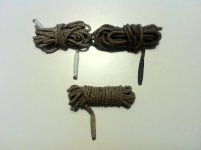
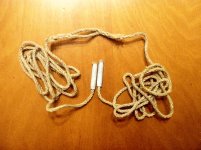
One of the more distinctive pieces of Yugo kit is... the bore snake! I've got at least FOUR of them in my collection...

The JNA must have really liked them as the M98/M48, M53 and M76 tool kits all came with one, (though the M37 (the ZB30j) tool kit only came with a cleaning rod).

As I'm in the process of translating the M76 manual, I thought it would also be interesting to share the official JNA doctrine on how to use... the bore snake!

I notice that the JNA was rather strict about using cleaning rods, as "The use of the cleaning rod is permitted only with the approval of the officer in charge." I'm guessing they figured the bore snake was relatively harmless enough to entrust to the common soldier...

IMG_6033.JPG

IMG_7111.JPG

Description

The bore snake
is made of hemp. It has lead weights on the ends for easier passage through the barrel, and a loop in the middle for pulling in a cloth or rag when cleaning the barrel.

Using The Bore Snake

44.
When two soldiers clean the weapon's barrel using a bore snake and a cloth (patch), the procedure is as follows:

-the soldier assigned to the rifle-machine gun grabs the weapon by the stock with his left hand (receiver) and turns the muzzle down toward the ground, with his right hand he grabs one end of the bore snake with a cloth looped on it and pulls a lead weight into the chamber and pushes the cord through the barrel until the lead weight exits the muzzle, and

- the second soldier (when the rope's lead weight is released) grabs the muzzle with his left hand (the rifle grenade spigot on a semi-automatic rifle), and with his right hand, he grabs the rope and pulls it toward him.

When pulling the rope, the gun barrel must be in line with the rope so that the rope does not scrape against the edges of the muzzle or the chamber. The cloth or patch is changed 5 to 6 times and pulled through until it comes out clean. If the barrel was not coated with DRNČ before cleaning, soak it with a solvent with each change of the patch.

If the cleaning rod gets stuck, send the gun to the shop to have it removed.

45. When a barrel is cleaned by a single operator using a rope and a patch, the rope insertion procedure is as in item. 44. After the lead weight of the rope comes out, the gun barrel is turned muzzle-up (to a vertical position) and the rope is pulled straight up. Then, the barrel is turned muzzle-down again and the process is repeated, changing the cloth—the patch—until it comes out clean.
 
Back
Top Bottom