Ladder test results got me stumped.

Alpheus

CGN Ultra frequent flyer
Rating - 100%
168   0   0
Location
Ottawa
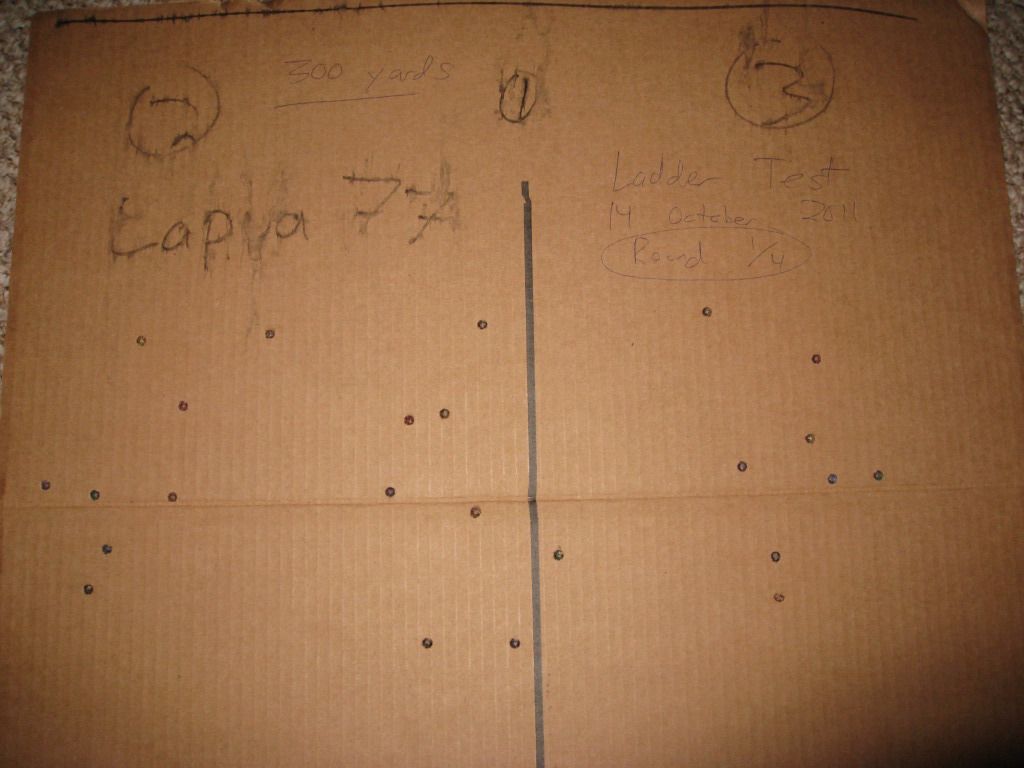
So I did the ladder test at 300m, got some bizarre results. Take a look:

DSC00536_zpsd30a8e1b.jpg


The rectangular hole was my aiming point, the target underneath was black in that area.

The load was as follows:
168gr Berger BT Target
Once fired Federal brass @ 2.010
2.800 COAL
Varget from 41.9gr to 45.9gr in .2gr intervals
CCI BR2 primers

It was -5C, absolutely no wind.
Took awhile to get pressure signs, flattened primer and extractor impression at 45.9gr.

The trick of highlighting the bullet tips worked well, too bad half my rounds were MIA. Apparently increasing the powder makes the bullet drop more, not less, who knew?!? The rifle and scope are good, checked when confirming my zero. I shot the test fairly quickly, could a hot barrel cause this?

I think I will try a more conventional approach next, just make up 5 round groups with increasing powder.
 
My wife did a ladder test with her .222 and the shots would go up and down as the load increased. Not what I expected but we seem to have found a node that looks promising.

I will have to try highlighting the tips.
 
I had another target set up above the paper in the photo because I didn't know how high the ladder would go. Of course, no holes in it. Next time I might aim in the centre to catch everything.

Bigger intervals? I'll give that a go as well.
 
Not a bad "Pattern" but the load associated to each load is required.
You will be looking for a group that formed using difference loads.

260Remington-IncrementalLoads004jpg-1.jpg


Knowing which hole is which load is what your are looking for. 1 was the starting load and 8 was the final load.
Of the three target shot, 2 & 4 were always close.

The hotter loads do not necessarily go higher but their impact is determined to some extent by the barrel harmonics. Some would call it "Principles of Ballistics", in other words, who knows?
 
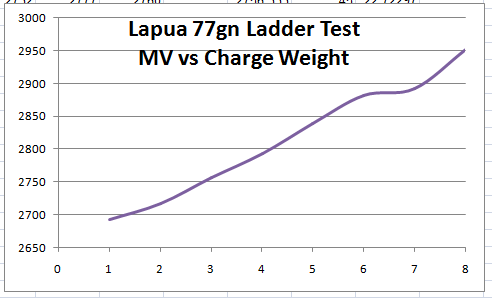
In my opinion, a ladder test is set up for failure without a chronograph. Unless what showed up on paper and what showed up on the chrony were consistent, I wouldn't be able to justify the results.


About a year ago I did 4 ladder tests 24 rounds each with my 223. Most of the results were consistent. I found both velocity nodes and matched those to the bullet holes grouping up. That should mean that the powder charge and barrel harmonics were in harmony (sorry for the pun lol).


PortageGuns170.jpg


Graph-Lapua.png
 
Um! A ladder test is useless unless each shot is marked with the sequence it was shot.
Try again using sequences like 42, 42.1, 42.2, 42.3 and continue up to 43. Shoot this at 100 and stop, walk out and mark every three shots. This does 2 things it allows the barrel to cool and you can see and mark the sequnce it was shot in. My ladder test has the bullet holes with the load marked at each hole.
Then try 43.1, 43.2 43.3, 43.4 all the way up to 44. Again shoot 3 mark target with the sequence shot.
Then load up 3 of each of the clusters.
Don't overheat your barrel. It throws the results off.
Hope this helps.
 
Um! A ladder test is useless unless each shot is marked with the sequence it was shot.
Try again using sequences like 42, 42.1, 42.2, 42.3 and continue up to 43. Shoot this at 100 and stop, walk out and mark every three shots. This does 2 things it allows the barrel to cool and you can see and mark the sequnce it was shot in. My ladder test has the bullet holes with the load marked at each hole.
Then try 43.1, 43.2 43.3, 43.4 all the way up to 44. Again shoot 3 mark target with the sequence shot.
Then load up 3 of each of the clusters.
Don't overheat your barrel. It throws the results off.
Hope this helps.

Another idea to help would be to use a roll of bulk kraft paper (found at walmart, very cheap) and cover the back stop with it. Then create an aiming point with a marker, or target, or whatever for a single point of aim and then dial the scope so your impacts are not near that point. You won't have to think about groupings this way and I find it is WAY better to focus on good technique and each individual shot rather than shooting groups.
 
Yeah, I flipped two target papers around so the frame was all white and I had an aiming point at the bottom. If all my shots had ended up on paper, rather then half of them, I might have learned something useful.

I will try the shoot and walk approach next time. And aim at the centre.
 
Yeah, I flipped two target papers around so the frame was all white and I had an aiming point at the bottom. If all my shots had ended up on paper, rather then half of them, I might have learned something useful.

I will try the shoot and walk approach next time. And aim at the centre.

Record on a blank piece of paper where your impacts are from the shooting line looking through your scope. It will help you identify where each impact was on the paper.
 
Don't overheat your barrel. It throws the results off.

Very important tidbit of info! Ladder tests require alot of patience. My day of 4 ladder tests (100 rounds) took me about 3-4 hours and that was rushing it (I made the mistake of bringing my finacee with me :( )

If you don't feel like walking to the target everytime, I put marker on all of the bullet tips in a determined order. You can kind make it out on the picture I included above. My mistake was that I was shooting at BROWN cardboard instead of WHITE paper. It was very difficult to differentiate between the colors.
 
In my experience, I prefer to shoot my ladder tests at least 600yds. That is far enough to really get the verticle dispersion tested. And its easier to visualise the pattern so to speak. This is just "my" thoughts on it, but the only real important thing is to have enough flight distance to establish a noticable pattern.

Some times interesting things show up on ladder tests.

Keep it fun guys! And thats not hard in this hobby/obsession! Lol!
 
Last edited:
When I ladder develop I usually take a huge sheet of paper and a bunch of pasters from basspro and have a different poa for each load... A little more time consuming but my results always make me happy at the end of the day... I usually shoot 5-10 of each load all into one poa to and usually measure the centre most group ... Basically I don't want to miss a good load because of a flyer
 
When I test I just shoot group after group of the "ladder" tests. Then find whatever is grouped smallest and fine tune from there. I also look for horizontal variation more so then vertical. With 10 groups you can see a pattern of nodes.

Might have did it wrong, but I'm pretty happy with .5 MOA on a econo gun.
 
I think you guys are confusing a ladder test with an 'optimal charge weight' (OCW) test.

OCW tests usually happen after a ladder test has shown which charge weights provide similar MVs and patterns which helps predict future sweet sopts.
 
ya first off, no one sheet of paper, need a large target 24" x 24", second, you need to learn to keep your shots true and steady at the break of the trigger, i ended up using 4 sheets of paper sided by side total in a square and had a 1"x1" grid on each with 4 targets different loads had a different target and seen which one grouped better and narrowed 9 loads into 3 then seen which one shot better and worked it from there
 
See my article on load tuning on my website. I gave up on ladder testing a long time ago. I now use a modified method. Works each time and quickly narrows down where your accuracy nodes need to be.

Saves a ton of components, shooting and bore wear.

Way too much can go wrong and cloud your data when firing 1 rd.

Jerry
 
So I re-did my ladder test today, got some very useable info. I did it a bit differently this time. Took my time between shots, walked down and marked the target every 6 rounds so my barrel didn't heat up. Used the highlighter trick again, and had a little copy of the target grid onto which I plotted each shot as a reference.

Laddertest_zps296ee71b.jpg


Same loads and distance as last time, but very, very windy. I was only worried about vertical and it shows, almost 7.5" horizontal spread.
I see some promising nodes at:
8-9-10: 0.339" charges 43.1, 43.3, 43.5
11-12-13: 0.608" charges 43.7, 43.9, 44.1
14-15-16: 0.718" charges 44.3, 44.5, 44.7

I'm going to do mini-ladder tests in each of those nodes, dropping to 0.1gr increments. And then some test groups. I won't bother trying to play around with jump/jam in this rifle, it has a lawyer throat and I'll be getting it re-barreled later this year anyway.

Little anecdote, when I was confirming my zero at 300m, I put 3 Federal Gold Medal into a hair over an inch group. In other words, around .3MOA. I'll put that down to good old fashioned luck. I decided not to make it 5 rounds, you know, to preserve my bragging rights. :sniper:
 
Another idea to help would be to use a roll of bulk kraft paper (found at walmart, very cheap) and cover the back stop with it. Then create an aiming point with a marker, or target, or whatever for a single point of aim and then dial the scope so your impacts are not near that point. You won't have to think about groupings this way and I find it is WAY better to focus on good technique and each individual shot rather than shooting groups.


This is what I use as well. I used an old porch bench swing as a target stand and strung out the paper using cheap sping clamps from the dollar store. It also works very well when checking the shotgun for patterning at different distances.

-Jason
 
Back
Top Bottom