Lake City Brass - primer pocket problem

Mudduck

Regular
Rating - 100%
165   0   0
Location
The Kawarthas
I purchased some once fired 3006 lake city brass. While prepping the brass I noticed that it seems a lot harder then Winchester or Remington. Was wondering if I should anneal it before reloading. Now when seating new primers I am concerned they are not seated tight enough.. I thought the 2 Lyman tools should have removed the crimp - Maybe I need to remove more?

I posted some pictures of the primer fired only cases and the tools I used
 
Last edited:
is it just plinking ammo? assuming you were sizing and depriming at the same time it could be crimped primer pockets causing the extra force. that being said it certainly won't hurt annealing it.
 
I have reloaded a bazzilion rounds of military brass. Have never annealed one yet.

The extra resistance might be because it was shot in a large chamber, such as a machine gun. I don't usually reload that kind of brass, but when I do, I use an extra dollop of lube in the lube pail.

For my Dillon, I decap military brass in a separate operation and then champfer all the primer pockets so the primers will seat without issue.
 
What brass prep step is giving you concern?
LC brass has crimped primers, as mentioned. Once that's gone, it's just .30-06 that's a tick thicker near the case head. Gets reloaded just like any other brass. In any case, annealing is only done to the case neck and shoulders.
 
If you ever get a chance at LC .30-06 match brass, jump on it. This stuff didn't have crimped in primers, whereas regular GI brass did. I got 2000 pcs of unfired LC 67/68 Match brass about 15 yrs ago and it has been excellent. From time to time you can find fired LC69 GI brass with the primers crimped in, which is also very good for Garand reloads.
 
If you ever get a chance at LC .30-06 match brass, jump on it. This stuff didn't have crimped in primers, whereas regular GI brass did. I got 2000 pcs of unfired LC 67/68 Match brass about 15 yrs ago and it has been excellent. From time to time you can find fired LC69 GI brass with the primers crimped in, which is also very good for Garand reloads.

I picked up a thousand LC brass for my M1A jyst over a year ago, got the dillon SS600 to take out the primer crimp, should last me a good while. It is harder to size, as from what I've read it is a little harder brass than non-military, which makes it better for shooting from a semi.
 
Military brass is made to higher hardness standards than commercial brass in the base web area to better withstand the larger diameter military chambers. And as stated above if the ammo was fired in a machine gun the chamber diameter will be even larger and approximately .004 larger than a standard SAAMI commercial chamber. On top of this 30-06 and .308/7.62 military cases will also be thicker and have less case capacity with the exception of .223/5.56 cases which are slightly harder and have more case capacity than commercial cases.

Below are the Rockwell hardness readings for .223/5.56 cases.

LC 2008 = 96

Lapua 223 Match = 86

Winchester 223 = 69

Remington "R-P" = 49
 
Thanks for all the info on LC brass and annealing. Last night I decided to try priming 3 brass to see how well they went in. I used an RCBS hand primer. They began to go in tight but then sort of popped in but I didnt like the feel of it. They were also seated quite low so I decided to to fire 2 of them with only the primer. these were the results - one unfired and 2 fired.

Not certain how I messed these up because Ive never had this before
but it looks like I may have to throw out the entire batch :eek:(

I use a Lyman case prep machine and have included photos of the 2 tools I used on the primer pockets


Here is a picture of inside the primer pocket that I have prepped using the Lyman tool and an RCBS hand tool. There are 2 low spots so it appears the primer isnt getting full contact. Im using Federal primers

 
Ok, I am looking at this on my phone so its hard to see but what is wrong in the pics? You worried about the primer backing out?

OP is finding it difficult to prime the cases. Some primers are seating in a bit deep and others aren't seating flush. OP needs to ream/swage his cases to remove the crimp before priming.
 
OP is finding it difficult to prime the cases. Some primers are seating in a bit deep and others aren't seating flush. OP needs to ream/swage his cases to remove the crimp before priming.

Hmm.. that's not exactly how I'm reading this thread. Surely, if the crimp hadn't been removed, the primers wouldn't be slipping in too easily.. I read it as:

1) OP has LC brass and has prepped it with the Lyman tools, including thinking that have removed the crimp

2) OP has had inconsistent difficulty seating primers and is concerned that they are going in too easily. OP said 'They began to go in tight but then sort of popped in but I didnt like the feel of it.'.

3) OP thinks their primers are sitting too low. They do look low in the pics.

4) OP fired a few prepped rounds and is concerned about the backed-out primers. I.e.: are they symptomatic of overly loose primer pockets?
 
Hmm.. that's not exactly how I'm reading this thread. Surely, if the crimp hadn't been removed, the primers wouldn't be slipping in too easily.. I read it as:

1) OP has LC brass and has prepped it with the Lyman tools, including thinking that have removed the crimp

2) OP has had inconsistent difficulty seating primers and is concerned that they are going in too easily. OP said 'They began to go in tight but then sort of popped in but I didnt like the feel of it.'.

3) OP thinks their primers are sitting too low. They do look low in the pics.

4) OP fired a few prepped rounds and is concerned about the backed-out primers. I.e.: are they symptomatic of overly loose primer pockets?

Hey Heavy Tread. You got it 100% correct. If the primer pops out that much when firing an empty shell what will happen with powder and a bullet
 
Hmm.. that's not exactly how I'm reading this thread. Surely, if the crimp hadn't been removed, the primers wouldn't be slipping in too easily.. I read it as:

1) OP has LC brass and has prepped it with the Lyman tools, including thinking that have removed the crimp

2) OP has had inconsistent difficulty seating primers and is concerned that they are going in too easily. OP said 'They began to go in tight but then sort of popped in but I didnt like the feel of it.'.

3) OP thinks their primers are sitting too low. They do look low in the pics.

4) OP fired a few prepped rounds and is concerned about the backed-out primers. I.e.: are they symptomatic of overly loose primer pockets?


Doh! I think I need to pause the TV when I read some of these threads. My bad. lol

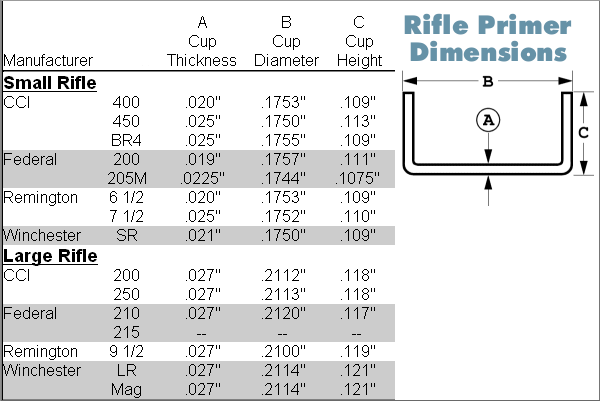
Hey Mudduck, are you using CCI or Federal primers? If CCI, you might try some Federals which are a fraction larger in diameter over the CCI.

calhoonprimers02.png


Good info from Bigedp51 below...
 
Last edited:
The amount the primers are protruding from the rear of the case is your head clearance or the "air space" between the rear of the case and the bolt face. This can mean two things 1. The rifle has excessive headspace 2. Or you over resized the cases and pushed the shoulder of the case back too far. NOTE, the firing pin has enough force to push the case shoulder back when it hits the primer and the force of just the primer going off could push the shoulder back even further. Meaning you might not have either of the two problems above and a good reason to have a good case gauge.

When you pull the trigger you release the firing pin, the firing pin then contacts the primer and pushes the case forward until the shoulder of the case contacts the chambers shoulder. The cartridge then goes "bang" and the pressure pushes the primer out of the primer pocket until it contacts the bolt face. On a fully loaded cartridge the pressure continues to build until the pressure is great enough to force the case to stretch back and contact the bolt face.

HEADCLEARANCE-a_zps1a9a1011.jpg


Below is a animated image of a cartridge being fired, first the primer is forced out of the primer pocket and as the pressure increases the base of the case contacts the bolt face. At low chamber pressures the primer will always protrude from the rear of the case and this is normal. What isn't normal on a properly resized case is for the primer to back out more the a few thousandths.

HeadClearance_zpsf30a3af1.gif


When resizing the correct shoulder bump is important for long case life, below look at the red and green dotted lines and the words "shoulder setback" which is also called shoulder bump. On a bolt action rifle the shoulder bump should be .001 to .002 and on a semiauto .003 to .004. So you will need a good case gauge to measure your fired and resized cases for the correct shoulder setback or shoulder bump.

shouldersetback_zps59bf1b04.jpg


The Hornady cartridge case headspace gauge would be my first choice in gauges, because of the ease of measuring fired and resized cases for proper shoulder bump.

headspacegauge004_zps4465b7bc.jpg
 
The amount the primers are protruding from the rear of the case is your head clearance or the "air space" between the rear of the case and the bolt face. This can mean two things 1. The rifle has excessive headspace 2. Or you over resized the cases and pushed the shoulder of the case back too far. NOTE, the firing pin has enough force to push the case shoulder back when it hits the primer and the force of just the primer going off could push the shoulder back even further. Meaning you might not have either of the two problems above and a good reason to have a good case gauge.

Hey Bigedp51
Thanks so much for taking the time to share all this information. This some of the best teaching/explanation I have seen
Im using Federal Primers but its good to know that the CCI are slightly smaller
The rifle is a new Benelli R1. I have been using Winchester brass in it without any issues so Im assuming headspace should not be an issue
The brass was once fired from some type of Semi automatic. I suspect it wasnt a hunting rifle based upon the amount of pressure I had to use on my Forster press - however it could also be that this is due to LC being harder brass
I dont have a Hornady Gauge but I have the next best thing or maybe the best thing .... depending on personal preference ..a Forster Datum kit LOL
All of my 3006 brass as been resized and reloaded (except for this LC brass) , so I will wait until I shoot off some at the range, and then take the measurements.
I will post my findings
Thanks again everyone for all your help and suggestions
Im going to take some measurments ... because it may be exactly what you have shown
 
Back
Top Bottom