












































You are using an out of date browser. It may not display this or other websites correctly.
You should upgrade or use an alternative browser.
You should upgrade or use an alternative browser.
Lead bullet .45 acp loads for Wild Bunch
- Thread starter kferguson
- Start date


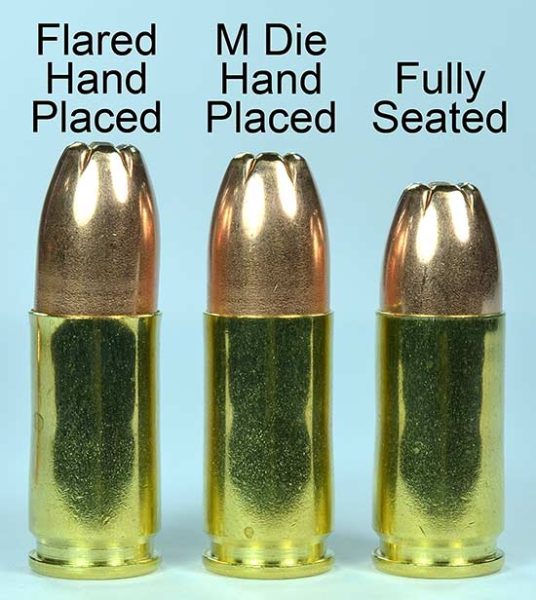
If the seater plug in your seating die does not match the nose contour of your bullet the bullet can tilt during seating.
And a Lyman type "M" expander allows the bullet to be started straight in the case with just using your fingers.
Below I only bump the case mouth onto the second step that makes the mouth .001 or .002 larger than bullet diameter. And then the taper crimp will close up the mouth slightly and streamline the case mouth for feeding.
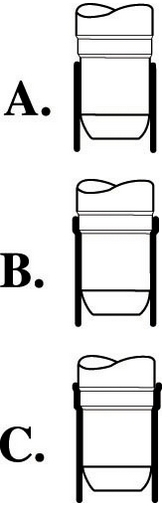
Another problem you may be having is seating and crimping at the same time, and this can cause the crimp to bulge. It is better to seat and crimp in separate operations to prevent this bulging. The vast majority of reloaders do not trim their cases to the same length and the longer cases are the ones that will bulge below the crimp.
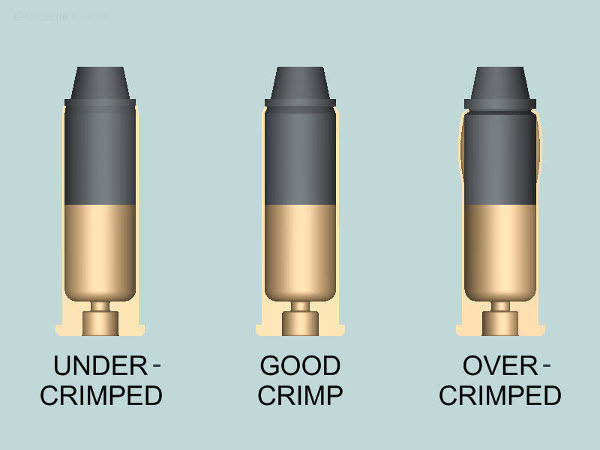
Below is a roll crimp for revolvers but the right hand image shows the case bulge.
Another problem could be the overall length of your cartridge causing it to hang up.
And a Lyman type "M" expander allows the bullet to be started straight in the case with just using your fingers.
Below I only bump the case mouth onto the second step that makes the mouth .001 or .002 larger than bullet diameter. And then the taper crimp will close up the mouth slightly and streamline the case mouth for feeding.
Another problem you may be having is seating and crimping at the same time, and this can cause the crimp to bulge. It is better to seat and crimp in separate operations to prevent this bulging. The vast majority of reloaders do not trim their cases to the same length and the longer cases are the ones that will bulge below the crimp.
Below is a roll crimp for revolvers but the right hand image shows the case bulge.
Another problem could be the overall length of your cartridge causing it to hang up.
Had the same problem with the same mould. Got a Lee factory crimp die that fixed the trouble. It has a sizing ring that resizes loaded rounds to minimum chamber dimensions.
There can be a problem using the Lee FCD with cast bullets, depending on the bullets diameter and the case wall thickness. The carbide ring in the base of the FCD can squeeze and size the case enough to reduce the cast bullet diameter. I have never had this problem with cast bullets sized .001 larger than jacketed bullets and the cases I use. But I have read many people complaining about the FCD sizing the bullet and hurting accuracy. This may be a bigger problem with cast bullets in revolvers and bullets sized to the cylinder throat diameter.
Bottom line, just check and make sure the Lee FCD is not reducing the case diameter excessively and reducing the cast bullet diameter.
The Lee FCD is nothing more than a cheat for reloaders who do not trim their cases to the same length. The longer cases if over crimped can bulge and cause chambering problems.
.45acp does not need trimming - ever. They already start short and do not get long with the low pressure of the .45 ACP. Trying to trim will just get you into trouble by creating excessive headspace. What make a improvement in accuracy and function is to use case of the same brand.
Use a taper crimp die.
Body diameter of the loaded round less .001 max .002 measured as close to the junction bullet - case- that all is needed be with lead or jacketed. Loaded and crimped that way, malfunction rate is close to zero.
The only thing to monitor thereafter is the OAL of the loaded round.
The .45 ACP is my favorite caliber and reloaded and competed with it with lead bullet for close to 40 years..mostly H&G 68, and still do today.
Use a taper crimp die.
Body diameter of the loaded round less .001 max .002 measured as close to the junction bullet - case- that all is needed be with lead or jacketed. Loaded and crimped that way, malfunction rate is close to zero.
The only thing to monitor thereafter is the OAL of the loaded round.
The .45 ACP is my favorite caliber and reloaded and competed with it with lead bullet for close to 40 years..mostly H&G 68, and still do today.
Last edited:

I had problems getting started with 45ACP and cast bullets, too.
One I got the dies set on the Dillon tool head properly, never had a problem since. about 30,000 rounds.
Adjust the flare die (mouth expander die) so that the bullet enters the case a bit. This means no bullet shavings.
Then adjust the seater die body so that it installs enough taper crimp to remove the flare and a tiny, tiny amount more.
As suggested, take the barrel out of your 45 and use it as a gauge to make sure the set up is correct. Do a plunk test on a handful of loaded rounds and make sure they drop into the chamber and seat on the case mouth, with no interference.
One I got the dies set on the Dillon tool head properly, never had a problem since. about 30,000 rounds.
Adjust the flare die (mouth expander die) so that the bullet enters the case a bit. This means no bullet shavings.
Then adjust the seater die body so that it installs enough taper crimp to remove the flare and a tiny, tiny amount more.
As suggested, take the barrel out of your 45 and use it as a gauge to make sure the set up is correct. Do a plunk test on a handful of loaded rounds and make sure they drop into the chamber and seat on the case mouth, with no interference.
I use the same bullet without any problem.
All of the above advice is really good, other than the need for a FCD. Never used one and don't need it.
I use a taper crimp die after I seat bullets, and this nicely closes out the flare that is needed for trouble free seating.
One problem with the TL style bullets is that it is possible that some are really oversized, as you are using them without sizing. This can happen while casting if you are not paying close attention to closing the mould completely (and gently ). A really oversized bullet will mean that the cartridge might not seat.
When you say they are not feeding, do they go in partially?
Also, overall length is important. That is one of the reasons to take your pistol barrel (out of your gun), and drop the cartridge in to see if it drops in fully. You might need a slight variation in your seating depth (that is, it is very slight so most seat OK, but an occasional other won't).
Pictures are valuable in helping us understand your problems.
All of the above advice is really good, other than the need for a FCD. Never used one and don't need it.
I use a taper crimp die after I seat bullets, and this nicely closes out the flare that is needed for trouble free seating.
One problem with the TL style bullets is that it is possible that some are really oversized, as you are using them without sizing. This can happen while casting if you are not paying close attention to closing the mould completely (and gently
). A really oversized bullet will mean that the cartridge might not seat. When you say they are not feeding, do they go in partially?
Also, overall length is important. That is one of the reasons to take your pistol barrel (out of your gun), and drop the cartridge in to see if it drops in fully. You might need a slight variation in your seating depth (that is, it is very slight so most seat OK, but an occasional other won't).
Pictures are valuable in helping us understand your problems.
Last edited:
I do size the bullets to .451. I bought a .450 sizer to see if that helps but haven't had a chance to try it. I do have the LEE factory crimp die. Not sure about spring in the R11. I bought it here, used, it came with a bunch of springs, mags and a full length guide rod as well as the stock guide rod.
If you haven't slugged the barrel, I would suggest .451 is a poor choice for a cast bullet. .451 might work for a jacketed bullet, but normally a cast should be at least .452. Not sure why you are sizing a Tumble Lube design, but your choice; I would not bother.
Again, check the diameter of your cast bullets, and also determine if the seated bullet makes the cartridge too large to properly chamber, or if the seating depth is too long preventing easy seating.
https://imgur.com/hbpRr25
This is what mine look like.
Again, check the diameter of your cast bullets, and also determine if the seated bullet makes the cartridge too large to properly chamber, or if the seating depth is too long preventing easy seating.
https://imgur.com/hbpRr25
This is what mine look like.

If the FCD resizes your case it does the same thing to the seated lead bullet...always. The reduced diameter of the bullet can cause leading due to gas cutting or less than optimum accuracy. Properly belled and then crimped properly ie leaving you with a straight case will solve the issue provided you have the OAL correctly. .45acp cases like all straight walled cases shrink overtime with reloading. I have never measured a used .45acp case yet that was .898" long. In fact I have never encountered a new factory case that was .898" long either. I have had cases that had been reloaded to the point where you could hardly read the head stamp. Some were so short I often thought they were head spacing off the extractor as opposed to the case mouth.
Take Care
Bob
Take Care
Bob

I use multiple bullet designs, all get sized to .452". Never trim cases, and always taper crimp. None of my 1911s give me any pain. I would try some factory ammo to see if the gun works with other ammunition and decide if the issue is the gun or the ammo... Get a chamber gauge to verify your reloads are good to your chamber.
If you haven't slugged the barrel, I would suggest .451 is a poor choice for a cast bullet. .451 might work for a jacketed bullet, but normally a cast should be at least .452. Not sure why you are sizing a Tumble Lube design, but your choice; I would not bother.
Again, check the diameter of your cast bullets, and also determine if the seated bullet makes the cartridge too large to properly chamber, or if the seating depth is too long preventing easy seating.
https://imgur.com/hbpRr25
This is what mine look like.
I never said they were tumble lube, they are regular round nose bullets with a lube groove.
I use multiple bullet designs, all get sized to .452". Never trim cases, and always taper crimp. None of my 1911s give me any pain. I would try some factory ammo to see if the gun works with other ammunition and decide if the issue is the gun or the ammo... Get a chamber gauge to verify your reloads are good to your chamber.
I prefer to take the barrel out of the pistol and use it as a gauge. There is a remarkable variation in chambers. Norinco, for example (and CZ) seem to have very short throats, so using the barrel for a plunk test is the most effective gauge, and costs nothing.
If you haven't slugged the barrel, I would suggest .451 is a poor choice for a cast bullet. .451 might work for a jacketed bullet, but normally a cast should be at least .452. Not sure why you are sizing a Tumble Lube design, but your choice; I would not bother.
Again, check the diameter of your cast bullets, and also determine if the seated bullet makes the cartridge too large to properly chamber, or if the seating depth is too long preventing easy seating.
https://imgur.com/hbpRr25
This is what mine look like.
Lyman relaoding books now all quote .451 for 45acp. I switched down from.452 several years ago. The barrels for .45acp were reduced in size back in the 50's or early 60's if I remember correctly. 45Colt bullets are sized .452 rather than the pre-WW11 .454.
Take Care
Bob

hatman1793
CGN Ultra frequent flyer
Take a look at the LEE 6 cavity mold # 90310. It's a excellent 200 grain bullet with a longer tapered nose, with a huge lube groove. If you are casting, you save 180 grains every mold fill, or almost two free bullets every 2nd pour.
Powder coating your castings means end to messy & slow lubing, & no lube needed to make your LEE .452 sizer true them up. Sure, you can size to .451, but most 45acp barrels are .451. Adding one thousandth of an inch over is what you want. I’m with Al-Sway, .452 is the way to go.....
Powder coating your castings means end to messy & slow lubing, & no lube needed to make your LEE .452 sizer true them up. Sure, you can size to .451, but most 45acp barrels are .451. Adding one thousandth of an inch over is what you want. I’m with Al-Sway, .452 is the way to go.....

What Ganderite said.
I don’t know if this will help but my wild bunch loads worked in my 1911’s and ever missed a beat. On the way to a shoot we picked up a1911 for my wife.
I just assumed my ammo would work for her. Poor thing....it was her first wild bunch match and her new gun choked on about every third round.
Anyhow, when we got home I found I had to turn the crimp die on the Dillon down a bit. That cured the problem.
I don’t know if this will help but my wild bunch loads worked in my 1911’s and ever missed a beat. On the way to a shoot we picked up a1911 for my wife.
I just assumed my ammo would work for her. Poor thing....it was her first wild bunch match and her new gun choked on about every third round.
Anyhow, when we got home I found I had to turn the crimp die on the Dillon down a bit. That cured the problem.





















