Lee Classic Loader (no press) --> $100 Match Grade Reloading Setup?

awesomealvin

CGN Regular
Rating - 100%
69   0   0
Location
BC
Tools ($100):
Lee Classic Loader ($35)
Hammer/Mallet ($10)
Reloading Scale ($35)
Powder Trickler ($20)
Patience/Elbow Grease (Kinda Free)

Ammunition (~$0.40/rd)
Brass: Once fired Federal/Winchester Bulk (Free)
Projectile: Hornady 55gr FMJBT ($0.14/rd)
Primer: CCI 400 Small Rifle ($0.05-0.07/rd)
Powder: H4895 ($0.18/rd)

Gun: T/C Compass in 223 (Bolt Action 1 in 9 twist)

I'm not trying to achieve accuracy nirvana, just "better than factory bulk" for under $0.50/rd. I shoot around 100 rounds/month (on a budget), so loading efficiency isn't much an issue. Also not sure about tumbling my brass. My once fired brass is very clean (never touched the floor), plus I'm only neck sizing so I'm not worried about the dies wearing out prematurely.

Anyone have experience on this? I'm just not ready for an all out $500 press/die setup. Any potential problems with this setup? Should there be something else I need to budget for? Thanks in advance.

PS *I have never reloaded before*

Lee%20Classic%20Loader.jpg
 
If you want accuracy, buy a Wilson chamber style bullet seater and an arbour press. I just bought a lee die set, and I could move the case around by 1/8 inch inside the lee bullet seater die, Not good.
 
My first loader was a Lee Loader in 303 British. Can't count how many rounds I loaded with it but it was lots. You don't require a trickler but go ahead if you want. (I just gently tap the dipper and still do it that way sometimes). If you're only shooting to 100 yards you could get away without the scale as well and just rely on the dipper but you're stuck with that load. Scales are good and make loading more fun as you can taylor your load. Instead of tumbling you can simply wash your brass, I've done it that way for years and brass is clean. Just rinse it very well. Eventually you'll end up with a good setup but for now, if you can't afford it, I've had pretty good results using the Lee Loader.
 
You'll need a primer pocket cleaner(a hex drive slot bit will do), a method to trim your brass(Lee has a cutter and calibre gauge not too expensive=less than $20), and a neck chamfering tool.
 
I've got Lee Loaders, Pacific Pakits, and Lyman 310 tools.

I highly recommend buying a Lee Hand Press for just a little more money.
 
I have used that loader. You are correct in thinking you can make good plinker ammo.

If you use a ball powder, like H335 or BLC2 or 748, your scoop will be remarkably consistent. No need to weigh.

Use the scales to make, say, 4 different loads, about 0.3 gr apart. Something like 23.5, 23.8, 24.1 & 24.5gr (with the actual weight depending on what powder you use.) Load 10 of each, and shoot them as 5 shot groups.

Shoot these and choose the load that looks to be best. Most rifles will show a favourite load.

If you want to use the 55 FMJ, note that the Hornady bullet (they are called "bullets" - not "projectiles" by experienced shooters) tend to group better than the other brands.

Once you have powder charge you like, take a 223 case and cut off the shoulder/neck. Clean up the cut mouth and solder on a handle made from a piece of coat hanger. You now have a powder scoop. Scoop a shot of powder, give it a shake and weigh it. If the powder charge is heavy, use a file to shorten the case a bit. Keep doing this until 10 shots in the pan is about 10 times your desired powder charge.

One of the things you will need is a loading block, to hold all your cases. After the loading block is full of charged cases, run your eye up and down the rows, making sure they all have powder and that the powder level looks about the same in all of them.

Having said all that, I suggest you do not buy the Lee loader. Buy a set of Lee dies and a Lee single station press. The dies will come with a scoop and shell holder.

This will allow you to full length size, when required and it much easier to use than the loader.
 
I have extensive reloading equipment worth many dollars and it is wonderful. I also have a 30-30, 45/70 and 30-06 Lee loaders. They are fun, inexpensive and produce accurate amo. For the 223 I doubt you’ll save much money however. Check specials on amo from places like Tenda,sometimes it’s not worth reloading that caliber. With that being said, to me hand loading is a great pass time, also I can produce very accurate amo. I say go for it. Thirty years later, I don’t regret getting into it at all.
 
I could move the case around by 1/8 inch inside the lee bullet seater die, Not good.
Ah I see. However wouldn't the two factors that determine accuracy be the case neck diameter and bullet seat depth? The fitment (radially) between the bullet seat die and the case I would imagine wouldn't affect accuracy? As long as the bullet gets pressed in the neck, I'm good...no?

you could get away without the scale as well and just rely on the dipper but you're stuck with that load. Scales are good and make loading more fun as you can taylor your load. Instead of tumbling you can simply wash your brass, I've done it that way for years and brass is clean.
Yes I'm considering getting the scale and tickler just so I can develop a load for my rifle. I know Lee sized the scoop on the safe side, however it still feels sketchy measuring powder with what looks to be a glorified spoon. As for cleaning I hear people get good results with a water/dish soap/vinegar wash. Not sure what the exact mix is, may I ask what is your brass wash recipe?

You'll need a primer pocket cleaner(a hex drive slot bit will do), a method to trim your brass(Lee has a cutter and calibre gauge not too expensive=less than $20), and a neck chamfering tool.
Yes, I'll add the primer pocket cleaner, chamfering tool, and case trimmer to my list. As for the Calibre Gauge, since I'm only neck sizing would my casing even fit in the gauge itself? I already have a pair of calipers for the overall length.

...take a 223 case and cut off the shoulder/neck. Clean up the cut mouth and solder on a handle made from a piece of coat hanger. You now have a powder scoop.
Nice trick! I'll rig up a precision scoop (and double check with scale of course) once I got a load developed.

For the 223 I doubt you’ll save much money however. Check specials on amo from places like Tenda,sometimes it’s not worth reloading that caliber.
Thanks for the tip! I'm not looking to save money per shot, more looking to save money on quality ammunition. Factory match grade 223 go for almost $1.50/rd. With a little elbow grease, I'm hoping my budget setup can create similar performance at ~$0.40/rd.

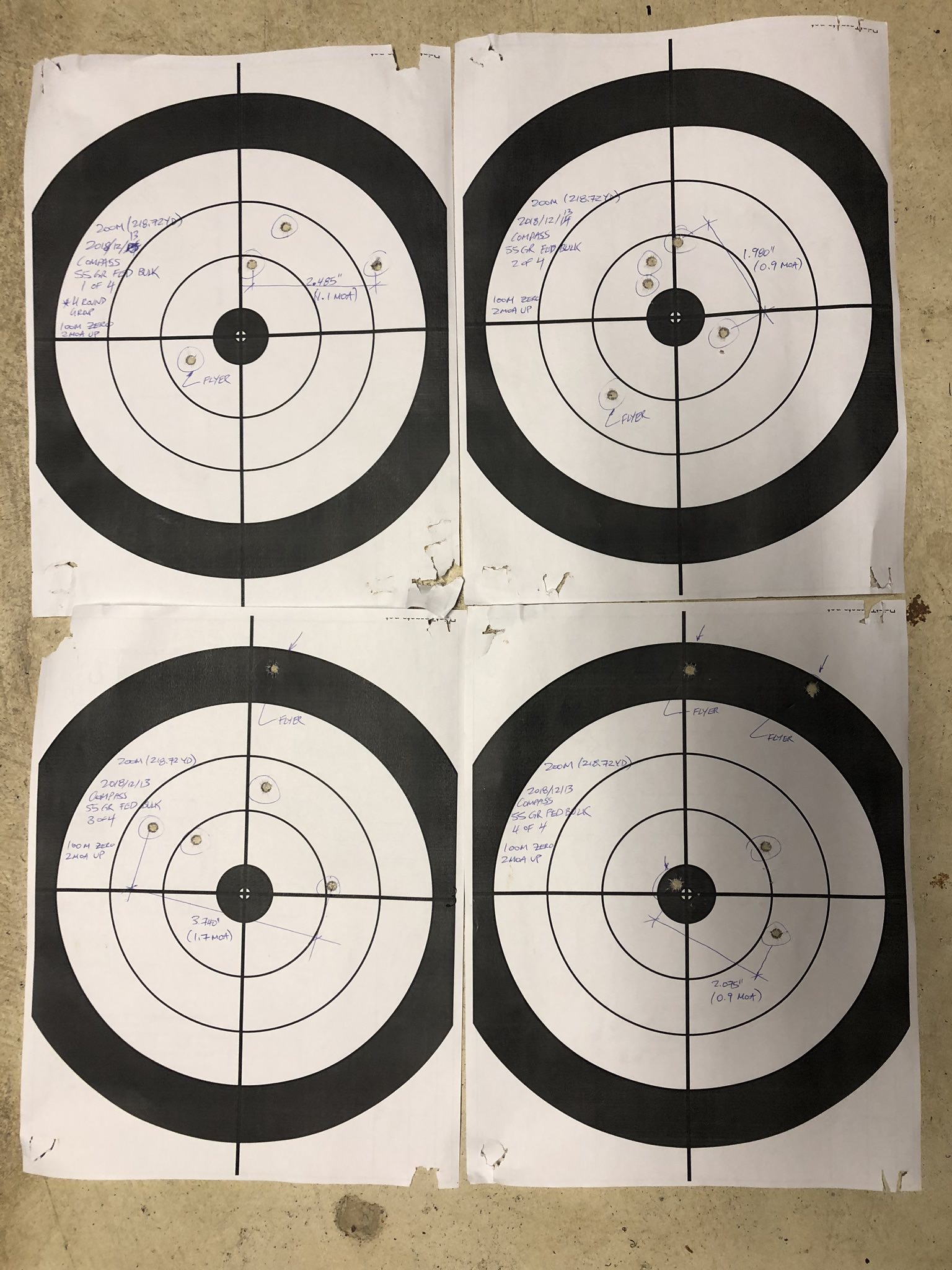
I've shot a center fire rifle a grand total of 100 rounds, so I'm still learning. Below are the targets I shot at 200M yesterday using Federal Bulk 55gr 223 (Cheapest ones from Cabela's ~$0.55/rd) with my $50 Simmons 3-9x40 scope. I took out what I think is a flyer/human error, best group being 0.9 MOA (Top Right) and worst being 1.7 MOA (Bottom Left). I was losing daylight for the last two groups (bottom) so there was considerably less barrel cooling and more shooter rushing. In the end of the day, I'm hoping to keep my skills sharp and bring the target out to 300M and even attempt 500M. However with these flyers (or shooter error?) I'm not even confident I'll get all 5 rounds on paper at 300M. I'll be happy if I can hand load ammo accurate enough to identify my poor shooting without asking myself "was that just a flyer from poor ammo?". And the potential for loading polymer tip bullets for coyote hunting is also intriguing for me.

And thankyou everyone for the responses!

WA43BMZ.jpg
 
Case neck size determines how tightly the bullet is held, or not? Some match shooters use a very light neck tension , others a bit more. To each his own. Consistency is very important.
The fact that the case flops around in the bullet seater die, means that the bullet will not be seated concentric with the case, the bullet when fired, will enter the barrel crooked. Every shot will be different. No consistency. You can buy an arbour press very cheap. Princess Auto, Ebay. I think I paid $30 for mine.
 
Just my 2 cents- don’t waste your money on the lee loader, In less than a year you’ll be looking to upgrade to a press and dies. There can be found some very reasonably priced used equipment on the EE.

Before I had a tumbler I washed all my brass. I would mix 2 cups of viniger into 4 litres of water and give it a squirt of dish soap, then let it soak for 1/2 an hour, agitating it by hand every 10 minutes or so.

Then I would rinse with water and place the brass into a bleach solution to neutralize the acid. About 4 tablespoons of bleach/ 4 litres of water, agitate by hand and then rinse again with water. There’s no need to let it soak in the bleach.

From there I would immediately put the brass into the oven at 200* Fahrenheit to dry it. The reason I did this is because my well water contains a lot of sodium and the brass would get spotty and tarnished if I didn’t dry it right away. If you have treated city water this step may not be necessary.
 
Last edited:
I have used that loader. You are correct in thinking you can make good plinker ammo.

If you use a ball powder, like H335 or BLC2 or 748, your scoop will be remarkably consistent. No need to weigh.

Use the scales to make, say, 4 different loads, about 0.3 gr apart. Something like 23.5, 23.8, 24.1 & 24.5gr (with the actual weight depending on what powder you use.) Load 10 of each, and shoot them as 5 shot groups.

Shoot these and choose the load that looks to be best. Most rifles will show a favourite load.

If you want to use the 55 FMJ, note that the Hornady bullet (they are called "bullets" - not "projectiles" by experienced shooters) tend to group better than the other brands.

Once you have powder charge you like, take a 223 case and cut off the shoulder/neck. Clean up the cut mouth and solder on a handle made from a piece of coat hanger. You now have a powder scoop. Scoop a shot of powder, give it a shake and weigh it. If the powder charge is heavy, use a file to shorten the case a bit. Keep doing this until 10 shots in the pan is about 10 times your desired powder charge.

One of the things you will need is a loading block, to hold all your cases. After the loading block is full of charged cases, run your eye up and down the rows, making sure they all have powder and that the powder level looks about the same in all of them.

Having said all that, I suggest you do not buy the Lee loader. Buy a set of Lee dies and a Lee single station press. The dies will come with a scoop and shell holder.

This will allow you to full length size, when required and it much easier to use than the loader.

^^^ Totally agree with Ganderite. I too went the Lee Loader route when I started and even though it gave me a good hands on experience with reloading it also completely buggered me over when I started shooting 22-250. The shoulders weren't getting bumped back and it took weeks to figure it out.....Lee Loader ONLY NECK SIZES! Many chambers were a touch over sized and you have to full length size every now and then, and more often with sloppy chambers. Do what I did but skip the Lee Loader. Go to gun shows and check kijiji for a good old cast IRON press and then you only need to get the dies for each caliber you shoot. I ended up buying 3 single stage presses in a year and never paid more than $30 for one, 2 RCBS and 1 REDDING, then I stumbled onto a kijiji ad for a complete Lyman turret press kit with 9mm and .357 dies, with powder thrower and a extra bnib rcbs powder thrower all for $120!!! (turns out the seller was a cop and I would next see his face all over the news a year later for some very baaad stuff so be cautious when dealing on kijiji....especially with firearms related stuff). Enjoy your reloading, I sometimes prefer it to shooting!
 
I started out with the “hand press kit” came with a hand press and set of dies and I bought the powder scoop kit from Lee so I had more choices available than the one in the die set. At that time I was well under $100 and I used that set up for most of a year before adding anything at all.

Those scoops are surprisingly accurate if used as instructed and I mostly used starting loads or quite mild loads. I was blown away by how accurate many of the starting loads were.
 
You mention match grade accuracy as one reason to reload. Bear in mind that at this stage in your shooting journey, having fired a hundred rounds, the ammo is very likely not going to be an accuracy-limiting factor. Also, finding a load your rifle likes best can be done with whichever reloading equipment you end up choosing. It is mostly a matter of finding a bullet that likes your twist rate and finding a power factor that is a sweet match for the barrel harmonics. A basic Lee loader kit can do all that, so don't be scared to start with one. My father has fired a moderate load in his .222 for 50 years, and all he has is a lee loader and a hardwood mallet. No trimming or cleaning tools. No scale even...my uncle made him a custom powder dipper out of a rifle case back in the 60s when he bought the rifle.

That is not an ideal situation, and if you want to run higher pressures you will have to trim cases and weigh charges. I only mention my dad to show that the Lee Loader can and does work to reload very very cheaply, and also safely, provided you don't push boundaries.
 
The Lee cutter and calibre gauge are two parts required to trim cases, the second part sets the proper length, ie when it stops cutting. Use by hand, slow drill press or variable hand drill.
 
I've noticed a couple of these threads lately. Count me in the crowd of people that started with a Lee Loader; there isn't much else to be said about it that hasn't already been mentioned.

I felt it should be mentioned that if your bullets don't say "match" on the box, you may not be happy with their performance. If you're looking to recreate/approach the accuracy of factory match loads, you need to be looking at BTHP bullets, not FMJ. I went through the same process when I started loading and I don't even look at "bulk" projectiles anymore (FMJ, SP etc.). That's not to say I wouldn't buy bulk BTHP Match bullets, just that I'm not interested in your typical Campro, Hornady etc. FMJ offerings.
 
Back
Top Bottom