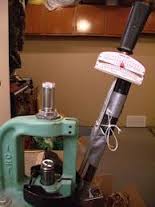
Lee collet cam over why not??

Lead hammer

CGN Ultra frequent flyer
Rating - 100%
3   0   0
Location
Saskatoon
I have just started using my Lee die. I have reduced my runout, but have not shot any yet. I have followed the Lee instructions for my RCBS, and instructions from who I got them from. So just looking at the die closer, instead of guessing 25lbs,( I hate guessing ) I would like to try calming it over, or I am going to make an adapter for my press and torque wrench, or make an adjustable hard stop for the press before cam over.
Ideas???
 
You can use press cam over and not guess at 25 lbs "BUT" with variations in neck thickness you can leave more pronounced vertical marks on the case neck from excessive force.

Google polishing the Lee collet die and do not pull on the press handle like a 800 pound gorilla.

The Lee collet die instructions tell you use approximately 25 lbs of force and rotate the case 1/8 turn and size again. This helps with inside neck diameter uniformity and reduces the vertical marks on the case neck.

That being said I still didn't like guessing at 25 lbs and the marks on the case neck from the Lee collet die and prefer using Forster full length benchrest dies.

NOTE, I ruptured a disk in my neck and ended up with nerve damage to my right arm. This meant I had to really guess at the 25 lbs and this drove me nuts. Meaning anyone with a better calibrated arm will have better results.

Even after watching your Canadian TV program Red Green my Idea didn't work.

1vfVT3Q.jpg
 
Last edited:
If the die is kissing the shell plate after it cams over, you're good. If it cams over and you can still see daylight between the shell plate and bottom of the die, lower the ram and give the die another 1/4 turn. Repeat until there is no more daylight between the die and shell plate. If you are grunting after raising the ram, you are doing it wrong.
 
Well I body sized and prepped a brass, set the press to cam over, adjusted in small amounts at a time. Looks to be perfect, hardly any marks on the neck if any. I will have to see if it’s repeatable this way or not.
 
Ok, so I find this cam over method super easy I hope they shoot great.
I have a question though, how much brass springback is normal? I realize the brand of brass and the work hardening will play a roll, but this is what I’m getting.
Mandrel OD of 0.2605
Sized case neck ID of 0.2615
ELDX. OD of 0.263
 
Screw it in another turn so it won't cam over. You can feel the die squeeze the neck onto the mandrel. Easy to feel how much effort it takes.

You are over thinking it.

I agree with this, I think you might be over thinking it.
I went through the same thing as you and I tried setting up my lee collets to cam over, but what I found after a while was I could feel inconsistent seating pressure while seating bullets (I do anneal). I think bigedp51 is right, that its probably from differences in neck thinkness etc. So now I just do it with no cam over and I have better results with bullet seating pressure. I think Lees recommendation of 25lbs is probably because it takes close to that to fully squeeze the brass all the way onto the mandrel. As long as you're getting that minmum force, I don't think that it matters if some of them have a little extra force on them. The brass is already squeezed all the way down around the mandrel and has no where else to go, unless you go crazy on it, then I'm sure you could really start extrudung some of that brass up between the collets and make bigger ridges. It doesnt take long to get the feel for making sure you're getting enough squeeze.
 
Last edited:
You are probably right mod7rem, and Ganderite. I will try a few accuracy tests with and without cam over and see whats up. So far by by using cam over, I can virtually eliminate all ridges, and all case mouths measure the same ID. Also the Rockchucker takes very little effort this way. I'm sure I would get the feel for using the LEE method after a bit and it will be interesting to compare. I guess my thinking is no cam over = guessing 25-28-9 something pounds by feel, ( and maybe the location of the press handle???) and with cam over, setting it with the thinnest neck producing enough tension, and the thickest neck not causing much brass distortion or die issues. My Hornady brass has a neck thickness of 0.0125-0.014" of the ones that I sized. I'm thinking that marks on the case neck are just excess pressure thats not needed, and just means either you/me used your/our gorilla muscles a bit too much, or in the cam over, you have the die in just a tad too much or you need to have a bit of extra squish to ensure the thinner necks get sized properly. I wish the weather was warmer here as its way too cold for me to go shoot.

 
Back
Top Bottom