Lee Collet die problems

Kinjo

CGN Regular
Rating - 100%
8   0   0
Location
southern Ontario
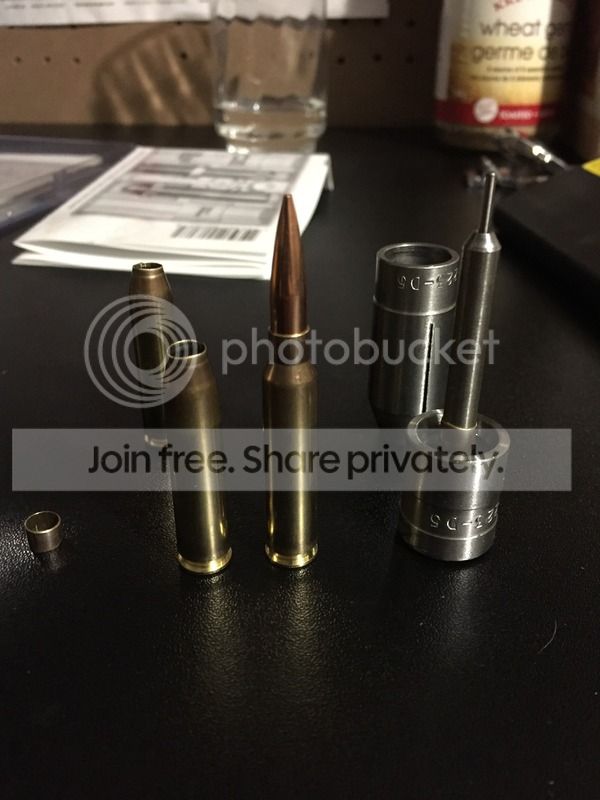
I've been using my 308 collet die for some time with no problems. Then I got a case stuck in the die and could take the die apart to get the brass out. So I bought a new one and it worked fine for about a year. Then one day as I'm sizing my necks I noticed as I lowered the ram I could feel a little tension ( it wasn't a smooth push into the die ). The case stuck but I was able to pull it out of the collet but not without the neck getting ripped off the case. Then I got another stuck in the die a few days later, however this time I was able to get the die apart and get the piece of the neck off the mandrel, but it wasn't easy to remove.
So I took the die apart cleaned it out and ensured there were no burrs inside the die. Lubed and put back together. Worked fine for a while. Then I notice some of the shoulders were bowed out from the collet resizing not just the neck but also resized about 10 thou of the shoulder. And some cases the neck was shoved down into the shoulder and shoulder flatted out leaving the top of my cases looking like a top hate.
No one of talk to seams to understand why I'm having this problem. But I most certainly can't be the only one. I'm thinking the problem stems from the case getting hung on the mandrel.

Anyone have any ideas or experience the same problem, please help.

Cheers
 
Best tool to bump shoulder is a Redding body die.

FL die can also work IF the final dimension is close to the chamber dimension... otherwise, the case can split on the next firing.

I always run my competition brass through a body die to bump shoulder before going into the Lee collet die. Have made tens of thousands of rds without any issue.

Jerry
 
Me too Jerry. I am FL resizing without a neck bushing, and then neck sizing the brass with a neck sizing die. Usually after 3 or 4 firings. Then trimming if required.
 
I thought I could just neck size forever if I use brass in bolt action. Is this thinking incorrect?

Depends on the pressures you run.. Anything under 45,000psi is unlikely to need to be sized in the case body... the brass simply will not expand that much.

BUT most loading is much higher. Eventually, the spring back will be less then the actual size and stiff chambering will begin.

Competition shooters just get ahead of the issue but having a die that will bump any case that is a schnick to long. Many times, you put the case in and feel nothing at the top of the stroke.

But a case a few thou too long is going to cause chambering issues and that can lead to misses.

Jerry
 
Me too Jerry. I am FL resizing without a neck bushing, and then neck sizing the brass with a neck sizing die. Usually after 3 or 4 firings. Then trimming if required.

If you feel the FL bushing die is sizing the case body properly, I would just insert an appropriate neck bushing and do it all in 1 step.

Many times, FL sizers overwork cases.. why I suggested the body die.

Jerry
 
Thanks for the explanation, Jerry.

Even when I neck size only, I typically use the case length gauge to ensure that the brass is sized right. Hopefully this will help weed out issues when I chamber a round. It looks like I'm already at 52,000 PSI based on what hodgdon has informed me.

I don't want to further derail this thread.


Depends on the pressures you run.. Anything under 45,000psi is unlikely to need to be sized in the case body... the brass simply will not expand that much.

BUT most loading is much higher. Eventually, the spring back will be less then the actual size and stiff chambering will begin.

Competition shooters just get ahead of the issue but having a die that will bump any case that is a schnick to long. Many times, you put the case in and feel nothing at the top of the stroke.

But a case a few thou too long is going to cause chambering issues and that can lead to misses.

Jerry
 
Learned something cool in this thread - thanks Jerry. I just picked up a few Lee collet dies in .308 and .300 Win Mag and was wondering about shoulder bumping. Running through a body die makes great sense!
 
image_zps8gw8hoax.jpeg


I was having this same problem, so i have the Lee collet, and a Hornady set that I used previous, so I should run all my brass through my Hornady FL die and bump the shoulder back then use the collet die? Won't the Hornady die already size the neck for me?
 
image_zps8gw8hoax.jpeg


I was having this same problem, so i have the Lee collet, and a Hornady set that I used previous, so I should run all my brass through my Hornady FL die and bump the shoulder back then use the collet die? Won't the Hornady die already size the neck for me?

Yup....thats what it looks like.
If you don't mind me asking. What did you do to the brass before using the collet?
 
I didn't do anything, that was brand new lapua brass.

I just followed the directions I found on YouTube and that happened 3 times out of 100. Now the only thing I didn't do is put a little bit of lube on the collet like the video suggested. I havnt used the dies since having this issue.
 
I didn't do anything, that was brand new lapua brass.

I just followed the directions I found on YouTube and that happened 3 times out of 100. Now the only thing I didn't do is put a little bit of lube on the collet like the video suggested. I havnt used the dies since having this issue.

I'm hoping you just found the problem. When my buddy introduced me to the collet die he never said anything about lub. So I never thought to use it myself.
 
Quick question to the OP - how much force are you applying to the press handle? The sizing action of the collet die is generated by down force on the press handle (the instructions say to apply approx 20 lbs). It's important not to allow the press to cam over - unlike a conventional sizing die.

Can you confirm no cam over?
 
I had the same issue and I can confirm that I was not going over cam and I was not using more then 20lbs of force.

Kinjo search on YouTube and watch the video that shows how to properly set up the die, the guy talks about having stuck brass and says he uses a dab of white lithium grease inside the die to prevent sticking.
 
Back
Top Bottom