












































You are using an out of date browser. It may not display this or other websites correctly.
You should upgrade or use an alternative browser.
You should upgrade or use an alternative browser.
Lee Collet Neck Dies
- Thread starter Longboat
- Start date

What exactly does the Redding body die do that a full-length sizing die doesn't?
It doesn't size the neck where a FL die does.


I am not a "precision" shooter nor a precision reloader, but I do have some Lee collet dies. As far as my experience goes, they work just fine. I shoot several different 30-30, 32WS, .303 Br, 8x57, .308 rifles, so lately I have been FL sizing everything. I will have to go back to neck sizing to perhaps extend the life of the brass. I have never annealed brass in my years of reloading. I do cast for all the calibers that I shoot often, thus saving a fair bit of money. When you have 100+ rifles to choose from, it gets really old trying to keep meticulous records of every load used in each rifle.
I do admire precision shooting, don't get me wrong. I don't have the necessary skill to pursue that avenue. I do have a neat old time target outfit, however, and I just might keep that rifle and try to do some better shooting. I posted about the rifle in the Precision forum. It is a "22-3000" or 22-250, put together in 1947 (same year as me ), with an old time Unertl 12x. In the hands of my buddy Dave, the rifle will show its stuff. I managed a 1" group with AE factory ammo at 100 yds. Well constructed reloads would likely do better.
I do admire precision shooting, don't get me wrong. I don't have the necessary skill to pursue that avenue. I do have a neat old time target outfit, however, and I just might keep that rifle and try to do some better shooting. I posted about the rifle in the Precision forum. It is a "22-3000" or 22-250, put together in 1947 (same year as me
), with an old time Unertl 12x. In the hands of my buddy Dave, the rifle will show its stuff. I managed a 1" group with AE factory ammo at 100 yds. Well constructed reloads would likely do better.
I don't know why, but just had this feeling you'd come by and chime in on this
There is something you got to give us body+neck collet size guys vs premium FLS die do it all,
We accomplish almost the same thing (if not even the very same thing) for much less $$$.
Considering some guys are reloading 4-5 rifle calibers, buying 5x NM forster FLS dies could run close to 1000$, vs 250-300$ the other way around.
I tested nine different type .223 dies for neck runout after sizing and if its saving money vs neck runout the Lee full length dies do very well.
The biggest cause of neck runout happens if the expander is locked down off center. And the Lee locking collet when tightened centers the expander vs other make dies.

But I prefer the Forster dies because they produce a better concentricity but as you stated at a higher cost.
NOTE, below the video shows case neck runout using the expander "BUT" the expander forces neck thickness variations to the outside of the neck. Meaning when you check your case necks this way you subtract the neck thickness variations from the amount of neck runout to get the actual runout measurment. This tells you if the expander is pulling the case necks off center and needs to be centered.

Will using the neck sizing die automatically give me tighter groups?
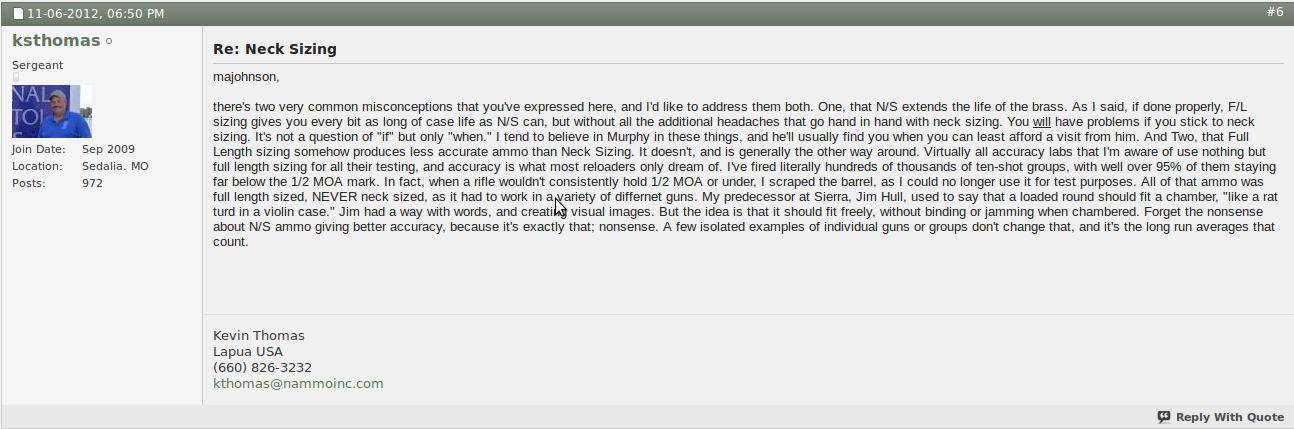
Below Kevin Thomas of Lapua USA who also worked in the Sierra ballistic test lab.
Below Erik Cortina of Team Lapua USA.
NOTE, the reason so many shooters use the Lee collet die along with a body die is because this method produces less runout than using a bushing die.
"BUT" a honed Forster full length die will do the same thing and the case only needs to be sized once.
Last edited:
I do believe that the forster FLS die is better than my Redding body/Collet neck combo,
But with my setup I do have 10 round group targets at 300M, showing less than 1/4 moa vertical for 10 shots.
So yes your setup would be better and I truly believe it as I have read plenty on it,
But the body-neck setup saves a substancial amount of money when multiple calibers are involved, and is very close second in my opinion, as I have some targets that speak for themselves.
So really you can't go wrong with both,
And if money is not an issue, your way of doing saves a step in the reload process.
But with my setup I do have 10 round group targets at 300M, showing less than 1/4 moa vertical for 10 shots.
So yes your setup would be better and I truly believe it as I have read plenty on it,
But the body-neck setup saves a substancial amount of money when multiple calibers are involved, and is very close second in my opinion, as I have some targets that speak for themselves.
So really you can't go wrong with both,
And if money is not an issue, your way of doing saves a step in the reload process.
I do believe that the forster FLS die is better than my Redding body/Collet neck combo,
But with my setup I do have 10 round group targets at 300M, showing less than 1/4 moa vertical for 10 shots.
So yes your setup would be better and I truly believe it as I have read plenty on it,
But the body-neck setup saves a substancial amount of money when multiple calibers are involved, and is very close second in my opinion, as I have some targets that speak for themselves.
So really you can't go wrong with both,
And if money is not an issue, your way of doing saves a step in the reload process.
I’ve got the Forster FL die and a Lee collet/Redding body die for my 6.5cm. I’m planning on doing a head-to-head comparison of the two methods to see which provides the best accuracy out of my rifle. Once the weather improves and I can get out to the range I’ll post up my results here.
I’ve been using a Forster FL and Benchrest seater die to load for a Savage model 11 in 243 with excellent results. This rifle was only capable of 2 moa with a variety of factory ammo I tried prior to reloading for it. With the Forster equipment I’ve got it consistently shooting into .75moa, which is fantastic accuracy for a lightweight $400.00 hunting rifle. And those are real life groups, not Internet forum groups.

Interesting about the honed out die. So then it does not have a bushing? The way I understand it is that a bushing die should use outside neck turned brass. Where as a Lee collet does not need to be. The 6.5 guys never mentioned it in the video, if you had to turn necks or not. They did mention 4 thousands clearance I believe?
sharp shooter
CGN frequent flyer
- Location
- Essex county (Ontario)
As of yet, I see no need to neck turn with the Lee Collet. It makes wall thickness very uniform. But hey I'm the new guy so...
Runout is caused by many steps in reloading. Uneven neck wall thickness is one of the biggest causes in my experience. even if you escape it while sizing, it can still come back during seating if your neck is uneven.
You should be neck turning if using a collet die and a collet die doesn't make your neck wall thickness uniform, neck turning does. It sounds like you are pretty new to this so here is my advice if you want really accurate ammo.
Buy Lapua brass.
Buy a salt annealing kit to make that expensive brass last a long time.
Buy Forster FL sizer and seater.
Buy a Forster trimmer to start, you can get a turner head down the road for it.
Use a Forster FL sizer and seater until you get more experience. Shooting inside 300 yards its all you need trust me.
If you by Lapuas brass you shouldn't need to neck turn unless you are shooting great distances (1000 yards)
When I bought a collet die, I also bought a neck turner because they go hand in hand. I bought them because I couldn't buy Lapua brass in .204 Ruger and needed to turn my brass as runout was bad.
gerry303ca
Member
- Location
- Fredericton, NB
I bought my first one because my .303 Brit. were splitting after 2 or 3 uses. I now get up to 20 or more. Needless to say, I now use the collet neck sizing die for most of by bolt guns.
I’ve got the Forster FL die and a Lee collet/Redding body die for my 6.5cm. I’m planning on doing a head-to-head comparison of the two methods to see which provides the best accuracy out of my rifle. Once the weather improves and I can get out to the range I’ll post up my results here.
I’ve been using a Forster FL and Benchrest seater die to load for a Savage model 11 in 243 with excellent results. This rifle was only capable of 2 moa with a variety of factory ammo I tried prior to reloading for it. With the Forster equipment I’ve got it consistently shooting into .75moa, which is fantastic accuracy for a lightweight $400.00 hunting rifle. And those are real life groups, not Internet forum groups.
Please share results once you do.
Fyi, my body+collet die, are use in conjunction with a forster seating die.
I also turn my necks.
Not trying to argue your years of experience so don't take me the wrong way. Appreciate everyone's input!
I do use neck sized Lapua brass and check seated bullet runout which is approximately. 001 give or take a few 10,000 thousands. Never approaches .002. Very happy with that at my stage in the game.
I've measured wall thickness on new unfired Lapua and Hornady brass and it does vary a tiny bit. But after firing and neck sizing only the wall thickness becomes very uniform. Always always within 1 MOA. Sub 3" groups at 300. Nailing V bulls at 600 with a Bergara 308. And my Bergara 6.5 Creedmoor is even better.
I was under the impression that Lee does not make neck turning gear because the collet die takes care of that job. Which is what I see so far at least in my case.
For annealing I picked up an AMP induction annealer.
I will definitely try the methods you guys suggest. I'm having a ton of fun and love to experiment. If I can get even better than I have I'm all for it. And it's very intersting.
I do use neck sized Lapua brass and check seated bullet runout which is approximately. 001 give or take a few 10,000 thousands. Never approaches .002. Very happy with that at my stage in the game.
I've measured wall thickness on new unfired Lapua and Hornady brass and it does vary a tiny bit. But after firing and neck sizing only the wall thickness becomes very uniform. Always always within 1 MOA. Sub 3" groups at 300. Nailing V bulls at 600 with a Bergara 308. And my Bergara 6.5 Creedmoor is even better.
I was under the impression that Lee does not make neck turning gear because the collet die takes care of that job. Which is what I see so far at least in my case.
For annealing I picked up an AMP induction annealer.
I will definitely try the methods you guys suggest. I'm having a ton of fun and love to experiment. If I can get even better than I have I'm all for it. And it's very intersting.
Just full length sizing I get 12 shots from the brass. No annealing.
Using the method of full length sizing shoot, neck size for the next 4 shots, anneal and some of my brass are up to 20 shots fired. So neck sizing extends the life of the brass.
Using the method of full length sizing shoot, neck size for the next 4 shots, anneal and some of my brass are up to 20 shots fired. So neck sizing extends the life of the brass.

I see no sense in lubing a case and size it in a body die and then use the Lee collet die to size the case neck.
I say this because I have several Lee collet dies and prefer using the Forster full length benchrest dies with the high mounted floating expander.
When just neck sizing the Lee collet die will make more concentric cases than a normal neck sizing die or bushing die.
That being said the Lee collet dies are meant for die hard neck sizers too lazy to lube their cases.
Bottom line the Lee collet die has the ability to produce cases with less neck runout than bushing dies and why they are so popular.
But I prefer full length resizing and Forster dies for making very concentric cases.
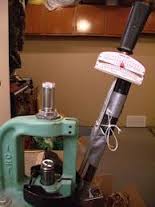
Below I tried using the Lee collet dies and a torque wrench for uniform pressure on the case neck. But the duct tape would always rip and the string would break so I switched to Forster dies.
The best part about reloading is the person pulling the press handle decides how to do it. So pick the dies you like to use the best and do not worry about what other people think.



What are you trying to measure with that "torque wrench". Haha.
What are you trying to measure with that "torque wrench". Haha.
20 lb-Ft on the collet die as recommended by Lee. That’s my best guess anyways.
It doesn’t need to be an exact science the torque value.
Because between 20lbs and 40lbs of torque, you’ll have exact same neck tension as brass has nowhere to go.
More than that you’ll break the die if over torquing.
Once you realise how 30lbs feel, it’s not hard to just go by feel and end up anywhere between 30-40, it will give all the same neck tension anyways.
Because between 20lbs and 40lbs of torque, you’ll have exact same neck tension as brass has nowhere to go.
More than that you’ll break the die if over torquing.
Once you realise how 30lbs feel, it’s not hard to just go by feel and end up anywhere between 30-40, it will give all the same neck tension anyways.





















