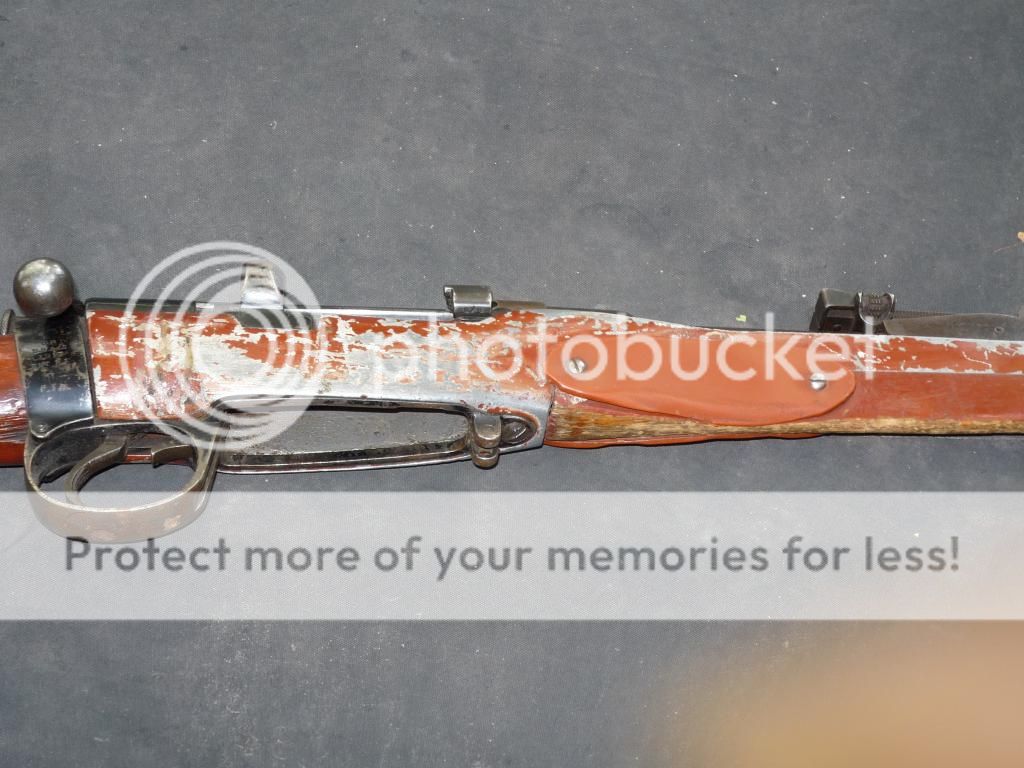
Lee Enfield Aluminum stock update New photos for smellie post #8

^ Linky no workee.


Yes I realize that, could you help? I am trying to post a video of smellies rifle....



this is the link.


Thank you...
gottcha_zpse139fba3.gif
[/URL][/IMG]
 
Last edited:
Yes I realize that, could you help? I am trying to post a video of smellies rifle....

this is the link.

Ok, now it works if you click on the picture- it opens the video in another window. You know, someone put a lot of effort into that stock.
 
I have been looking at the threads on a few other sights about this rifle and I find it amazing how so many people who's opinions I greatly value are so quick to dismiss this or other rifles as bubba because they haven't encountered one before but when you look at some of the trials rifles that they hold the rifles are as poor of an idea as possibly this one.

I find it strange that no one on the other sights seem to realize that there are two identical rifles, both rebarreled the same year when smle were not being worked on, both have the same modified Ross buttstock which is noted in the Reynolds book, both had the same finish and ugly military paint, but they seem to believe that it is just a home brew that a kid made up,

Even if the rifles in question are not trials but a sporter built by a certain manufacture it would be interesting trying to get to the bottom of story instead of upping ones Internet egos.
 
I have been looking at the threads on a few other sights about this rifle and I find it amazing how so many people who's opinions I greatly value are so quick to dismiss this or other rifles as bubba because they haven't encountered one before but when you look at some of the trials rifles that they hold the rifles are as poor of an idea as possibly this one.

I find it strange that no one on the other sights seem to realize that there are two identical rifles, both rebarreled the same year when smle were not being worked on, both have the same modified Ross buttstock which is noted in the Reynolds book, both had the same finish and ugly military paint, but they seem to believe that it is just a home brew that a kid made up,

Even if the rifles in question are not trials but a sporter built by a certain manufacture it would be interesting trying to get to the bottom of story instead of upping ones Internet egos.

Could not agree more! There is some merit to this for sure, wether that be military or civilian conversion it's still there. Doesn't make sense that a company who was converting these for profit would take the time to make a stock mold and spend they much money in it when the whole idea begind a Sporterized milsurp was that it was to be cheap. That doesn't make sense. The idea of a military trial to get rid of swelling and shrinkage in tropical climate does.
 
Could not agree more! There is some merit to this for sure, wether that be military or civilian conversion it's still there. Doesn't make sense that a company who was converting these for profit would take the time to make a stock mold and spend they much money in it when the whole idea begind a Sporterized milsurp was that it was to be cheap. That doesn't make sense. The idea of a military trial to get rid of swelling and shrinkage in tropical climate does.

We have a winner!! Give that ^^^^ man a cigar!!
 
Furthermore, if I'm hunting with that thing in late October, early November, here in northern Alberta and things are tight at home I'm not forking out any extra money for a stock that will freeze my hands, even if it was just the finger tips! I really don't think this is a commercial thing or a home experiment. Making cast parts at home is a tough proposition even now.
 
While I'm keeping an open mind on this, I can't see any reference in Reynolds so a citation would help.
 
I was going through a few books, I'll check again, I don't believe the aluminum was in the Reynolds book but the modified Ross buttstock, I'm out of town for a few days and will try and find the reference about modified Ross butts.
 
After reading some of the comments, I took mine apart, just to see what I could see. I really do think that folks are jumping to conclusions too quickly.

For one thing, the aluminum fore-end root is a very nicely-done casting. It was cast vertically, with the long, thin section DOWN and with a Sprue of decent length, sufficient to give a solid casting at the vital REAR part of the fore-end where it fits the rifle so closely. Whoever did it had a GOOD casting-shop and they really knew what they were doing. There had to have been a wood pattern for this casting: aluminum has close to 2% shrinkage in castings and this thing bolts up almost solid..... and it shows NO evidence of hand-fitting. As well, the Reinforce for the Middle Band is in its correct place and this stock has THREE additional Reinforces in it. This thing was not just jumped together; it was designed. The Triggerguard fits rather loosely; this is proof that an oversize wooden pattern was made before the casting was done. Once in place and bolted-up, though, it fits tight.

I think this is a subject which deserves serious investigation. In my opinion, too many people are jumping to conclusions too quickly. NONE of us have seen absolutely EVERYTHING. Give you an example: the SMLE rifle went into production more than a year AFTER the demise of dear Queen Victoria, so there is no chance of possessing an SMLE with her Royal Cipher. As well, Edward VIII was never crowned, the Government was destroying rather than building rifles during his short reign and Enfield already was being shifted-over to Number 4 production although the process was far from complete. So there is no chance of having an SMLE with an Edward VIII cypher. I have both here, sitting side-by-side on a rack. Sure, they don't exist, but don't tell THEM that; you might hurt their feelings. The Victoria rifle is an SMLE (Converted) Mark IV and the Edward is one of the tiny number made at Ishapore in 1936, during his short reign. They might both be surviving anomalies, but they DO exist and they are here for anyone dropping by to examine, should they so wish. Exactly the same holds for this poor, ugly old NRF. I just have to find it a Mark III Ross buttplate and screws so it doesn't look positively naked when it has guests.

If one rifle had appeared here and the other in Hargrave (7 miles, about the distance from Dover to Folkestone), I would shake my head and ask, "Allright, what was Johnnie Miller doing in 1946?". Johnnie Miller was a local character, a gifted machinist, who operated an entire machine-shop on equipment which was antiques when I knew him, 50 years go; he could have made this without help, although anyone else would need a shop and crew. But the rifles didn't turn up 7 miles apart. They appeared in Brandon, Manitoba and in Toronto, well over a THOUSAND miles apart: think London to Reykjavik.

They are BOTH Birmingham rifles, both post-Second-War FTRs, they both have 1945 barrels, they both have Enfield Inspectors' markings, they both are numbers-matching and they are as identical as pennies in a roll, right down to recycled Ross butts and their Suncorite finish. That adds up to LOT of coincidences: too many to ignore, by my lights.

They are worth some serious investigation.
 
.
One good thing about the Internet is that it allows us a lot more information (good or bad) about a lot of aspects of our Hobby. Because of this world-wide access to these things, we have different things and "oddities" coming to light almost every day.

In many cases, this is an object or firearm that "does not exist' or "never was made", but I am getting very cautious about making statements like that, because when you do, three days later someone will post a picture of the "non-existing object." Many things were done on an experimental or small run nature to try to improve something, or use alternate materials. An example of this is the Swedish Mausers. When WWI broke out, the supply of European Walnut diminished, so the Swedes turned to American Walnut, Elm, Maple, and even Mahogany, but settled on Beech after a year of experimentation. The Germans developed laminated stocks in late WWII. Some plastics were tried for rifle stocks.

As was pointed out here, it takes money, time and a good shop of equipment to make up a pattern, mould and casting to produce that forestock. It would be quite expensive for a private individual to do so, but what is several thousands of dollars to a Government, especially if it is at War?

SMELLIE mentioned rifles that do not exist. The 1936 SMLE with the Edward cypher on it for one does exist. I know, because he got that one from me.

Ever heard of a SMLE with a CHOKE BORED barrel? SMELLIE has one, and the only other one I have seen was in the Pattern Room.

I have read somewhere about Aluminium forestocks being tried, and rejected because of the cold weather problems. I will have to check my copy of Reynolds to see if that was where I saw it.

.
 
Last edited:

I have been looking at the threads on a few other sights about this rifle and I find it amazing how so many people who's opinions I greatly value are so quick to dismiss this or other rifles as bubba because they haven't encountered one before but when you look at some of the trials rifles that they hold the rifles are as poor of an idea as possibly this one.

I find it strange that no one on the other sights seem to realize that there are two identical rifles, both rebarreled the same year when smle were not being worked on, both have the same modified Ross buttstock which is noted in the Reynolds book, both had the same finish and ugly military paint, but they seem to believe that it is just a home brew that a kid made up,

Even if the rifles in question are not trials but a sporter built by a certain manufacture it would be interesting trying to get to the bottom of story instead of upping ones Internet egos.

Thank you! I'm glad I'm not the only one thinking that rifle is getting short shrift on the other forums. I think the comments on it's crudeness were unwarranted from what I can see. As I said- someone put a lot of effort into these stocks, and did a damn good job of it even if I don't understand what they were trying for.
 
I`m wondering if maybe those rifles were part of an experiment to design a rifle for an environment where wood rot or moisture was an issue.
I don`t believe for a second that it was anything less than factory work
 
If you get a chance to take photos with your new camera Smellie please send them over or post a link. Ian Skinnerton asked me to email him some photos of the rifles in question.
 
Smellie and Neal: Thanks for putting these pics up! Interesting rifles indeed.

I read through both threads on both sites...although some strong negative opinions were expressed, admittedly the people in question do possess quite a bit of experience and expertise.

Smellie: For the love of God, please post some good pics of the thing disassembled. You have a new camera...

Would love to see all of the details of the forend and also the work done on the Ross buttstocks to make them fit an Enfield socket.

Did you guys notice that rifle Englishman.ca posted...the black rubber or whatever it is on the buttstock looked complete...was that not a different rifle? Or is it Neal's rifle?

Come on guys, let's see some good pics. Pics are a whole lot better than a kick in the nuts with a frozen mukluk.
 
I was pm'ing with smellie a few weeks back and mentioned a friend showed me a few pictures of a lee enfield in an aluminum stock that he owns.

>>>>
001_zps1f09d520.jpg


>>>>>

"i have in my posession a 1917 dated bsa rifle. have not been able to find any info. G.R. B.S.A.CO. 1917 SHT LE
FTR. BARREL AND ACTION MATCH BOLT #85337. now the good part. it has an alloy forend with wooden insert-it is definately a casting and lines up very well. ..."


I have never molded aluminum before, but I know enough about the principles of Lee Enfield "stocking up". When Smellie posted that the pour was vertical and there was a lot of sprue, something sparked my curiousity. I've made a few plastic scale models in my day. Molten aluminum pours, filling voids fills pockets, but nothing under gravity flow likes to go around sharp corners. Little air pockets and bubbles get in the way. If the most critical surfaces are at the bottom, the full weight of the pour would have longer to settle around the nooks and crannies. I would also imagine, the caster using some sort of vibrator to get everything in place. If the mould was poured flat, besides having to finish a 2 foot long surface, what are the risks that the pour wouldn't settle all the way?
 
Back
Top Bottom































































