Lesson learned- different lot #'s + different loads!

cartwheel

CGN Regular
Rating - 100%
10   0   0
So earlier this year I bought another big box of Hornady BTHP 168gn because they aren't that expensive, work well enough for me and I was running out of my old lot.

Away I go and load them up just the same as my previous pet load- 42.8gn of H4895 with a length of 2.220" base to ogive on my comparator. This puts me at a 0.010" jump in my chamber.

Well out to the range I go and I'm finishing up the previous batch of loads and then I start into the new ones. I knew I got into the new ones because all of a sudden I had a sticky bolt lift... I'm a bit perplexed- I'm not loading that hot as I've never seen over-pressure signs before, below max published loads and also loading out longer than standard COAL... So I did something I probably shouldn't have and let another one off- sure enough, sticky bolt lift- exactly the same. Ok- need to figure out what is going on.

Come home and pull some bullets- powder measures exactly 42.8gn. Tried it on both my beam scale and electric. The only other stick powder I have is Varget and I am sure I didn't mix them (and that would be a wimpy load anyway).

So then I start looking at the bullets and measuring them up. Thankfully I had 4 bullets from the old lot... Weighed them and no difference but when I compared ogive to base measurement they were +0.018" different from the old lot to the new lot! My bullet seater also was +0.009" longer from bullet base to seater contact. So I was seating the bullets using the dummy from the old lot but the new bullets were a very different shape. Some quick math shows that my bullets were deeper in the case by 0.009" but the ogive was further out 0.009" meaning I was basically right on the lands.

Lesson learned- lot to lot variability can be huge. I didn't expect this much variability to be honest- would I expect better lot consistency from better bullets? Everything else was the same lot- primers, powder and brass. The only difference was the lot # of the bullets.

Should I expect better consistency lot to lot? To me it almost seems like I am loading two different bullets. I wonder how many times in the past I was shooting sub-optimal loads... if I was seated another 0.010' from the lands I probably would not have noticed this whole situation.

Anyone else have experiences like this?
 
I mean sure every round I make pistol or rifle. I also back the seater off when opening a new box of bullets and remeasure. Most of the time it is pretty close. Always thought this was common practice.
 
That does seem like a big difference between lots. Interesting that just 10thou closer spiked the pressure that much. In my experience, going from slight jump to touching the lands doesn't change pressure that much. http://www.ar15.com/forums/t_6_42/428271_Seating_Depth_COAL__and_the_Relationship_to_Chamber_Pressure__An_experiment_UPDATE_IN_OP.html
I did a similar test but went off muzzle velocity, going from 30thou jump to touching only increased velocity 15fps.
I wouldn't be surprised if your 42.8gr is actually just below your rifle's max.
If you have any of the original lot left, I would compare the bearing surface lengths and overall bullet lengths. From your description it sounds like the new lot are longer in both dimensions.
 
Last edited:
Yessir - I've run into that issue quite frequently, in some cases with more variation using Hornady bullets (which I quite like otherwise) You can see where rookies can get into trouble - they read on the internet that they should load 10 thou off the lands to get max accuracy, next thing you know they are jamming the bullet...
FWIW - I keep a reference bullet from every box or lot, marked with a Sharpie. I use this for comparison purposes, and for setting up my seating die.
 
Yup, had SMKs from diff lots with large variation. I too keep reference bullet for each lot.
 
I had a similar experince with Berger VLDs when I first started using them. I was expecting greater consistency between lots as well, since they are a premium bullet. Good thing my mild obsessiveness eventually led me to check loaded lengths once the tray was finished. In my case, the new lot was shorter, which wouldn't have done much other than shoot a bit worse (that rifle likes them jammed). I can't recall exactly what the dimensional differences were between the two lots but I remember that both the shanks and ogive lengths were different.

Rooster
 
So earlier this year I bought another big box of Hornady BTHP 168gn because they aren't that expensive, work well enough for me and I was running out of my old lot.
Away I go and load them up just the same as my previous pet load- 42.8gn of H4895 with a length of 2.220" base to ogive on my comparator. This puts me at a 0.010" jump in my chamber.

So then I start looking at the bullets and measuring them up. Thankfully I had 4 bullets from the old lot... Weighed them and no difference but when I compared ogive to base measurement they were +0.018" different from the old lot to the new lot! My bullet seater also was +0.009" longer from bullet base to seater contact. So I was seating the bullets using the dummy from the old lot but the new bullets were a very different shape. Some quick math shows that my bullets were deeper in the case by 0.009" but the ogive was further out 0.009" meaning I was basically right on the lands.

Sorry I don't follow. You said you loaded to the same base to ogive number of 2.220". How could the bullet shape change anything other than the seating depth in the cartridge. The ogive is the ogive.

308 Winchester? If so you are close the the max load of H4895. Small changes could put you over the limit.

Each time I load I check the setting to the lands. This changes over time with throat erosion.
 
Something does not jibe here. When pressure tested in a lab, apparently there is a pressure spike with the bullet touching, or into the rifling. But, this spike comes well before peak pressure is reached. The bullet will be more than an inch down the barrel, thus well past the bullet touching, when peak pressure is reached. I have many times, with several different rifles, seated the bullets to clear the lands, or to touch the lands, and at no time did I ever see a pressure change that could be detected by a sticky bolt.
I won't hazard a guess as to why the sticky bolt, but I don't think it came from your theory.
 
I run 42.0gr H-4895 with the Hornady 168 BTHP. There is another node at 42.8 to 43.0gr H-4895. I have tested to 43.6gr without signs of sticking in my rifle. I have a factory Remington 700 5r Milspec with 24" barrel and the 168gr bullet would need a telescope to see the lands. Why Remington would think I need to run a 208+gr bullet in a 308Win I have no idea. I have gone through a great deal of 100 and 250 bullet boxes of HOR 168 BTHP and have never touched anything once I settled on the best powder load and seating depth for my rifle. They have all been the same OAL which I do check from time to time just to be sure the ending step is consistent. I too just bought a bulk box of HOR 168gr BTHP. I'll have to go through my stash and see if I have any of the smaller lot 168gr left to compare with, just out of interests sake.
 
Hi- yes, I did compare and the new lot are longer both base to ogive and base to tip. They mic to the same diameter across the bearing surface to within my measuring capabilities. I wonder if it was the combination of a zero jump, the fact that the bullet was another 10 thou deeper in the case plus maybe some heat from the previous rounds (but I don't shoot fast enough to get a barrel anything further than "warm"). I went back to check when I did the load workup and apparently I went to 43.2gn without pressure signs with the old bullet lot.

It has to be the bullet- when I loaded up my range box I had about 50:50 between old lot and new lot. I shot the old lot bullets first just because that is how they got loaded and went into the box- so the only reason I actually knew something was different was the sticky bolt lift... cartridges were loaded all together at the same time- same brass lot, same powder jug, same primer lot, same seater settings, just different bullet lots. And FWIW I am using winchester brass with about 2thou neck tension and no crimp.

Anyway- when I get a chance I will do some experimenting and probably another load workup... just never expected to see a different lot of bullets make such a difference. Thanks for the help everyone!

That does seem like a big difference between lots. Interesting that just 10thou closer spiked the pressure that much. In my experience, going from slight jump to touching the lands doesn't change pressure that much. http://www.ar15.com/forums/t_6_42/428271_Seating_Depth_COAL__and_the_Relationship_to_Chamber_Pressure__An_experiment_UPDATE_IN_OP.html
I did a similar test but went off muzzle velocity, going from 30thou jump to touching only increased velocity 15fps.
I wouldn't be surprised if your 42.8gr is actually just below your rifle's max.
If you have any of the original lot left, I would compare the bearing surface lengths and overall bullet lengths. From your description it sounds like the new lot are longer in both dimensions.
 
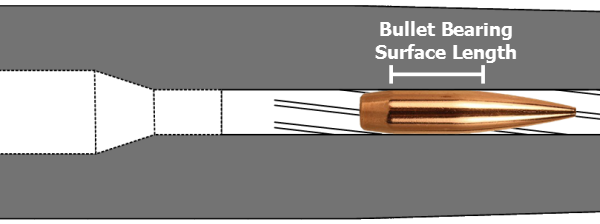
The bearing surface length isn't the diameter.

bullet-bearing-surface-length-diagram1.png


Use your comparator and measure from the boattail ogive to the meplet, and the base to nose ogive. Do a bit of math with these numbers and the base to meplet length, and you should be able to calculate your bearing surface length. Or if you have two comparators then it's really easy.
 
I am currently loading 178gr BTHP, even in the same lot I am getting about .005 variation, or so my CT calipers tell me...

I would concur that something else is going on.

Powder lot the same? Did you do the work up on a colder day or something?

Just some thoughts.
 
The bearing surface length isn't the diameter.

bullet-bearing-surface-length-diagram1.png


Use your comparator and measure from the boattail ogive to the meplet, and the base to nose ogive. Do a bit of math with these numbers and the base to meplet length, and you should be able to calculate your bearing surface length. Or if you have two comparators then it's really easy.


The bearing length is 0.016" or so longer on the new lot but the bearing diameter is immeasurably similar. The measurements on overall length (base to meplat) is a few thou longer and from the rear of the bearing surface to meplat were similar for both lots. The major difference is the base to ogive measurement.

If this can be explained any other way I am happy to hear ideas... working theory is the load was near max to start and the combination of zero jump, deeper seating and longer bearing surface would just bump it over the edge...
 
The bearing length is 0.016" or so longer on the new lot but the bearing diameter is immeasurably similar. The measurements on overall length (base to meplat) is a few thou longer and from the rear of the bearing surface to meplat were similar for both lots. The major difference is the base to ogive measurement.
If this can be explained any other way I am happy to hear ideas... working theory is the load was near max to start and the combination of zero jump, deeper seating and longer bearing surface would just bump it over the edge...

If you are accurately measuring from the base of the loaded CARTRIDGE to the ogive, and you are keeping that distance constant, then you should not change the jump to the lands. If anything the jump will increase over time due to throat erosion. But if the bullet base to ogive dimension changes, this should have ZERO effect on the overall cartridge base to ogive. Yes it will give you a few thou variation in the seating depth of the base of the bullet inside the case, but that should have a very minimal effect on pressure.
 
Back
Top Bottom