












































Lithgow No.1 Mk III* with a little problem (test fired today)

Pulled this rifle apart today for the first time. All screws were a major PITA to get moving. I have come to the conclusion that the entire rifle was coated in something like Tung Oil. I also found THAT DAMNED CRACK. I have read about fixing the crack and forced epoxy into it and then tried to clamp it. Funny thing happened. If the clamp was in the middle it didn't really do anything. If I put it higher or lower, I could close the crack on bottom, which would spread the top, or vice versa. So in the end I just wadded the epoxy on in two coats an hour apart to let it set up and fill the crack better and left it not clamped. I hope it stays strong enough. I would have felt better if it would have clamped tighter. I know the little metal reinforce block was holding it apart but the wood has deteriorated so badly, I didn't want to mess with it anymore. You can see a piece is already missing.
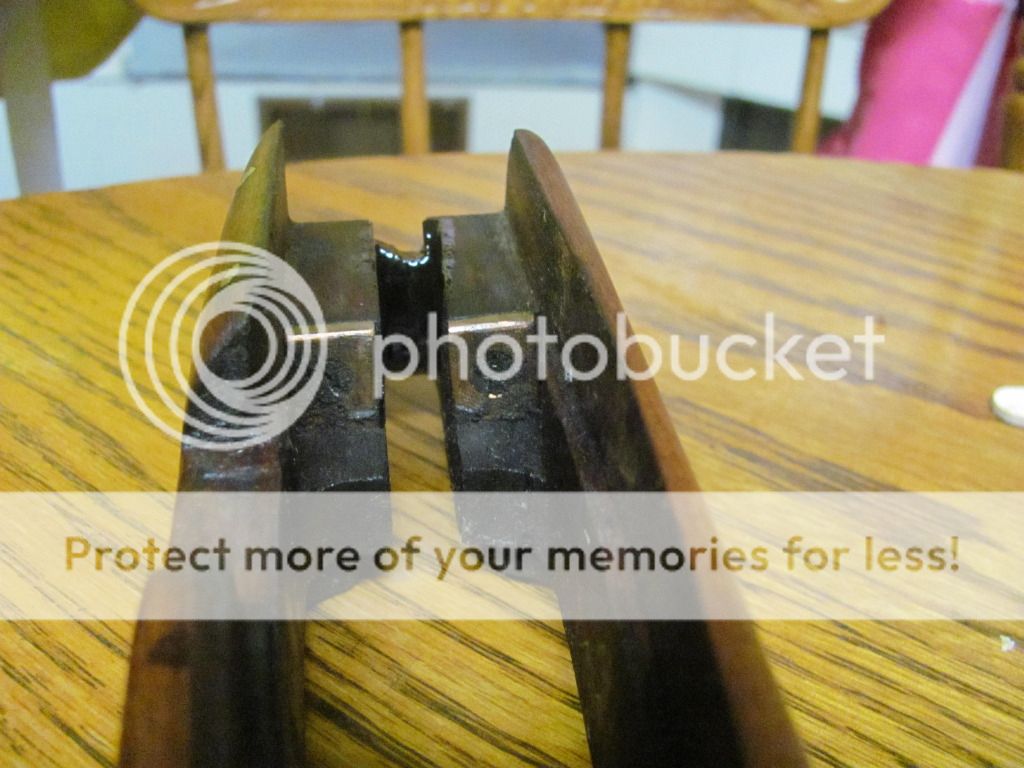
001-19.jpg


I'm also going to strip the entire stock and BLO it. It's the correct finish and I like it a lot better.

I took extra fine steel wool to the metal parts and the Tung oil came off like brown oily scum.
 
fixing up old messed up screws

A friend of mine gave me a tip on how to fix up screw heads this past week. Put them in a vise and using a small ball pean hammer pean them back into shape. I the used a screwdriver as a punch to reshape the slots. They looked great other than the white metal, so I got some cold blue cream and blued them. I dunno how that stuff would look on bigger surfaces, but for the screws it worked great.
 
That crack in the stock must be common, my no1 mk3 sporter has the same crack, doesn't seem to effect accuracy though. I believe that crack is from the square end on the butt stock bolt not being lined up when being tightened and then someone try's to force it together? I'm no expert but I'm guessing that's how it happens.
 
The Damned Crack very often results from someone unscrewing and pulling of the BUTT without FIRST removing the Forestock.

It can also occur from the wood DRYING, as it will, especially in THIS climate. The rifles were built in a country with a much damper climate than we have here. They were sealed fairly well but, given enough time in an extreme environment such as we have on the Prairies, they WILL start to dry out..... and warp..... and shrink. All those old Sniders that you see with too-large Buttplates? Those buttplates fit perfectly when the rifles were made; that they are 'way too big now is down to the shrinkage of the wood.

And exactly the same thing happens with th SMLE. The ation was tight in the wood when the rifle was built, but the wood has been drying since the rifles got here..... and the steel parts have not shrunk even one little bit. So the wood gets tighter and tighter and, finally, it reaches it breaking-point and it lets go. The cure is to repair the wood with a non-shrinking epoxy compound. This will actually add a tiny bit of width to the bearing areas of the wood.... and the rifle goes back together again tight. If it isn`t tight, that's when you glass-bed the critter.

The Damned Crack is responsible for more bad shooting with the SMLE rifle than half the bad barrels in existence, all added up. Have on go SNAP! on you in the middle of a match and you'll understand how (and why) it got the name.

A good SMLE should be a 2-MOA rifle at worst. Many can be tuned so that, when used with good ammo, they can turn out ONE MOA or even less, if you do your job as well. Even in the very WORST of wartime conditions, a rifle that would not shoot better than 3 MOA never left the factory; it was worked over until it WOULD shoot well. ONE MOA is grouping on a QUARTER at 100 yards. If your ammo is up to snuff (by which I mean VERY darned consistent) and you have a good barrel, your rifle should turn in pretty close to that. If it doesn't, then you have a problem somewhere with the wood.

Hope this helps.
 
The wood on this lithgow is so brittle where the damned crack is, it crumbles with little pressure. I put a thin layer of epoxy on the whole area.

The wood was very snug and hard coming off. It took all the strength I have in my hands to put the foreend back on the receiver. She's snug to say the least.

It shot reasonably well with factory ammo before the fix. I'm looking forward to see if there is any improvement.
 
Yeah, little brass blocks to handle the recoil I assume. I don't know if this is standard on this era of Lithgow or not.
 
Are they a lithgow thing? I haven't had another No.1 apart.

Makes sense, more durable where if it were only wood I would think the wood would eventually shrink and get squashed which could make one side bare more of the recoil than the other. I think it's pretty important for accuracy that these two points bare the recoil evenly.
 
Are they a lithgow thing? I haven't had another No.1 apart.

Makes sense, more durable where if it were only wood I would think the wood would eventually shrink and get squashed which could make one side bare more of the recoil than the other. I think it's pretty important for accuracy that these two points bare the recoil evenly.

I'm not too sure, if it's a lithgow thing? Although I believe that my Sporter is a lithgow to, the wood is also identical to yours.
 
Back
Top Bottom






















