
Over the summer from the Nationals and World F-class Championship. I was shooting with another BC F-Class competitor the whole week and had a blast just chatting. He did very well in both events and came in as the top highest rank BC competitor at the Worlds. He was shooting NEW Lapua (0F brass) that had just been neck turned. So could new Lapua brass give good results, yes, but keep in mind there will be some unexplained fliers so you have to make the call if it's you or the case or a bad shot. I would just mark those cases and see if they group with the other cases in further firing. YMMV.













































You are using an out of date browser. It may not display this or other websites correctly.
You should upgrade or use an alternative browser.
You should upgrade or use an alternative browser.
Load development on new cases
- Thread starter Camoman1
- Start date

I always run new brass through a sizing die before loading. As has been mentioned before in this thread, handling before you got it is beyond your control.
I don't know for sure how much difference you'll see after it's been fired once in your rifle, but I suspect any difference will be minimal.
I don't know for sure how much difference you'll see after it's been fired once in your rifle, but I suspect any difference will be minimal.

My apologise for maybe not being more precise and detailed in my first post to this thread as I tend to forget there are different levels of knowledge in load development
All manufactured brass, regardless of manufacture is undersized, maximum working pressures cannot be obtained until the brass as been fired several times and is fully formed to the chamber, IT IS DURING THIS FIREFORMING PROCESS and ONLY DURING THIS PROCESS it is safe to lightly oil the case to help it form perfectly to the chamber dimension.
It is a fairly common practice used in changing case dimensions such as 220 Russian in to a PPC used in benchrest, it also holds merit when changing the neck of an standard cartridge to an AI cartridge.
All the process is used for is to help the case form to precise fit of the chamber and is not a requirement,
For those who maybe interested in taking their load development skills to a higher level, there are many elite shooting members on here and I think most are very open to sharing their knowledge in how to make consistent accurate loads
Digging deeper... You may get out of this hole but you'll have to shovel much faster.

Digging deeper... You may get out of this hole but you'll have to shovel much faster.
I've got s feeling that after he is done digging, you will be buried.

I have lubed cases as part of case prep. BUT, a lubed chamber does increase bolt thrust, so anyone doing it had better pay attention.
I have done it when working with a rifle and cases that would tend to stretch at the head and lead to eventual case head separation. Some caliber conversions are easier to do with lube.
What I do is use a START load and lube the case, so that the case sets back hard on the bolt face, without adhering to the chamber wall and suffering any stretch.
I see no reason to do it with a front locking bolt rifle with fairly tight headspace.
After this one firing, the cases are cleaned and the chamber is washed, getting rid of the lube.
I have done it when working with a rifle and cases that would tend to stretch at the head and lead to eventual case head separation. Some caliber conversions are easier to do with lube.
What I do is use a START load and lube the case, so that the case sets back hard on the bolt face, without adhering to the chamber wall and suffering any stretch.
I see no reason to do it with a front locking bolt rifle with fairly tight headspace.
After this one firing, the cases are cleaned and the chamber is washed, getting rid of the lube.

I've never used an oiled case for reasons mentioned by others but for spits and giggles I googled the idea and sure enough one guy recommends it in his article for a magazine h ttps://gunsmagazine.com/fireforming-brass/. I still don't like the idea as other methods seem to work well for me.
One guy recommends it, and hundreds, if not thousands recommend not doing it. I know which way I'd go.
If I remember correctly, the British method of proof testing was to suitably lube a number of cartridges (loaded to otherwise normal specs) and fire those. I would imagine the increased bolt thrust was as much of a torture test as they wanted to try.

- Location
- Prince Albert, Sk
I just can't comprehend that someone thinks it takes 3 firings to fireform a case.

I just can't comprehend that someone thinks it takes 3 firings to fireform a case.
You have to segregate neck sizing from full length resizing and the effects of brass spring back after firing.
When neck sizing only after a few firings the case will conform to the chambers shape and become hard to chamber.
And when full length resizing the case conforms to the resizing dies dimensions and not the chamber dimensions.
Too much of what benchrest shooters do with their custom chambered rifles and custom dies filters down to the average reloader and does not apply. Meaning competitive shooters who neck size only are a dying breed.
The majority of competitive shooters are now full length resizing and adjusting their dies for minimum shoulder bump of .001 to .003.
A case for a semi-auto should be .003 to .005 smaller in diameter than its fired diameter after sizing for reliable extraction. This smaller case diameter allows the case to "spring back" from the chamber walls and "not" bind and drag on extraction.
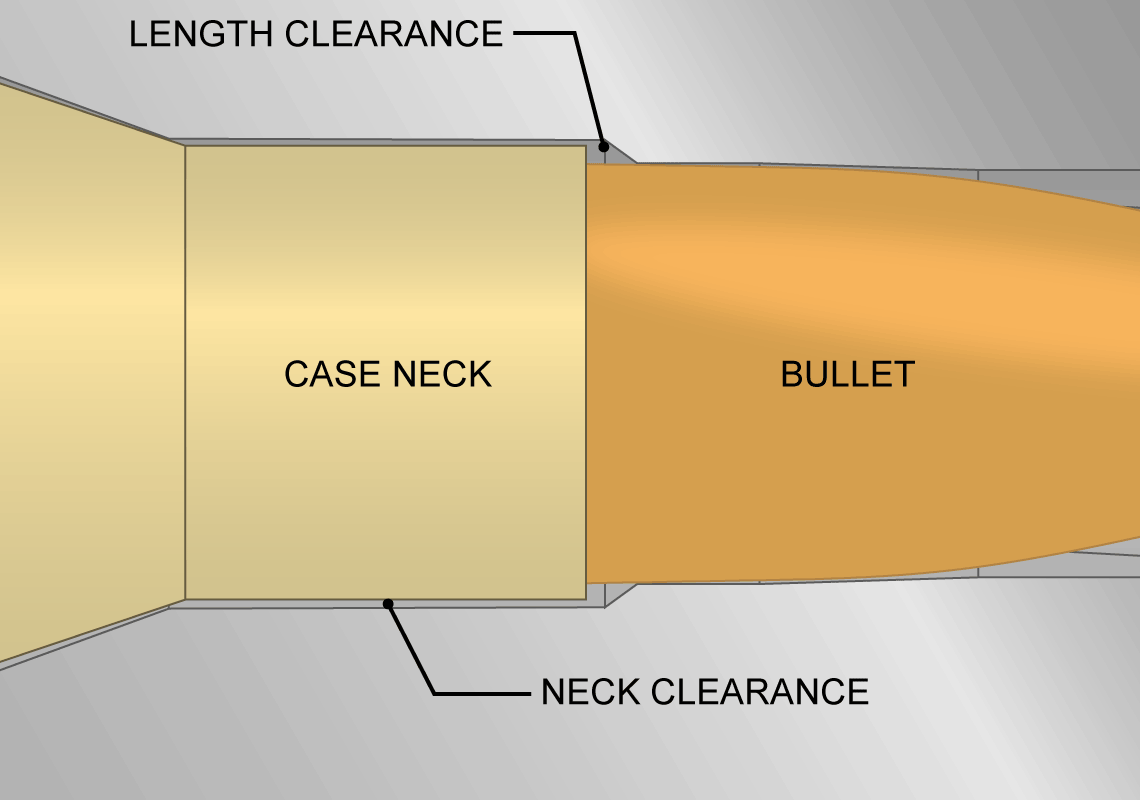
On a full length resized case the only part of the case that contacts the chamber should be only the case shoulder. The ejector pushes the case forward until it contacts the chambers shoulder and the base of the case is not touching the bolt face. The FL size case body does not touch the chamber walls because it was reduced to a smaller diameter. And the case neck gripping the bullet does not touch the chamber walls. It is the case shoulder and the bullet in the throat that centers the case and aligns the bullet with the axis of the bore.
Below German Salazar at his "The Rifleman's Journal" website is answering a question about "partial full length resizing" that will let more of the case contact the chamber walls.
And Mr. Salazar goes on to explain the benefits of full length resizing and "NOT" having the case body make contact with the chamber walls. This is because a case can warp and become banana shaped when fired. This is caused when the case has unequal case wall thickness and expands more on the thin side of the case. And a case like this will cause the bullet to be out of alignment with the axis of the bore. Meaning a full length resized case gives the bullet wiggle room to be self aligning with the axis of the bore. (the case should fit the chamber like a rat turd in a violin case)
Reloading: Partial Neck Sizing
by German A. Salazar
http://riflemansjournal.########.com/2010/06/reloading-partial-neck-sizing.html
"Now the last scenario, a full-length sized case in which the neck is also fully sized. There is clearance at the neck and in the body of the case, the closest fit anywhere is the bullet in the throat. If the neck to bullet concentricity is good (although it needn't be perfect), then the bullet will find good alignment in the throat and the case body and neck will have minimal influence. Let's not forget that the base of the case is supported by the bolt face or the extractor to a certain degree as well; this is yet another influence on alignment. As you can see, there are several points from base to bullet that can have an effect. My procedure is to minimize the influence of those that I can control, namely the case body and neck, and let the alignment be dictated by the fit of the bullet in the throat and to some extent by the bolt's support of the base. Barring a seriously out of square case head, I don't think the bolt can have a negative effect on alignment, only a slightly positive effect from minimizing "case droop" in the chamber. Given that a resized case will usually have a maximum of 0.001" diametrical clearance at the web, this isn't much of a factor anyway."
To me fire forming is getting the case shoulder within .002 to .003 of the chambers shoulder after firing and not let the case stretch and thin in the base.
And to be honest some of the best groups I have ever fired were with brand new unfired brass. (very small rat turd in a big violin case)

And if you have a Hornady cartridge case headspace gauge and measure a "fired" case you will know how much shorter your new cases are than the chamber.
Bottom line, with a new unfired case the only thing you should worry about is how much shorter the case is than the chamber. Meaning how much the case will stretch and thin on its first firing.
And you can create a false shoulder or seat the bullet into the rifling to hold the case against the bolt face and not lube the case to prevent it from gripping the chamber walls.
NECO CONCENTRICITY, WALL THICKNESS AND RUNOUT GAUGE

Also referred to as "The Case Gauge," this item is designed to measure:
1) The curved "banana" shape of the cartridge case;
2) The relative wall thickness variation of a cartridge case;
3) The cartridge case head out-of-squareness;
4) Individual Bullets - out-of-round "egg shape" and/or curved "banana" shape (excepting very small bullets);
5) The seated bullet and cartridge runout of loaded rounds. The accuracy of any firearm is determined -- and limited -- by the quality of the ammunition shot in it. The effect of imperfections in ammunition is cumulative; each flaw adds to the influence of all others. Precision shooters spend much time and effort "uniforming" cartridge cases, using advanced techniques to eliminate variation. Yet until recently, one of the most important of these variations has not been susceptible to detection by any device readily available to marksmen.
Normal manufacturing tolerances cause brass cartridge cases to vary in wall thickness around the circumference of their bodies. Under the stress of firing, a case with such variation stretches more readily along its thin side, transferring more pressure to the bolt face at that point and introducing an unbalanced force which contributes to bolt whip and vibration of the barreled action in its bedding. This whip and vibration varies from one shot to the next as cartridges are fired with their thin sides randomly oriented at different angles, causing reduced accuracy. The problem is made even worse if the brass is too hard or springy to completely fireform to the shape of the chamber, in which event the greater stretching of the case's thin side will cause it to develop a curve along the length of its body. These "banana" cases cannot hold a bullet aligned with and centered in the bore, undercutting the effectiveness of the handloader's careful case preparation.
http://www.neconos.com/details.htm
Last edited:





















