Loading .223 for AR-15. No case Gauge

I think everyone here is missing the true reason one uses a case gauge.
The reason is headspace.
If you have a headspace gauge then you're good to go.
Otherwise you don't know if you pushed the shoulder back far enough or too far.
 
I think everyone here is missing the true reason one uses a case gauge.
The reason is headspace.
If you have a headspace gauge then you're good to go.
Otherwise you don't know if you pushed the shoulder back far enough or too far.

How does one push a shoulder back to far or not far enough if you use LEE dies and follow the instructions in the box?

The inside on the Die is supposed to be a hair smaller then a typical rifle chamber, if the die hits the shell holder whatever is inside the die will conform to its shape as a rule.

Why should I or anybody else who runs thousands of pieces of mixed brass thru a progressive bother with trying to perfectly bump a case shoulder back?

Say I have a Norc CQA 5.56 (I do) and I check my fired brass to find I can bump a shoulder back to only a maximum spec (yay my brass lasts a little longer!) I reload 3000rnds of 55gr LC FMJ's... Now I buy a .223 barrel for my XCR (I did) and I measure it's brass only to find its chamber is a medium spec requiring the shoulder to come back a bit more then my Norc... Well... Guess I can't shoot the 3000rnds I have already rolled up because they won't fully chamber in my XCR...

Folks, if your new to reloading don't monkey with bumping anything, run it all thru a FL die and be done with it especially if you fire your reloads in more then one rifle.

And don't even think about backing a FL die off the shell holder if you reload range brass, when you try "bumping" shoulders back you aren't fully sizeing the body taper of a cartridge, any bulges in a cartridge base from being fired in a well used rifle won't get pushed back and your ammo won't chamber properly.

Now... Flame away but for gods sake explain to folks the hazards of messing with dies for certain effects before you post especially regarding reloading for semi autos or at least explain in detail how to do it rite.

 
How does one push a shoulder back to far or not far enough if you use LEE dies and follow the instructions in the box?

The inside on the Die is supposed to be a hair smaller then a typical rifle chamber, if the die hits the shell holder whatever is inside the die will conform to its shape as a rule.

Why should I or anybody else who runs thousands of pieces of mixed brass thru a progressive bother with trying to perfectly bump a case shoulder back?

Say I have a Norc CQA 5.56 (I do) and I check my fired brass to find I can bump a shoulder back to only a maximum spec (yay my brass lasts a little longer!) I reload 3000rnds of 55gr LC FMJ's... Now I buy a .223 barrel for my XCR (I did) and I measure it's brass only to find its chamber is a medium spec requiring the shoulder to come back a bit more then my Norc... Well... Guess I can't shoot the 3000rnds I have already rolled up because they won't fully chamber in my XCR...

Folks, if your new to reloading don't monkey with bumping anything, run it all thru a FL die and be done with it especially if you fire your reloads in more then one rifle.

And don't even think about backing a FL die off the shell holder if you reload range brass, when you try "bumping" shoulders back you aren't fully sizeing the body taper of a cartridge, any bulges in a cartridge base from being fired in a well used rifle won't get pushed back and your ammo won't chamber properly.

Now... Flame away but for gods sake explain to folks the hazards of messing with dies for certain effects before you post especially regarding reloading for semi autos or at least explain in detail how to do it rite.


I actually am using Lee FL dies and I do load for my Norc.
The first time I made 100 rounds for it I went to the range only to find out that most of my 100 rounds wouldn't chamber.
Fortunately my range has a well stocked store (CRAFM) which sells case gauges.
I found that most of my rounds were out of spec.
I had to set my die to touch the shell holder PLUS 1/2 a turn to get them to fit the case gauge properly and chamber.
I had the same issue with my Dillon RT 1200 rotary trimmer so in my case a case gauge is indispensable .
The case gauge has a cut on the head area which allows you to see if you are adjusted near minimum or maximum headspace.
On the opposite end the cut shows minimum and maximum trim length.
Here is a good explanation.
http://www.stu-offroad.com/firearms/reloading/casegauge/casegauge-1.htm
 
I know how they work, I have a few.

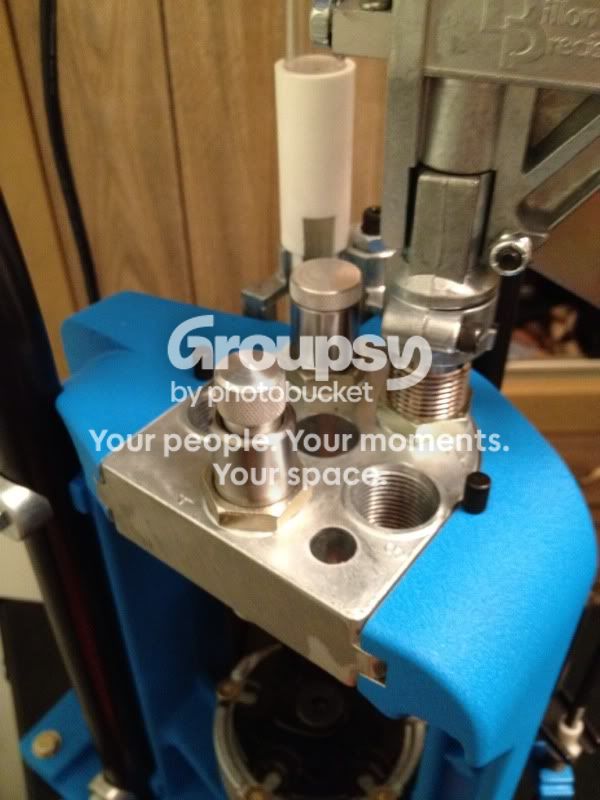
Setting dies in dillon presses require a better understanding of "slop"... When I setup a tool head I screw my dies in till they touch then lower the ram a bit and turn them in untill I can feel them just offer feedback at the max top of the stroke then back off maybe 1/8 of a turn, between the carousel and tool head play and any material under the shell plate you need to really watch what happens when you start squeezing brass into that die to make sure the die and shell plate touch with no gap... Single stage presses are another ball of wax and don't have nearly as much "slop" as progressives and I know folks who turn there dies in singles to take up 1/8" of ram travel just to be sure they get consistent FL resizing.
 
I have to chamfer even without trimming to get any plane based bullet (like the economical Hornady 60gr SPs) to seat without shaving copper off them. For BTs it might not be necessary.
 
I have to chamfer even without trimming to get any plane based bullet (like the economical Hornady 60gr SPs) to seat without shaving copper off them. For BTs it might not be necessary.

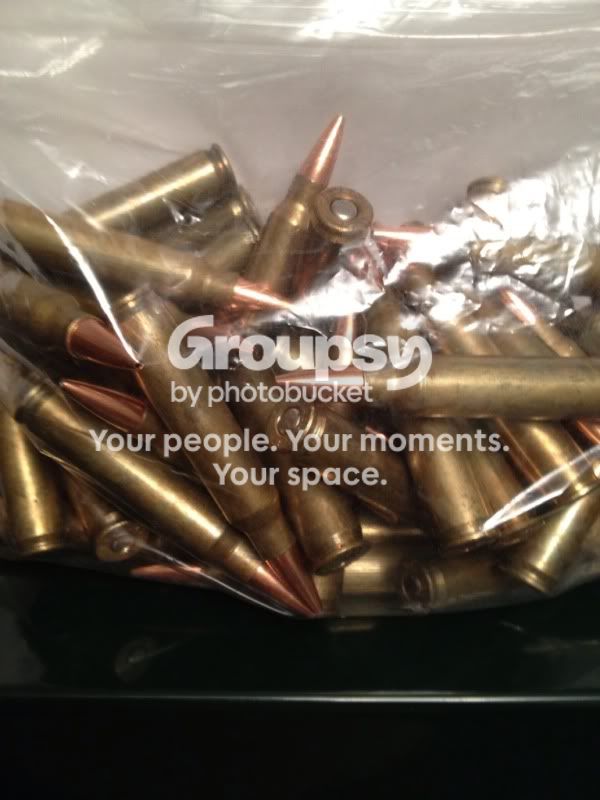
Just ran off 100 Economy FB bullets no shaving of the jacket once the brass ran thru my neck sizer in hole #1

Hornady 60gr Varmint
21.5gr WC735
CCI 400
COL 2.220
Range brass 1F

6ceaa686.jpg


195aedb1.jpg


fe77374b.jpg
 
Last edited:
Those don't look like varmint bullets they look like fmjs
Not to say you're method doesn't work,
but it seems just as easy to chamfer as it does to run the cases through the die again.
IMHO
 
You callin me a liar? LMFAO.

Yes they are Hornady 60gr Varmint bullets, still have the label from the box if you would like a picture of that too... Flat bases same as the SP according to my Hornady chart.

If you run a progressive other then a 1050 chances are your brass runs thru the machine twice anyway, if you have a single stage then it's an extra step so by all means do it by hand...
 
Yeah I already have calipers. I want to do it right the first time around. Being new to reloading I don't have the experience to know what works and what doesn't yet.

I've got a Dillon electric case trimmer coming. Is it worth it to just buy a separate toolhead for the trimmer to save having to set everything again? I'm thinking so but I'd like youre input as well.

Thanks to all of you who have responded so far. I've found invaluable information on this forum to date. Don't know where I'd be without CGN.

Just be very careful setting that thing up. The instructions that come with it are kind of crap. Despite doing my best to follow the instructions, I ended up running the cutter into the trim die and killing both the die and the cutting blade. Thankfully Dillon took care of me.


This is the info I got from Dillon after my problems:

The adjustments are all trial and error. Adjust the head space first and lock it in place. Be sure there is plenty of sizing lube on the case each time you put it up in the die. Next screw the trim motor down on the die until the blade is about a 1/4 “ above the case mouth. Next turn the trimmer motor 1/4 turn at a time and then less when you start getting close to the desired length. This will get you familiar with the unit. Basically it’s like adjusting bullet seating depth, start too high and work your way down.

Each 1/4 turn of the motor will cut off approximately .0011 of an inch. When you trim brass it all won’t be exactly 1.750, it will be more like plus or minus .001.
 
Back
Top Bottom