Hey guys-so much YouTube content out there, yet so much of it poorly lit/photographed..and missing information. While my search there hasn't yielded much, I'm hoping the collective here on CGN will help boost my confidence. Here is the situation;
I've been reloading maybe 9-10 years, but never straight wall cases, and certainly never anything that requires crimping. Gun is an 1895G, and my gear is as follows;
RCBS "partner" press (small, single-stage but capable)
LEE 45/70 dies (new, untouched)
Lyman case trimmer
Lyman digital scale with built-in trickler
RCBS hand priming tool
Various powder funnels, mostly caliber-specific
BULLETS (2 types, from Budget Shooter Supply, I believe both are 405gr, one is a SP)
BRASS from BSS as well
CCI 200 large rifle primers
I've loaded .223 (lots), .243, 204 Ruger and 17 Hornet. Still load 204 and 17 hornet. I'm assuming the case sizing, trimming, deburring/chamfering, priming, powder charging, bullet seating is all the same, but that's as far as my experience will take me I think. (though feel free to correct me/make suggestions on any of the above) I understand the need for crimping in magnum/tube-fed guns, but here is what I need help understanding;
1.what exactly does "gas check" mean when referring to bullets?
2.is it the seating die that crimps at the end of the stroke?
3.how far does the bullet need to be seated (work to OAL specs?)
4.what role does the cannelure play, and how does it relate to crimping/location TO crimp? (or does it)
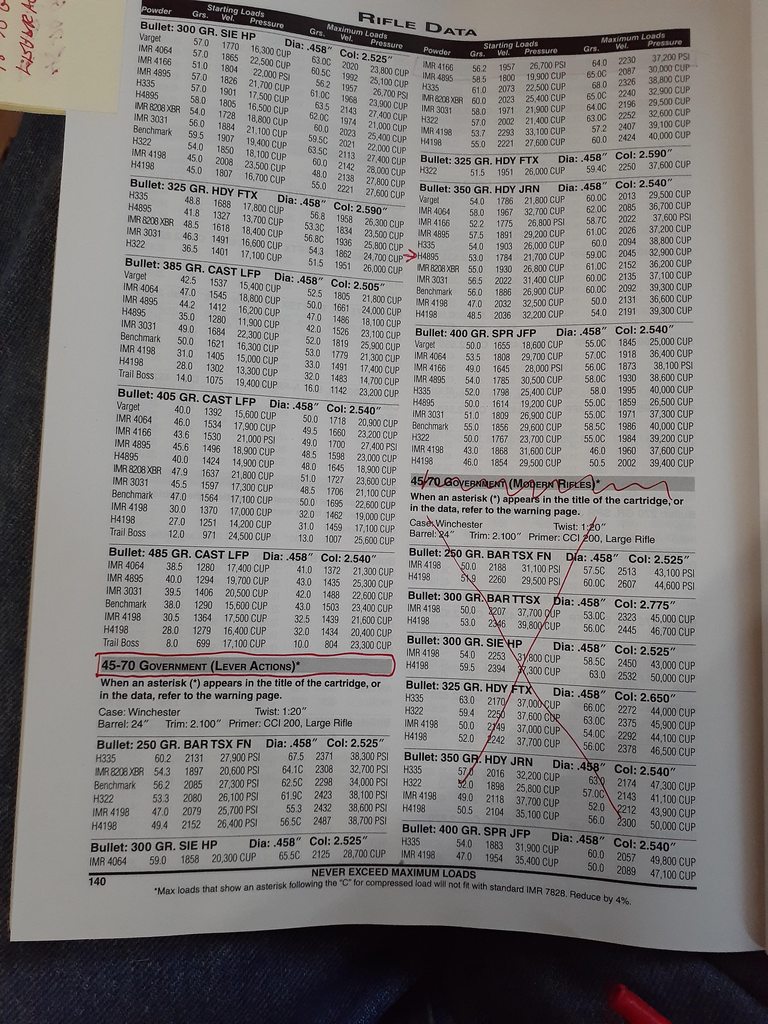
I'm sure some of the more experienced are likely chuckling over some of these questions, but we all have to start somewhere. lol I've loaded the aforementioned calibers with great success, work slowly/meticulously...and pretty much NEVER load to even the maximum powder spec. While the bullet choice might suggest otherwise, I have no large game aspirations for this caliber. Target shooting/plinking only. I'm receptive to using lighter bullets as a result, and would welcome recommendations and/or load data.
Not recoil shy, more thinking that target loads needn't have full power/consume as much powder. Happy to load these heavy bullets as required, and happy to buy more bullets and load lighter stuff too.
Hoping someone feels like helping me out, I appreciate you all considering the request.
Thank-you, honestly!
I've been reloading maybe 9-10 years, but never straight wall cases, and certainly never anything that requires crimping. Gun is an 1895G, and my gear is as follows;
RCBS "partner" press (small, single-stage but capable)
LEE 45/70 dies (new, untouched)
Lyman case trimmer
Lyman digital scale with built-in trickler
RCBS hand priming tool
Various powder funnels, mostly caliber-specific
BULLETS (2 types, from Budget Shooter Supply, I believe both are 405gr, one is a SP)
BRASS from BSS as well
CCI 200 large rifle primers
I've loaded .223 (lots), .243, 204 Ruger and 17 Hornet. Still load 204 and 17 hornet. I'm assuming the case sizing, trimming, deburring/chamfering, priming, powder charging, bullet seating is all the same, but that's as far as my experience will take me I think. (though feel free to correct me/make suggestions on any of the above) I understand the need for crimping in magnum/tube-fed guns, but here is what I need help understanding;
1.what exactly does "gas check" mean when referring to bullets?
2.is it the seating die that crimps at the end of the stroke?
3.how far does the bullet need to be seated (work to OAL specs?)
4.what role does the cannelure play, and how does it relate to crimping/location TO crimp? (or does it)
I'm sure some of the more experienced are likely chuckling over some of these questions, but we all have to start somewhere. lol I've loaded the aforementioned calibers with great success, work slowly/meticulously...and pretty much NEVER load to even the maximum powder spec. While the bullet choice might suggest otherwise, I have no large game aspirations for this caliber. Target shooting/plinking only. I'm receptive to using lighter bullets as a result, and would welcome recommendations and/or load data.
Not recoil shy, more thinking that target loads needn't have full power/consume as much powder. Happy to load these heavy bullets as required, and happy to buy more bullets and load lighter stuff too.
Hoping someone feels like helping me out, I appreciate you all considering the request.
Thank-you, honestly!