












































You are using an out of date browser. It may not display this or other websites correctly.
You should upgrade or use an alternative browser.
You should upgrade or use an alternative browser.
loading benches
- Thread starter brybenn
- Start date
About 1.125" of OSB with a 1/4" mild steel plate bolted on. No steel plate and it breaks instantly.
If you're looking for ideas, a solid wood outside door or the like from a Habitat for Humanity Restore works. Any solid bench from a used furniture shop does too.
If you're looking for ideas, a solid wood outside door or the like from a Habitat for Humanity Restore works. Any solid bench from a used furniture shop does too.

Any work top for a reloading bench should be at least 3/4" thick. And at 3/4" it will need lots of supporting structure. I used 3/4" on mine but it's sitting on and well attached to kitchen cabinets so the top straps of the cabinets and sitting on the edges of the sides every 20 inches helps support the top. If you want the top to be more self supporting with less framing under it then go with doubled 3/4" good quality fir plywood or use two layers of birch or maple cabinet plywood. Or one layer of 3/4 ply with a cheap kitchen counter top laminated onto it with lots of screws set in from below to act as "stiching" and effectively "sew" the two layers into one.
If you simply lay the two layers on each other with minimal screws and no glue they will slip on each other and won't give the same stiffness and strength. Like you get when you bend a deck of playing cards. But if you were to glue the cards together you could never bend it. Same idea with the layers on the bench top.
Even with doubled 3/4 plywood you still want a reasonable amount of bracing. I would not go with anything lighter than FIR (not the cheap construction lumber) 2x4 stringers front, rear and on the sides including a couple of cross pieces between the legs that tie into the front and rear stringers if it's an open under style bench. And if the length is more than 6 feet I'd include a middle leg to a lower 2x6 or even 2x8 fir lower stringer.
If you simply lay the two layers on each other with minimal screws and no glue they will slip on each other and won't give the same stiffness and strength. Like you get when you bend a deck of playing cards. But if you were to glue the cards together you could never bend it. Same idea with the layers on the bench top.
Even with doubled 3/4 plywood you still want a reasonable amount of bracing. I would not go with anything lighter than FIR (not the cheap construction lumber) 2x4 stringers front, rear and on the sides including a couple of cross pieces between the legs that tie into the front and rear stringers if it's an open under style bench. And if the length is more than 6 feet I'd include a middle leg to a lower 2x6 or even 2x8 fir lower stringer.
As mentioned above with the 3/4" plywood; what i did was pick up a sheet of 3/4 plywood and ripped it down the middle. This gave me a bench that was 24"x 8 feet and 1.5" thick. Glued and screwed the plywood together and built a frame out of 2x4, with 4x4 legs. Used plenty screws and attached to the wall studs where i could. I then used 1/8" oak veneer to dress it up a little.

My bench is made with 4x4's for legs and 2x4's for the framing. The top is 1/2" plywood with a piece of 1/2" plate 12" x 12" bolted and supported to the bench. The plate is flush with the plywood, the plate is drilled and tapped for each of the 3 press that I have and a threaded hole in the back left if for the bin holder. Have had no problems with flex.

Attachments

I was thinking something like this so I can move it around,out of the way,and it has storage...http://www.canadiantire.ca/en/pdp/mastercraft-maximum-base-workbench-0681224p.html#.VRr7WeE7fcs
beretta boy
CGN Ultra frequent flyer
- Location
- Orillia, Ontario
Solid pine - 1-1/2" thick. 2x4 oak frame underneath.

I was thinking something like this so I can move it around,out of the way,and it has storage...http://www.canadiantire.ca/en/pdp/mastercraft-maximum-base-workbench-0681224p.html#.VRr7WeE7fcs
Oh thank you! I was looking at these before Christmas, but thought I'd wait until Boxing Day or later in January to see if they would go on sale. At that time they were $300. Then they went out of stock. So I stopped looking.
However, my 550B is still sitting in the box 3 months later, I'm getting buried in 9mm brass that's all tumbled and ready to go, and now that it's nicer outside I'm thinking I have to suck it up and pay the extra $80 over what I would've paid in the first place. Hahaha.
I used 2X8s. I laid out 3, 6' long lengths side by side and then covered the top with a sheet of 1/8" masonite. It's smooth, tough and has lasted 20 years so far. I can also cut on it if I have to without damaging the bench or the knife. I love it.

- Location
- Houston, TX
I was thinking something like this so I can move it around,out of the way,and it has storage...http://www.canadiantire.ca/en/pdp/mastercraft-maximum-base-workbench-0681224p.html#.VRr7WeE7fcs
Wheels are a bad idea on a reloading bench. If you want something portable, I built a small bench for the press which uses two layers of plywood on top of a steel frame designed to support power tools. It's very sturdy but I can move it easily.


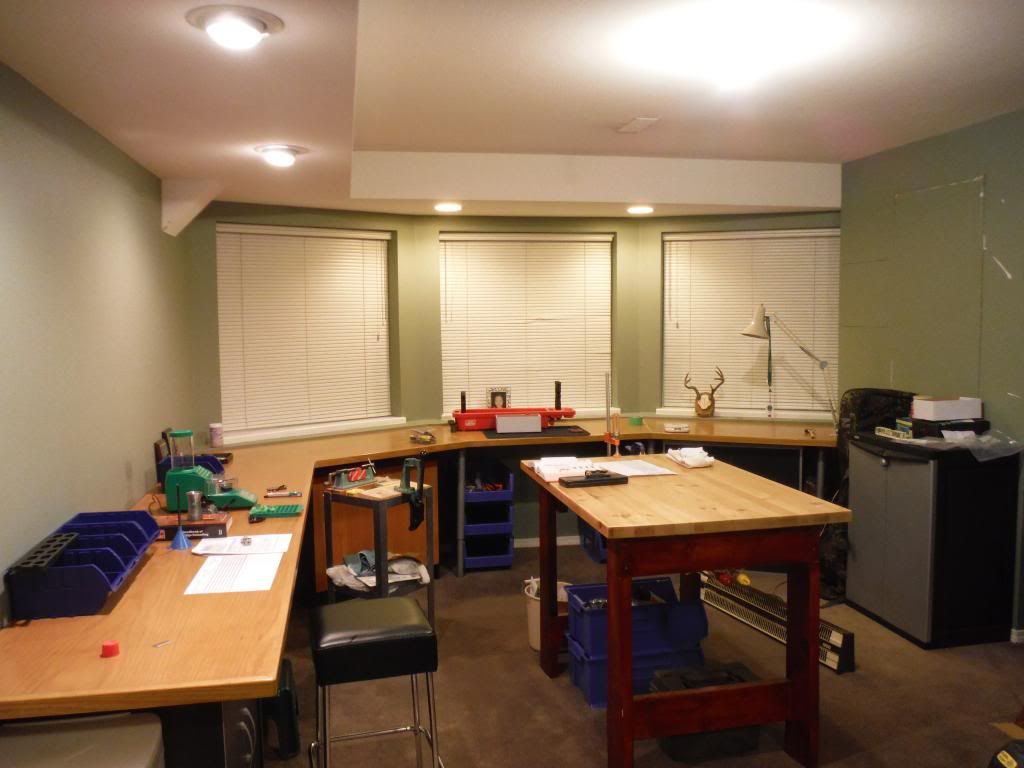
turbo_bird
CGN Ultra frequent flyer
- Location
- Kamloops, BC
Mine is 4" thick, rough cut fir, about 16' long. I had to use my engine hoist to put the top on the legs. It doesn't really wobble. Most of it is used as a work bench in my garage.
Kristian
Kristian
I used 1 inch G1S plywood on top of a 2x4 frame bolted to the foundation wall. I was originally intending to use the Strong Mounts, but didn`t have enough ceiling height in my basement, so I was getting some flex on the downstroke of my Dillon XL650. Next time I would double up the 1 inch plywood, or bolt a steel plate on top and bolt the press on top of that. One of the guys in my IPSC group recommended adding an additional leg directly under the press and that made a big difference.
View attachment 25005
View attachment 25006
Here`s the press in action. Just a tiny bit of movement when the downstroke bottoms out.
View attachment 25005
View attachment 25006
Here`s the press in action. Just a tiny bit of movement when the downstroke bottoms out.

Hey BB, I just built myself a new bench as the little wifey allowed me to use some extra room outside my vault. My top is 2X12 planking screwed down to a 2X6 subframe with double 2X4 legs and 1/2" Crezone screwed on top for a very nice work surface. I have a 3 1/2" overhang on the front to bolt my presses to and then the top is gusset supported under the lip on both sides of the press........no flex at all. I'll throw up some photos tomorrow. After building about 15 different ones over my life as houses and needs changed I've pretty much got it figured out..........I think anyway !!!
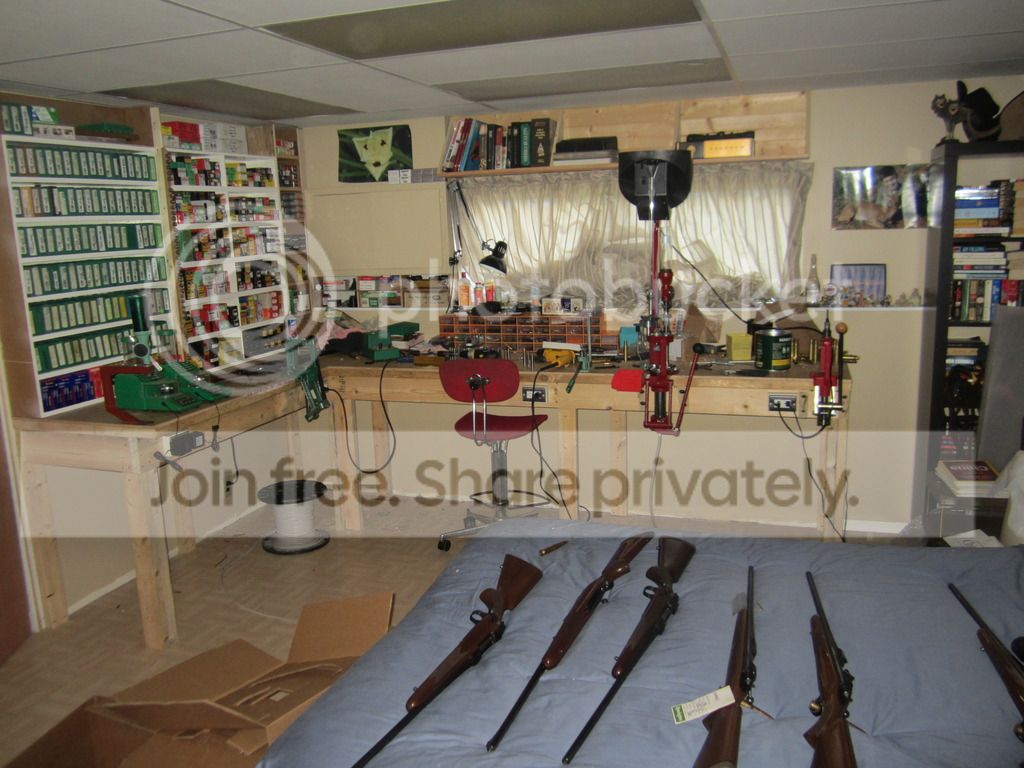


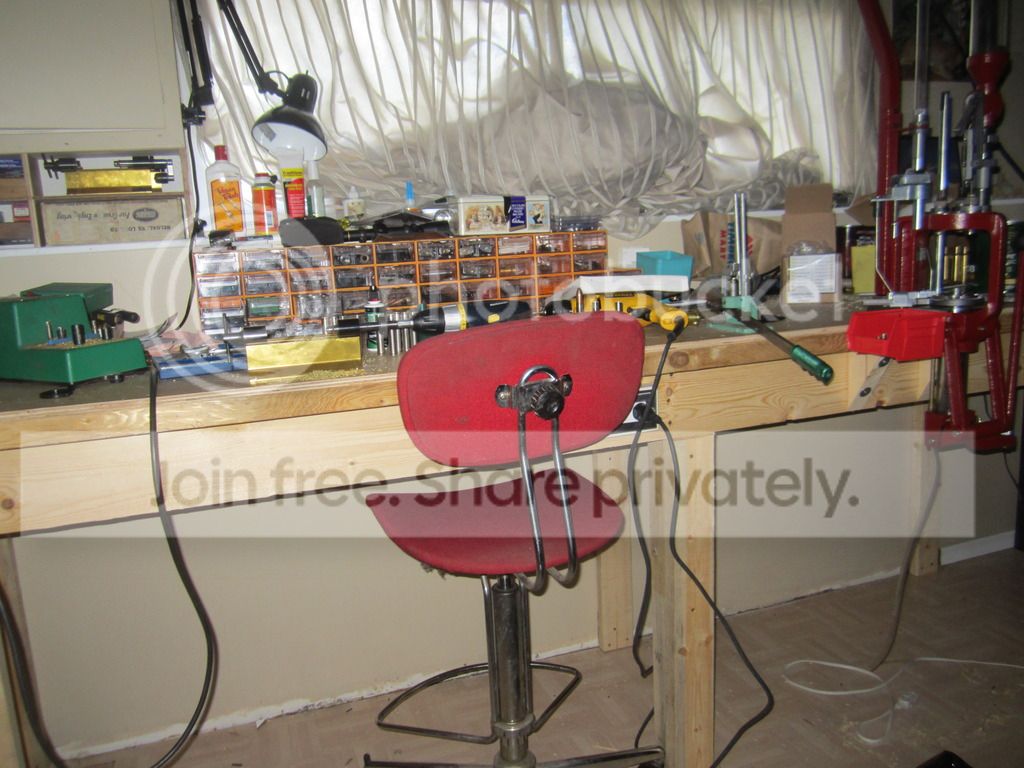


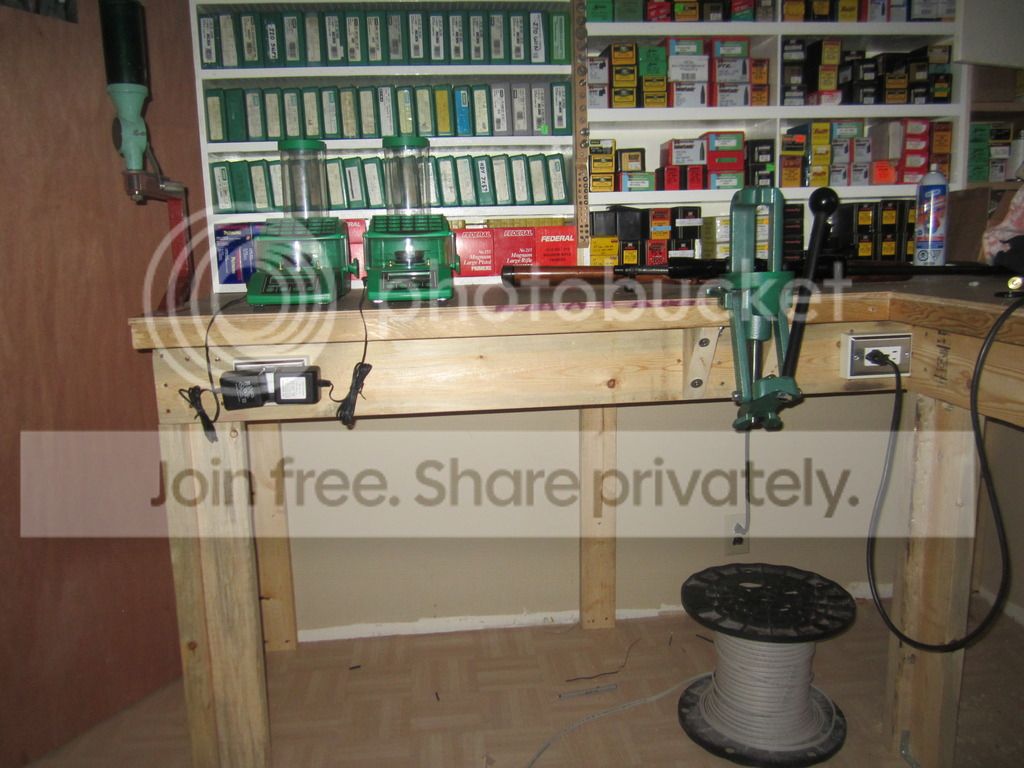


Last edited:

Mine have always been doubled 3/4" plywood, but quality plywood, not rough sheeting. I have never needed steel plate for the presses, but use oversized washers on the bolts underneath the counter... I can't feel any flexing when using the presses.
Thanks for the pics. My first bench worked great until I got a 458 wm case stuck. My anger won. My second bench was as awesome as it was ugly but I've since moved and my man cave is smaller than I had hoped so I need to construct a new one.
I want a nicer looking bench as I'm going to actually finish a room.
I'd like to have nice wood grain table top and wondered if 1" hardwood would do. The frame will be built solid and anchored to both walls and the concrete floor.
Looks like I'll build it with 2"x4" and glue and screw the stained hardwood on top of it and along the front edges.
Thanks for everyone's input
I want a nicer looking bench as I'm going to actually finish a room.
I'd like to have nice wood grain table top and wondered if 1" hardwood would do. The frame will be built solid and anchored to both walls and the concrete floor.
Looks like I'll build it with 2"x4" and glue and screw the stained hardwood on top of it and along the front edges.
Thanks for everyone's input
Bryben on my recent basement shop build I went with kitchen cabinet style lowers, a 3/4" MDF top that extends about 1" past the edge and is trimmed with 1x2 maple. The top from the maple back to the wall is cheap but tidy interlocking engineered flooring. The stuff stands up to sand and grit under shoes for years so I figured it would be a durable and low cost option for a bench top. And best of all the flooring isn't glued down. In fact it can't be as it has to float for seasonal dimensional changes so it won't buckle. For tensioning it at the rear edge to push it against the trim I used short arc cuts of PVC vacuum cleaner pipe as springs.
You can also see in the photo below how I drilled a standard spaced pattern of holes for mounting presses and other tooling. The tooling is then mounted to a 3/4" plywood sub plate and the plate is bolted down.
The results have proven themselves to be just fine, look pretty good and if I should ever damage one or more strips of the flooring the rear "backsplash" panel is removable and I can lift out the flooring, replace the damaged pieces and put it back in place.
It's worked out very nicely thanks to the top being well supported by the lower cabinets which are fixed to the floor and walls. The sub plates also aid in rigidity by spreading around the loads from the base of the press. The result is that any flex there is in the overall system is so slight that I don't feel it.
Best of all the cabinets and drawers give me lots of easily organized storage. And we all need more and better organized storage.
And yes, even the vise you see is on a sub plate and can be easily removed if I want to use that area for something else. The vise is set at the corner using three bolts instead of two as used on the presses.


You can also see in the photo below how I drilled a standard spaced pattern of holes for mounting presses and other tooling. The tooling is then mounted to a 3/4" plywood sub plate and the plate is bolted down.
The results have proven themselves to be just fine, look pretty good and if I should ever damage one or more strips of the flooring the rear "backsplash" panel is removable and I can lift out the flooring, replace the damaged pieces and put it back in place.
It's worked out very nicely thanks to the top being well supported by the lower cabinets which are fixed to the floor and walls. The sub plates also aid in rigidity by spreading around the loads from the base of the press. The result is that any flex there is in the overall system is so slight that I don't feel it.
Best of all the cabinets and drawers give me lots of easily organized storage. And we all need more and better organized storage.
And yes, even the vise you see is on a sub plate and can be easily removed if I want to use that area for something else. The vise is set at the corner using three bolts instead of two as used on the presses.





















