Looking for advice on collet resizing and headspace gauge checks

tendrsolL

New member
EE Expired
Rating - 100%
11   0   0
Location
Above
Hey all, I'm looking for some reloading wisdom.

I recently bought and started using a lee collet die for the first time, after using only FL sizing dies for a few years. After neck-sizing some cases and putting them trough a lyman headspace gauge (this model), I realized all of them fail the headspace gauge test... after double-checking the collet die and resizing methods, the cases still dont fit all the way in the gauge.

-is this to be expected from the fact that the cartridge walls may be a little wider due to fire-forming, causing the cases to not fit in the headspace gauge properly?

-I'd like to keep checking headspace for these cartridges and if so, is a caliper-mounted headspace gauge recommended to use along with collet dies?

If anyone has experience with this issue, I'd love to hear from you.
Thanks!
 
Yes, this is to be expected. I find I can collet size cases for 2-3 firings, then the shoulder needs to be set back, as they won't chamber, i.e. Bolt won't close, or hard to close.
I partially size with a FL die, just eneough that the case will chamber easy. I never just FL size, as I only want minimal clearance on the case base to shoulder dimension. I want .002 clearance in my rifle.
I'm assuming cases fired in the same rifle.
BTW I don't use a "headspace gage", because I want cases custom formed to my rifle.
The big question, for me, is:
Do the cases chamber easy in my rifle.
 
Last edited:
You are using a bolt action rifle?
Just to be sure

My fired cartridges measure 1.630" headspace
Jerry (mystic precision) sold me a body die, that doesn't touch the neck or decap, so i can bring my cartridge headspace back to 1.628". What they call a 2 thou shoulder bump.

Just set it up last night. Keeps the outer diameter of brass body fatter then when i process in a full lenght resize, and can benefit of collet neck sizing on top of it
 
Body die properly set up and used ensures headspace remains what you want. Little need to keep measuring it.

Lee collet neck die handles the neck sizing and maintains low runout.

Voila, prefectly sized case to fit ONE specific rifle.

Jerry
 
If you are using a rifle in the $25,000 range, as I presume Jerry uses, his method will work great.
But if you are using a 6-700 dollar rifle, like most of us do, just full length resize every time with dies in the quality of RCBS price range.
You will have no feeding problems and your brass cases will have a long life span, provided you anneal them after about five shots.
 
Thanks for the answers everyone!! To add a few more details: I'm using a rem700 5R, all cases fired from my own rifle. I still need to try and fit these neck-sized cases in the rifle, I just don't have it here at the moment...

I ordered a hornady headspace comparator to measure them more accurately and I may look into getting a body die to bump those shoulders back, that seems to be the way to go (as per Marty and Jerry).

I'm not dismissing H4831's post (which is good advice) but I have some time on my hands and I think this may help me get even better groupings now... every bit counts!! :D
 
If you are using a rifle in the $25,000 range, as I presume Jerry uses, his method will work great.
But if you are using a 6-700 dollar rifle, like most of us do, just full length resize every time with dies in the quality of RCBS price range.
You will have no feeding problems and your brass cases will have a long life span, provided you anneal them after about five shots.


I am using a Savage 10TR, can't get cheaper than that!
Difference between full lenght resize, and body die + neck collet resize, is "almost" 1/4"@100M
In my mind, was one of the best improvements to my reloads for the price

Still new to reloading rifle, having shot 250 rounds full sized and 60-70 neck sized, i see a difference
Or is it just me getting comfortable behind the rifle?
 
If you are using a rifle in the $25,000 range, as I presume Jerry uses, his method will work great.
But if you are using a 6-700 dollar rifle, like most of us do, just full length resize every time with dies in the quality of RCBS price range.
You will have no feeding problems and your brass cases will have a long life span, provided you anneal them after about five shots.

I wish my rifle was $25,000 :)

the process I use and have done so for many years over many many rifles, started with factory and milsurp rifles because of their wide ranging spec. There is no doubt that you can find a combo of factory chamber AND fl sizing die... that is a wonderful marriage for cost and simplicity. Been lucky a few times over the years.

Unfortunately, my experience shows manfs going to larger and larger chambers. Don't get me started on throat length :-0

My current Ruger predator in 6.5 CM has a chamber so big (brand new to me), the mildly formed brass needs special lube and handling to attempt to fit into a FL sizing die. I gave up and SIZE with a body die instead and this is a very tight fit. There are no shortage of overly long headspace (max spec) factory chambers... not so many as "fat" as this Ruger.

IF, and this is a HUGE IF, the industry actually agreed on the net size of their chambers vs playing with max specs, there would be far more simplicity in die choices for reloaders BUT that hasn't happened and isn't likely to happen as long as the brass case can take up the slack.

Oh yes, die makers can also play around with their dimensions and some choose to make MIN spec FL sizers.

Gotta love Lawyers...

On the other side of the coin, competition shooters have the choice, and more often the resources, to build exactly what they want using reamers of their liking and/or design. The gunsmiths I know that focus on competition stuff have min spec reamers in general. HERE, the use of a specific FL sizing die would be simple and very effective cause the shooter knows exactly what they are working with.

We don't, cause the FL sizing die itself can lead to undesired runout... so we use specific dies, or "better" ones.

When you control all the variables, die choice is simple. When you don't, better have access to a bag of tricks cause you have no idea what you are going to need to makes things hum.....

so why bother with all this multi step fussing???? case head separation... best case, a PITA jam in the chamber... worst case, visit to the local ER.

Oversizing a brass case can be as little as a sheet of paper... excessive expansion and then sizing WILL cause ANY case to separate. For those that shoot very little and may only work that case 1 or 2 firings, you may get away with any die for any chamber. For many reloaders, that case is going to see multiple bangs and that is where a clear understanding of the brass sizing process is good for health and accuracy.

YMMV

Jerry
 
I am using a Savage 10TR, can't get cheaper than that!
Difference between full lenght resize, and body die + neck collet resize, is "almost" 1/4"@100M
In my mind, was one of the best improvements to my reloads for the price

Still new to reloading rifle, having shot 250 rounds full sized and 60-70 neck sized, i see a difference
Or is it just me getting comfortable behind the rifle?

What you are seeing is why competition shooters put so much effort to fit the brass to that chamber. If a case is overly sized, it is going to drop or tilt in the chamber. There is no way that bullet is going to be lined up on the boreline.

When you size the fire formed cases just enough to chamber properly (body die), the rear 1/2 of the case fits precisely and can align the case with the chamber. Ask a machinist to see a taper collet to understand this. Why competition shooters do not want to disturb the web area of a case if at all possible.

The bullet is now aligned with the boreline (assume the chamber was cut straight) and can have a straight launch. The front 1/4 of the chambered cartridge doesn't touch the chamber (it better not) except in the shoulder and the corresponding portion of the chamber upon ignition and maybe the bullet ogive if shooters prefer to jam their bullet.

I think most reloaders think the bullet is aligned by the shoulder, neck and front portion of the case.

Also, brass expands at different rates and the larger the change in sized to fired dimension, the larger each bang can vary. Another reason competition shooters want tolerance as small as possible. This expansion absorbs energy from the powder burn and this change can have an affect on load tuning... no different then varying the amount of powder in the cartridges.

Ammo that varies in powder charge is not going to shoot as precisely as one that does not.

A big reason factory ammo rarely outshoots handloads.

Bet you never thought of ammo this way.....

Jerry
 
I have seen quite the odd case come apart in the chamber on firing, due to excessive length in the chamber. I have been standing in an off-hand shooting match when the fellow shooting next to me had the head blow off of the case being fired and I have been laying next to a shooter in a prone match who had his cartridge case blow its head off. In every instance of this that I have seen, neither the shooter, nor I, being right next to the shooter, knew anything had happened until the shooter opened his bolt and pulled out the blown off head.
In these instances the broken open cartridge case had completely sealed the gas from escaping where it was not meant to escape and another cartridge could not be loaded into the chamber because of the stuck case. This is why many target shooters of the day, as well as many hunters who went on long, wilderness hunts, always took with them a broken cartridge case remover. A cartridge case remover costs only a very few dollars and if you look through my shooting equipment boxes you will see a 303 British case remover that I have and have used.
But you are exactly right. YOUR MILEAGE MAY VARY!
So do all you can to prevent the cartridge from blowing apart in the chamber.
Bruce
 
No disrespect to Jerry but I full length resize when ever possible with the exception of my .303 Enfields.

Below was written by Mr. Salazar in answer to "partial full length resizing" and Mr. Salazar is writing about the benefits of full length resizing.

Reloading: Partial Neck Sizing
by German A. Salazar
http://riflemansjournal.########.com/2010/06/reloading-partial-neck-sizing.html

"Now the last scenario, a full-length sized case in which the neck is also fully sized. There is clearance at the neck and in the body of the case, the closest fit anywhere is the bullet in the throat. If the neck to bullet concentricity is good (although it needn't be perfect), then the bullet will find good alignment in the throat and the case body and neck will have minimal influence. Let's not forget that the base of the case is supported by the bolt face or the extractor to a certain degree as well; this is yet another influence on alignment. As you can see, there are several points from base to bullet that can have an effect. My procedure is to minimize the influence of those that I can control, namely the case body and neck, and let the alignment be dictated by the fit of the bullet in the throat and to some extent by the bolt's support of the base. Barring a seriously out of square case head, I don't think the bolt can have a negative effect on alignment, only a slightly positive effect from minimizing "case droop" in the chamber. Given that a resized case will usually have a maximum of 0.001" diametrical clearance at the web, this isn't much of a factor anyway."

If a case has unequal case wall thickness the thin side of the will expand more and the case will be warped and egg shaped when fired. If this happens and you neck size only the case will be out of alignment with the axis of the bore. And when you full length resize the case body is not touching the chamber walls and cause misalignment. Also if you read the postings at AccurateShooter.com more competitive shooters are full length resizing.

So again no disrespect to Jerry but I belong to the "rat turd in the violin case" club and full length resize my cases.

Y3IiYL5.jpg


Below is the o-ring method of fire forming the .303 British in the Enfields large diameter chamber. Normally the .303 case just lays in the bottom of the chamber and the rear of the case is not centered by the bolt face. Below when the bolt is closed it compresses the o-ring and "centers" the case in the rear of the chamber.

leGysA2.jpg


Below a modern bolt has a recessed bolt face that centers the rear of the case in the chamber. And the cartridge is pushed forward by the ejector and centered by the case shoulder and the bullet in the throat with a full length resized case. Meaning the case body is not touching the chamber walls and has no aligning effect with the bullet in the bore.

IMG_8545.jpg


The neck sizing and full length resizing debate is never ending and the person pulling the press handle decides which method works best.

And if you don't full length resize may the fleas of a thousand camels infest your crotch. :evil:
 
Last edited:
bigedP51, there is nothing to debate.....

The goals of sizing a case are fixed and very well defined. Whether a reloader understands them is moot... the WHY has been established since we were able to reload. Every type of firearm AND task has a well defined receipe...

The HOW is what shooters go round and round on... and the reasons for the "debate" mostly stem from budget and dare I say it, laziness.

If you KNEW a process could cause you and your firearm harm, would you use it?

Of the shooters I have helped over these many years, NONE have gone back to a 1 size fits all solution once they understood what they were really trying to accomplish.

I will never say a Body/neck size is best vs a FL sizer.... anymore then I will say a knife is always better then a spoon. First, the tasks and firearm need to be defined. The HOW then becomes very clear.

The FL sizing example you continually use is fine but can often be out of context. So I think you need to figure out the system being discussed before offering this one solution.

One size most certainly does not fit all.

Jerry
 
I have seen quite the odd case come apart in the chamber on firing, due to excessive length in the chamber. I have been standing in an off-hand shooting match when the fellow shooting next to me had the head blow off of the case being fired and I have been laying next to a shooter in a prone match who had his cartridge case blow its head off. In every instance of this that I have seen, neither the shooter, nor I, being right next to the shooter, knew anything had happened until the shooter opened his bolt and pulled out the blown off head.
In these instances the broken open cartridge case had completely sealed the gas from escaping where it was not meant to escape and another cartridge could not be loaded into the chamber because of the stuck case. This is why many target shooters of the day, as well as many hunters who went on long, wilderness hunts, always took with them a broken cartridge case remover. A cartridge case remover costs only a very few dollars and if you look through my shooting equipment boxes you will see a 303 British case remover that I have and have used.
But you are exactly right. YOUR MILEAGE MAY VARY!
So do all you can to prevent the cartridge from blowing apart in the chamber.
Bruce

And this is really the whole point of what process and tools to use. For the competitor, all their efforts to prep and travel have likely unraveled with a non functioning firearm. On some ranges, they might be politely asked to go home.

For a hunter, loosing the use of their firearm could mean all manner of grief... including getting stomped and/or chewed on. Why would anyone choose to run these type of risks?

Reloaders should make it a priority to truly understand the process of sizing a case and how that fits into the firearms and tasks they want to use. A really important step that can resolve so many functioning issues.

I know many just want a simple answer and avoid testing and trying new options. That is a huge pity as all the benefits of reloading could be lost.

But as it most appropo.... YMMV.

Jerry
 
bigedP51, there is nothing to debate.....

The goals of sizing a case are fixed and very well defined. Whether a reloader understands them is moot... the WHY has been established since we were able to reload. Every type of firearm AND task has a well defined receipe...

The HOW is what shooters go round and round on... and the reasons for the "debate" mostly stem from budget and dare I say it, laziness.

Jerry

You are correct about laziness, people who neck size are too lazy to lube and wipe off their cases.

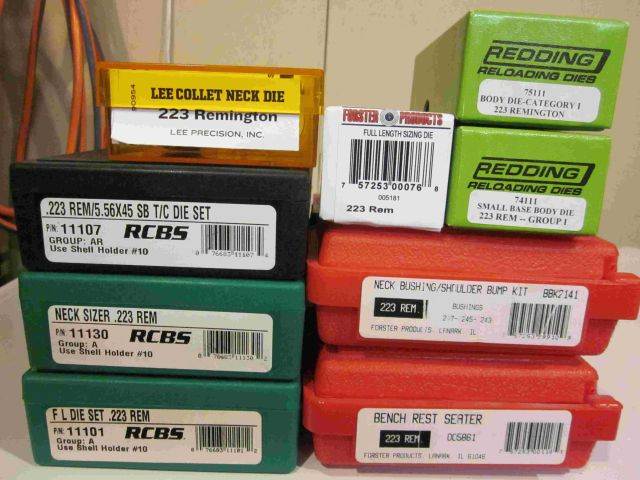
And at the Whidden custom die website they tell you they get the most concentric cases with non-bushing full length dies.

Below are the .223 dies I experimented with and the Forster full length dies produced the least neck runout on sized cases.

pltdloo.jpg


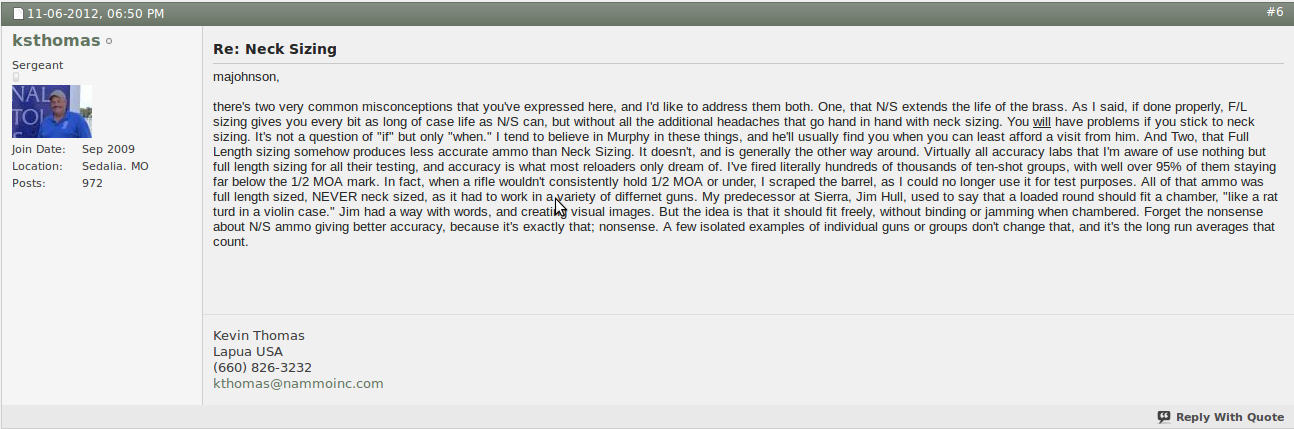
On top of this the information I posted by Kevin Thomas of Team Lapua USA and prior to this worked in the Sierra ballistic test lab I would say knows what he is talking about.

And no offense Jerry there are many people who swear that the Lee collet die is the best thing going. "BUT" I'm not one of them and prefer the Forster full length benchrest dies with their floating expander. And this is because the full length resized case is more concentric and fits the chamber like a rat turd in a violin case. Meaning giving the case wiggle room and letting the bullet be self aligning with the bore.
 
This is for hunting rifles that I spend a lot of time at the range with.
I've reached the point with my handloads that I use a Redding body die to size my cases just enough to have zero resistance when being chambered. I took the ejector plunger and firing pin out of the bolt to get a good feel of it. Then I use a Lee collet die to size the necks. Neither one of these steps changes the concentricity of the case and it allows me to skip messing around the inside of the necks(lubing and cleaning). I found when I had to mess around with the inside of the necks, I always had inconsistent bullet seating pressure on the press. I'm not sure if that was the main cause or not but now that I don't disturb the inside of the necks at all, the seating pressure feels more consistent. The only step now that influences runout for me is seating the bullets, so I'm thinking of getting some Forster BR seating dies.

I strive for clearance but not too much, and so far I'm getting good reliability and case life (10+ On 3 different calibers) with no obvious signs of head separating. I'm actually not sure what number to retire the brass on if I haven't found signs of separation or loosening primer pockets.
 
mod7Rem, the actual lifespan of a well prepped and maintained case is neither separation or primer pocket.... It is the flash hole shape and diameter.

If you fired a case enough, especially under higher pressures, the hole will erode... at some point, the batch of cases will have enough variations that the ignition process goes out of whack. If you kept consistent tabs on velocity with a quality device, you will start to see ES and SD of your best loads start to get much larger then expected

Since there is no way to repair this, that case and likely, that batch of cases, should be retired. The SP cases are more sensitive to this then the LR primer stuff. And yes, some are using pin gauges to keep tabs on this growth.

Another limit will be the elasticity of the alloy itself in the areas of the case you can't anneal. There is no one answer to this as each manf has their own receipe and each lot has it own quirks. You will start to see cases hard to extract with the same everything and really no pressure signs. The case body has worked hardened enough there is no spring back when fired... the case wall just "fuses" to the chamber and becomes hard to remove.

Assuming you keep up with proper annealing, neck splits are rare.

The limits are really tied to the overal pressure of the bang... keep things moderate and good alloy cases can last a very very long time. Throttle up and things will simply wear out.

Your loading experience mimics many competition shooters and your assumptions do agree with what we see and likely improve on target performance. The reason for the Forster, or any "better", inline seater is if the seated bullet has more runout then that bullet design prefers. you will hear all many specs for what is ok and not... but this is bullet specific and many hunting styles just don't care. Like everything, measure, test and see what happens.

The inside surface and consistency of the case neck is very important in bullet release... but that is another story.

Jerry
 
Last edited:
You are correct about laziness, people who neck size are too lazy to lube and wipe off their cases.

And at the Whidden custom die website they tell you they get the most concentric cases with non-bushing full length dies.

Below are the .223 dies I experimented with and the Forster full length dies produced the least neck runout on sized cases.

pltdloo.jpg


On top of this the information I posted by Kevin Thomas of Team Lapua USA and prior to this worked in the Sierra ballistic test lab I would say knows what he is talking about.

And no offense Jerry there are many people who swear that the Lee collet die is the best thing going. "BUT" I'm not one of them and prefer the Forster full length benchrest dies with their floating expander. And this is because the full length resized case is more concentric and fits the chamber like a rat turd in a violin case. Meaning giving the case wiggle room and letting the bullet be self aligning with the bore.

Ummmm, I don't think that makes any sense... If using any conventional neck sizer with an expander ball, you BETTER lube the inside of the case neck or all manner of runout will occur. The only neck sizer where lube is not needed is the Lee collet neck die simply because of how the die operates AND that is the whole reason to use this die.

The other would be a bushing neck die where there is no expander ball.

But I always suggest body sizing when using a neck sizer to ensure proper chambering. SO, going the neck sizing/ body sizing route takes 2 steps... that would be MORE work. It most certainly includes 1 step requiring lube.

If you got more runout using the Lee collet neck die then ANY die with an expander ball, you win the prize cause many many users of the LCD simply can't make neck runout. I routinely test all my dies, various cartridges from my rifles. The LCD is the only neck sizer that gives consistently zero change in runout... not a little change... NO change.

If you can create runout with the LCD, not sure what to suggest.

If you feel a poorly fit case is a better way to center up a case in a chamber, I really hope you enjoy hard jamming a bullet cause I don't see how any other method gives you a hope for success... ie properly aligning the bullet with the bore. And hard jamming is still iffy if the case has enough slop to "point" that bullet away from true before it hammers the lands.... one of the reasons, we just do that much anymore.

BUT, hey, I would really like you to talk to the top Ftr shooters in NA to follow your prescription. It would make my life of beating them so much easier.

Jerry
 
mod7Rem, the actual lifespan of a well prepped and maintained case is neither separation or primer pocket.... It is the flash hole shape and diameter.

If you fired a case enough, especially under higher pressures, the hole will erode... at some point, the batch of cases will have enough variations that the ignition process goes out of whack. If you kept consistent tabs on velocity with a quality device, you will start to see ES and SD of your best loads start to get much larger then expected

Since there is no way to repair this, that case and likely, that batch of cases, should be retired. The SP cases are more sensitive to this then the LR primer stuff. And yes, some are using pin gauges to keep tabs on this growth.

Another limit will be the elasticity of the alloy itself in the areas of the case you can't anneal. There is no one answer to this as each manf has their own receipe and each lot has it own quirks. You will start to see cases hard to extract with the same everything and really no pressure signs. The case body has worked hardened enough there is no spring back when fired... the case wall just "fuses" to the chamber and becomes hard to remove.

Assuming you keep up with proper annealing, neck splits are rare.

The limits are really tied to the overal pressure of the bang... keep things moderate and good alloy cases can last a very very long time. Throttle up and things will simply wear out.

Your loading experience mimics many competition shooters and your assumptions do agree with what we see and likely improve on target performance. The reason for the Forster, or any "better", inline seater is if the seated bullet has more runout then that bullet design prefers. you will hear all many specs for what is ok and not... but this is bullet specific and many hunting styles just don't care. Like everything, measure, test and see what happens.

The inside surface and consistency of the case neck is very important in bullet release... but that is another story.

Jerry

Thanks for the great info Jerry, I do regularly anneal and have never experienced a case neck split. In my earlier days of reloading I did experience poor case life because of case head seperation, which was my lack of knowledge and my bad practices.

I didn't realize the flash holes could limit the life of cases, I do keep velocity records using a Labradar but not sure if my rifles and my loading ability are capable of singling out changes caused by flashhole erosion.
Thanks again.

Trever
 
Back
Top Bottom