Looking for No.4 rifle barrel block to use with receiver wrench

maple_leaf_eh

CGN Ultra frequent flyer
Rating - 100%
96   0   0
I have been entrusted with a No.4 receiver wrench to do a few removals and installs. However, the wrench is only half the equation. As we all know, the No.4 barrel profile is a cone with a flat, known as the Knox Form. Who can help me with a short-term loan of a barrel block .... or .... good drawings for one? I want to pass on the next generation.
 
I have a set of barrel vise blocks that consist of two cast steel halves about 4" long 2 1/2" wide that when the 2 halves are mated together there is a 1 1/2" dia hole lengthwise through the blocks. To use, you put the barreled action vertically in your bench vise, poke a hole in a piece of cardboard and slide it over the barrel down to the top of the vise, now take the two halves of the barrel vise blocks and set hem on top of the cardboard on the vise, cut 2 strips of cardboard big enough to extend outside the blocks and place 1 strip of cardboard between each half of the block and slide it against the barrel, now secure this assembly with a C-clamp. Now you melt enough lead in a pot or ladle to fill the cavity and pour it in. After the lead cools, remove the C-clamp and the cardboard, and you now have a set of blocks for your barrel vise. Removing the cardboard strips allow for some squeeze in the vise. Some masking tape on the bottom cardboard and the barrel will reduce molten lead leakage. I have had these since the late 80s and used them many times, remelting the lead over and over. I don't know where you can find them to purchase, but they are pretty low tech to reproduce.
I could probably get some pics if that description is lacking

 
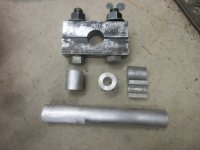
Here is a barrel vise I've used for years. 1 1/2" bars, 1 1/2" diameter aluminum bushings. Make them as I need them. 7/8" clamp bolts. Currently mounted on the edge of a workbench using a piece of heavy angle iron. Bolts pass through one side of the angle, the other is screwed to the edge of the bench. A salt shaker of resin is kept handy.
I made a few of these for sale. Quit when the cost of the materials, the time to make them and the cost of mailing them put the price higher than I thought to be reasonable.
IMG_1057.JPG
 
Mine is similar to Tiriaq's - might be made by him? Except bolts are 5/8" Fine Thread. Bolts thread into Lower half. Has an 1.5" diameter hole through, at right angles to bolts - I turn 1.5" outside diameter aluminum rod as needed - is possible to ignore the "Knox form" and simply make a tapered insert to hold that barrel in the barrel vice - I have seen some pictures of guys having 4" or more between barrel vice and receiver wrench - I do not like that, but it might work - too much opportunity for things to twist, I think - I like them to be close - like no more than 1/8" or so. I put wrap of paper or two around work piece - seems to help with "grip" and avoids any inadvertent transfer of aluminum to workpiece when tightened. Aluminum inserts seem to have "flowed" a bit with use - what had started as "rough machining" is actually very smooth now. I had read that some make inserts from steel - no guts for that, on my part.
 
I didn't make any sets with one bar threaded - always used nuts and bolts.
If there is any aluminum smear, metal fouling bore cleaner will remove it.
No. 4 barrels can be in tight. If the barrel is a scrapper, cut a relief groove. Lee Enfield receivers can be damaged; make sure the receiver wrench fits well. Started with a home made receiver wrench then made inserts to fit a Brownells receiver wrench
Tapered bushings to grab the Knox Form would be a good idea. There is also a design that is tapered, but has a flat plate that seats against the barrel flat.
The aluminum bushings do deform, in a good way.
With respect to making barrel vises like this, I have a power hacksaw. Takes a while to cut off 1 1/2" barstock. Drilling 3/4 or 7/8 holes is too much for my drill press - I do them with the mill or the lathe. The hole for the bushings is drilled and bored on the lathe using a 4-jaw setup. Cardboard is clamped between the bars when the bushing hole is made to create a crush when the barrel is clamped.




 
I am more set up for working with wood, versus with metal - so, still learning with the old Atlas lathe - and I might be doing stuff that a machinist would never do! I think my three jaw chuck and head stock are "close enough" to the axis of rotation of the head, so I hold the 1.5" O.D. in my three jaw chuck - then I use 1/4" bit in head stock and drive that through - making a "pilot hole" for subsequent bits - assuming barrel of interest is more than 3/4", I will use a 3/4" bit in headstock - else I use the 1/2" bit - gets a hole through the insert. Any chuck jaw marks on O.D. just help hold in Barrel Vice (I think). I then use inside reamer bit to turn inside to size - most of the bulk has been removed with drill bit. Then grab junk piece of 2x4 - drill a 1.5" hole through it - rip the thing in half - then use 3" deck screws to "clamp" a "to be" aluminum insert (that already has hole inside) into 2x4. I use my sliding compound mitre saw - with a blade with carbide teeth - go slow and it cuts aluminum just fine. Set the 2x4 "block" against the fence - on end - cut through top edge into and through the aluminum insert - that leaves healthy "kerf" for eventual clamping - can continue down with sliding mitre saw - start cut on one face through to wood - 2x4 "clamp" is still holding - then reverse the "block" and cut through from other side - stuff goes flying when cut is all the way through - if you cut through the entire block of wood. It is possible to just take aluminum, without getting much wood. Unscrew deck screws to release clamp - or pick up pieces - there is your insert with sufficient "clamping" clearance for the barrel vice. 2x4 into junk bin. I have made like 5 or 6 pairs of aluminum inserts as they were needed - some subsequent barrels used the same size as a previous one - is not terribly onerous for me to make a new one as needed, though.
 
Last edited:
Back
Top Bottom