












































You are using an out of date browser. It may not display this or other websites correctly.
You should upgrade or use an alternative browser.
You should upgrade or use an alternative browser.
LRMOA (Sightron)
- Thread starter Spcamno
- Start date

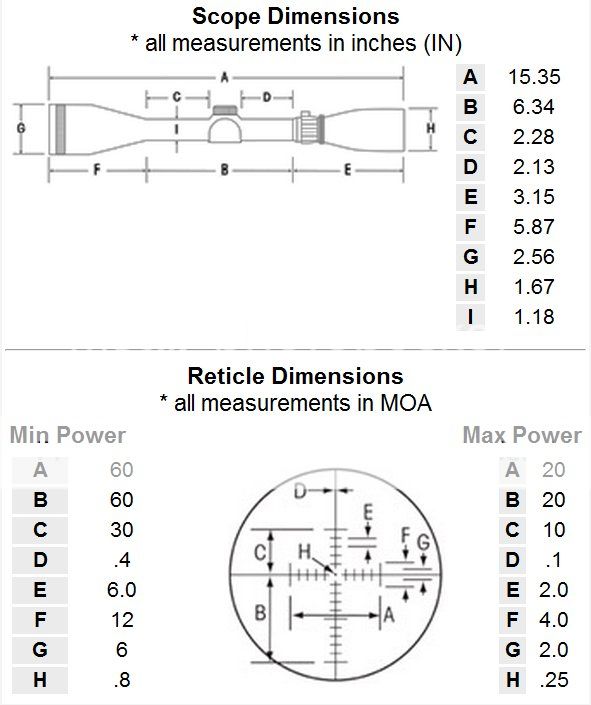

There are plenty of YouTube video describing how to use MOA. It's actually pretty easy once you get the hang of it. It's a lot harder to describe than to do.
But, in short, if you have a known object, say a 12" round gong, then you use your MOA reticle to meaure it's size in relation to the MOA hashmarks. So taking a look at the picture you post, if you dial back to Min Power, "F" is 12 MOA, or about 12" (yes, it's not really 12", I know) at 100 yards. If you range that gong at being the same size as F and Min Power, then the gong will be 100 yards away. Likewise, if the gong appears to be 1/2 of F, then it would be about 200 yards away, and so on. Likewise, at Max Power, each hashmark "E" is 2 MOA. So at 100 yards, that 12" gong will appear to be 6 hash marks. If it appears to be 3 hash marks high, then the gong is really 200 yars away. Etc.
I probably just did a piss-poor job of expaining it, but there you go. To better understand it, take a known object, put it at 100 yards, and play around with the magnifications and hashmarks, see what makes sense. Move the same object out to 200, 300, 400 yards, and repeat. It will make a lot more sense then.
But, in short, if you have a known object, say a 12" round gong, then you use your MOA reticle to meaure it's size in relation to the MOA hashmarks. So taking a look at the picture you post, if you dial back to Min Power, "F" is 12 MOA, or about 12" (yes, it's not really 12", I know) at 100 yards. If you range that gong at being the same size as F and Min Power, then the gong will be 100 yards away. Likewise, if the gong appears to be 1/2 of F, then it would be about 200 yards away, and so on. Likewise, at Max Power, each hashmark "E" is 2 MOA. So at 100 yards, that 12" gong will appear to be 6 hash marks. If it appears to be 3 hash marks high, then the gong is really 200 yars away. Etc.
I probably just did a piss-poor job of expaining it, but there you go. To better understand it, take a known object, put it at 100 yards, and play around with the magnifications and hashmarks, see what makes sense. Move the same object out to 200, 300, 400 yards, and repeat. It will make a lot more sense then.
Thanks Moose308 for taking your time to respond to my post and your detailed explanation!
I understand better now however, the two units given above ( A to H ) they are only meant to be use at their recommend power setting ie either lowest or highest correct?
I understand the hashmarks now but how often one will use the "D (.4)" or " H(.8)" for ranging?
I really need to get out to the field and practice ranging but this reticle definitely seems faster to accquire range than the traditional mil-dot and does not cover the target as much vs mil-dot.
I understand better now however, the two units given above ( A to H ) they are only meant to be use at their recommend power setting ie either lowest or highest correct?
I understand the hashmarks now but how often one will use the "D (.4)" or " H(.8)" for ranging?
I really need to get out to the field and practice ranging but this reticle definitely seems faster to accquire range than the traditional mil-dot and does not cover the target as much vs mil-dot.
I suspect if you search hard enough, especially if you are really dedicated to using the reticle to estimate range, that you will be able to find a chart of all the subtensions, at pretty much every magnifiication. If it's not already published, it should be easy to build your own chart for each magnification. Just subtract the min from the max, and dividing by the number of magnification range. That might be a handy chart to have in your pocket. On the back side of that chart, have a table of bullet drops in MOA for every 50 yards.
Thanks Moose for your reply and advice.
I totally agreed with you and I need to either locate a chart or prepare my own along with the ballistic chart to practice and explore more to utilize the scope's full potential.
Now I have to go back to grade 4 math and so some numbers crunching(LOL).
Thanks again for taking time to answer my questions, its a huge help to understand these reticles.
I totally agreed with you and I need to either locate a chart or prepare my own along with the ballistic chart to practice and explore more to utilize the scope's full potential.
Now I have to go back to grade 4 math and so some numbers crunching(LOL).
Thanks again for taking time to answer my questions, its a huge help to understand these reticles.






















