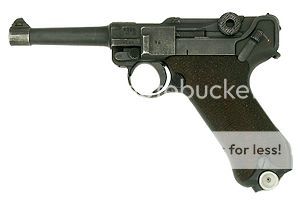
Luger reproductions.

Skinny 1950

CGN Ultra frequent flyer
EE Expired
Rating - 100%
42   0   0
Location
Vancouver
I would really like to have a P08 but with a 3.74 inch barrel that is out of the question so I would settle for a reproduction with a 4.25 inch barrel.
The knee action is unique and I don't really know how it works or how reliable it is.
I don't know of any gun maker that makes a reproduction Luger in 9MM and I am wondering if the design is so tricky that no one wants to touch it or if there is some reluctance to reproduce things that remind us of the Third Reich.

300px-Parabellum_15861.jpg
 
I would really like to have a P08 but with a 3.74 inch barrel that is out of the question so I would settle for a reproduction with a 4.25 inch barrel.
The knee action is unique and I don't really know how it works or how reliable it is.
I don't know of any gun maker that makes a reproduction Luger in 9MM and I am wondering if the design is so tricky that no one wants to touch it or if there is some reluctance to reproduce things that remind us of the Third Reich.

300px-Parabellum_15861.jpg

Go buy an original.

Or one of those refurbished ones that mauser turned out. They're not that expensive.
 
There was one company (Mitchell Arms) making reproduction Lugers in stainless steel but they stopped making them many years ago... Plus, it was prohibited due to barrel length! There were modern Lugers made in Switzerland also but the price was very high...

Your best bet is to get one of the variant with a slightly longer barrel such as a Swiss or the Swedish rebarreled... Or get one that was rebarelled to comply with our current laws...
 
The Luger really dates back to the turn of the 20th century, and so is pre-Nazi by a few decades. They were the sidearm everyone wanted to bring back from WWI as a souvenir, and by the time WWII had started, while still in use in large numbers, they were secondary to the Walther P-38.

The Luger has a complex trigger-sear linkage that makes manufacturing expensive. It also makes them have a trigger feel that is anything but crisp as it come from the factory. They are sensitive to functioning reliably with anything other than jacketed bullets, and don't do well when dirty.

The toggle link that allows the action to lock is derived from the Borchardt pistol, and while it's ingenious, it's far too complex for economical manufacturing. The Borchardt used a large "clock spring" to return the action to battery, and has a large housing that hangs over the grip for the spring. Georg Luger refined the design to allow for a much smaller leaf spring to be used, which after the first production series was changed to a coil spring . There are a few other guns which have used a similar kind of lock, but not many. Swiss Lugers and Navy Lugers were made with 6" barrels, and a model made for artillery crews with an even longer barrel was made. None of them is inexpensive. I don't know anyone who is making them now because they just cost too much to manufacture.

Lugers were made with a slot in the backstrap to accomodate a wooden board stock using an "attaching iron", but really, only the Navy and Artillery Models were routinely issued with the stock. The Artillery Model also was issued with a high capacity "snail drum" magazine. A small number of Luger carbines were as a luxury item. Lugers were marketed very, very aggressively all over the world, and they are quite literally a little world all by themselves. There are gunsmiths like Barry Jensen of Bits of Pieces in Delta, BC, who will replace the 4" barrel with a longer, "restricted" barrel and re-register the gun. It all costs a fair amount, though.

The "knee action" works by recoil. When a cartridge is fired, as the linkage is shoved backward by the recoiling casing, the action and barrel recoil together for a very short distance, and then the recoiling action strikes a surface that allows the action to "break" at the hinge point in the center, lifting the toggle link and opening the breech. A spring closes the action again, stripping a round from the magazine. It works quite well and even a machine gun was made that used that kind of action. After the first series of Luger pistols were produced, it was noticed that the action didn't always close completely, and an "anti-bounce" lock was introduced. They're interesting guns from the early period of gun design and manufacture. Good luck with your hunt.

 
Thanks MYF for the information...I know a lot more about Lugers now. There was a company making .22 cal. Luger-like guns but from the pictures it looked like they were made with cheap stamped out parts and didn't inspire much confidence as far as reliability goes.

 
There are both conversion units for Lugers (made by Deutsche Waffen Machinenfabrik = "DWM") and .22 pistols (and .32 ACP) made by other firms. The DWM .22 conversions used to be issued to military units for practice, but there were never a lot of them, and they're hard to find now (and expensive). No .22 Lugers were made. The pistols made by the other companies may look cheap, but they're .22 pistols, just as "heavenIsAlie" wrote. The toggle link used in the Luger is one of the strongest action locks ever made, and the 9mm version is just too strong for a .22 cartridge to operate reliably. But there's nothing wrong with the .22s; they're just not traditional "Lugers".
 
Mauser made a number of interesting Lugers in the 70s and 80s. I have a prohib on the way and it is going to be re-barrelled, and end up looking somewhat like this one:

attachment.php


However, it will have a custom rear sight base machined and will fit a Ruger flat top sight assembly. like this:

attachment.php


Herbert Werle of Germany makes fantastic Lugers, both new and modifications of mismatched shooters. Krausewerks USA also makes excellent copies, as did John Martz. All three also make/made .45 ACP versions in various flavors. Herbert Werle charges up to 2400 EUROs for a new production Luger in a standard caliber, and there are rumors that Krausewerks and Werle charge up to $15000 for a .45 ACP version.
 
Mauser made a number of interesting Lugers in the 70s and 80s....

Herbert Werle of Germany makes fantastic Lugers, both new and modifications of mismatched shooters. Krausewerks USA also makes excellent copies, as did John Martz. All three also make/made .45 ACP versions in various flavors. Herbert Werle charges up to 2400 EUROs for a new production Luger in a standard caliber, and there are rumors that Krausewerks and Werle charge up to $15000 for a .45 ACP version.

I believe Stoeger (who I believe own the Luger trade name) made some genuine Lugers in the 50s or 60s. The .22 versions referred to were made by Erma, who in their declining years made a number of "famous lookalikes". I have an Erma-made "Winchester" lever action .22 which is not bad at all but I've heard their "Lugers" were iffy.

Thanks for the info on the German re-manufacturers. I'd heard of Martz but not the others. $15k for a .45 ACP version? Ouch. But vastly cheaper than trying to obtain one of the only 3 known originals built by DWM for the US Army trials!

Werle looks pretty drool-worthy: www.waffen-werle.de/. Krausewerk pics don't seem load, but there are lots of misplaced apostrophes (!) I remember Krause now, from an article on the Baby Luger in a magazine a few years ago.

(BTW, your Luger pic doesn't appear, either.)

:)
 
Last edited:
Look at the date!

Ye gods... Well, he ought to have the &$&$& thing by now and update the pic, gol' darnit! :p

BTW, I was just on the Waffen Werle website again and he has a double-barrel Luger carbine - .22 LR and 9mm. Actually, two guns in one housing. I wouldn't want one myself but I have to give him credit for ingenuity, however impractical.

:) Stuart
 
Back
Top Bottom