lyman 45 help

gvanzeggelaar

CGN Regular
Rating - 100%
62   0   0
I just picked up a used lyman 45 and am trying to figure out how to get the grease sticks in this thing. When I look down into the grease tube there is a steel(might be brass) washer about 1.5" down from the top.

Now no matter what way I turn the grease screw this washer does not go any deeper or come up out of the grease tube. The screw just goes further into the grease tube and out of the bottom.

Anybody have any ideas?
 
Go to the lyman site and download the manual. There should be a parts diagram that will help.

There is a washer with 2 o-rings that moves up and down the tube when you turn the screw.
 
Possibly stripped?

Tough to tell without seeing it first hand.

Do a search over on Castboolits and find the manual and parts book for it, and see if you can get it apart. You may have to resort to heating the whole unit to soften the lube in it.

<edit to add> Just checked on one of mine. The screw should back out the bottom of the lubesizer as you 'tighten' it. It is a RH thread, but you would be turning it from the threaded end, rather than the bolt head, if it were a bolt. If the threaded rod is not coming out or the washer moving, I'd call it stripped.

Give it two dozen turns and see if the threaded rod is moving.


Cheers
Trev
 
Turning the screw to the right should bring the plunger out. Threads are pretty fine, so takes a lot of turning.
The "washer," you are looking at is the plunger that forces the lube to the bullet. There is an "O" ring around the outside of it, which keeps it from turning, and brings it out. If, by any chance, the ring is turning, you will have to figure some way to stop it from turning, while you get it out to repair it.
If it does not turn as you turn the bolt, just kep turning to the right and it will come out.
 
Y'all must have a different Lyman 45 than my two. Mine have a brass ring around the washer, no O-rings.

A later version than mine, perhaps?

Cheers
Trev
 
lyman 45

the screw should not come out the bottom this means that it is broken probably due to screwing the plunger to far down. clamp it to a bench so the screw can not come out bottem and turn the screw clockwise and the plunger will come up and out the top. you should be able to remove the bottom. the screw will have to be reattached by beazing or welding or new parts obtained. good luck
 
I missed that, "Screw coming out of the bottom."
All bets are off!

Well. I checked both of mine. The screw comes out the bottom of both of them, if you crank it when it is not bolted to the bench. That's how it was made. Neither is broken.
The bench stops the screw from backing out, thus pushing the piston up to the top of the cylinder.

One's an Ideal, the other has a Lyman sticker on it. Pretty sure the Lyman has never been used. The Ideal is about half full of black lube of some sort. Gonna have to clean that out.

The "manual" from a 45. Not much info, really.

http://home.comcast.net/~imashooter2/Lyman_45.pdf

The Lyman 4500 instructions (with O rings, waddya know!)

http://www.lymanproducts.com/lyman/bullet-casting/pdf/LyC_BC_LS_4500.pdf

The screw comes out of the main body through the bottom of the lube chamber on it, too.

Sooo.... If the piston is not turning, and the pressure screw is not retained by being bolted to a bench, it should come out the bottom of the casting, or it's stripped.

Cheers
Trev
 
If the o-rings don't create a tight fit, that "washer" will not move up the shaft either. All part of the joys of casting.
 
Well. I checked both of mine. The screw comes out the bottom of both of them, if you crank it when it is not bolted to the bench. That's how it was made. Neither is broken.
The bench stops the screw from backing out, thus pushing the piston up to the top of the cylinder.

One's an Ideal, the other has a Lyman sticker on it. Pretty sure the Lyman has never been used. The Ideal is about half full of black lube of some sort. Gonna have to clean that out.

Sooo.... If the piston is not turning, and the pressure screw is not retained by being bolted to a bench, it should come out the bottom of the casting, or it's stripped.

Cheers
Trev


It will have to be described better, or photgraphed for me, as I can not get my mind around a piece of equipment that would depend on another surface, your loading bench, or kitchen table, to turn against, in order to operate!
Mine is not too old, maybe 30 years, and is marked Lyman 450. I think the earlier Lyman equipment was marked Ideal.
That centre bolt is held in the bottom in some sort of ring retainer that allows it to turn, with pressure each way. In other words, it is held from going up, in order to push the piston down and push lube to the bullet. It is held from going down, in order to raise the piston.
In what you describe, what holds the bolt from coming up, in order to lube the bullet?
Here is a picture of the bottom of mine.

LY001.jpg

And here is the piston. It looks like two "O" rings around it, but it is actually a rubber, of some type, gasket.
LY004.jpg
 
Yeah. That's a 450.

The 45 is a lot different. Well. Other than doing basically the same job, with the same dies.

Search for a picture of a Lyman #45 or an Ideal #45, same thing. Not the same as your 450. Different castings. The 450 is a more solid chunk of iron.

They stuck with the same theme on the interior of the evolved product line through the 45/450/4500. They sure look a lot different on the outside.

On my 45's, the pressure screw is not positively retained except by the bench or plate that it is bolted to. It does not have a seal on the base end of the screw either.

I'll try to get a picture or two up tomorrow if you want to see them.

<edit> I saw that I didn't actually answer the question. The head of the pressure screw keeps it from being pulled up through the bottom of the casting, same as yours does. The head cannot pull up, so the washer/piston has to move down and compress the lube. But when the screw does not have a table under it, it will take the path of least resistance and come out the bottom when turned so as to lift the washer up to refill it. See that mess of center punch marks around the bottom of yours? Someone was trying to keep that from happening, from the looks of it.


Cheers
Trev
 
Last edited:
trevj said--<edit> I saw that I didn't actually answer the question. The head of the pressure screw keeps it from being pulled up through the bottom of the casting, same as yours does. The head cannot pull up, so the washer/piston has to move down and compress the lube. But when the screw does not have a table under it, it will take the path of least resistance and come out the bottom when turned so as to lift the washer up to refill it. See that mess of center punch marks around the bottom of yours? Someone was trying to keep that from happening, from the looks of it.

Sorry, but you are not right yet.
What you call, "the head of the pressure screw," is merely a cap, to keep dirt out of the lube and a guide for the top of the screw. By guide, I mean there are no threads in the cap. It is a bearing surface for the top of the screw. The little round circle in the centre, in the picture, is the bottom of the screw. It is obviously held in place, so it can't raise or lower, by the centre, round plate, shown. Those centre punch marks shown are from the factory, as I bought it new and never touched it.
This round plate likely is held by a shoulder from rising, thus alowing for great pressure in forcing lube to the bullet. The centre punch marks, to me, represent a poor engineering design, but is what will keep the plate from lowering, as the piston is being turned up, to refill with lube.

Now I will do some guessing. Those lubricators that people are talking about, where the screw extends out the bottom, has had an operator who, at sometime, has forced the piston up, it does go hard, and forced the round plate off the bottom. As I stated, a centre punch is a very poorly designed method of holding that round plate in the machine.
With the press now bolted to a table, the lubricator would continue to operate, as the table would keep it fom lowering, thus forcing lube in the bullet. I would not operate it this way.

To the OP who said the screw was protruding out the bottom, here is what I would do. Thoroughly clean the lubricator. Push the round plate up into it's proper place. Drill about three small holes exactly in the crack, between teh plate and the cast iron, equally spaced around the circle. With a tap (for making threads) a bit larger than the hole, thread your holes to accept short, flat headed screws. Be sure the screws go in enough to prevent marking the surface the lubricator is bolted to.
Your instrument will now be superior to what it was when it left the factory.
I am now finished with this thread.
 
You shouldn't be through with this thread. You seem to think the 45 is the same as the 450 you have. It isn't.

You are trying to solve a problem, that isn't one on a 45. The 45 does not use the staked in plug that the 450 does. Just a hole in the casting. Different animals for sure. If he drills and taps anything like you suggest, he'll screw it right up. The pressure screw needs to turn, eh.:)
Lousy design using that bloody plug, for sure.

Have you had your 450 apart? Taken the screw out of it? It comes out the bottom of the chamber. Through the larger plug.

To the OP. Turn that damn screw the other way. It'll then squeeze the lube like it is supposed to. First it will travel all the way up to the casting, then it will start to move the piston.

Otherwise, to lift the piston to the top, to refill it, push the protruding screw back up. The screw came out the bottom because that was the path of least resistance. Push it back. It'll take some actual pressure, esp if the lube is fairly hard.

Maybe this will sort this mess out.

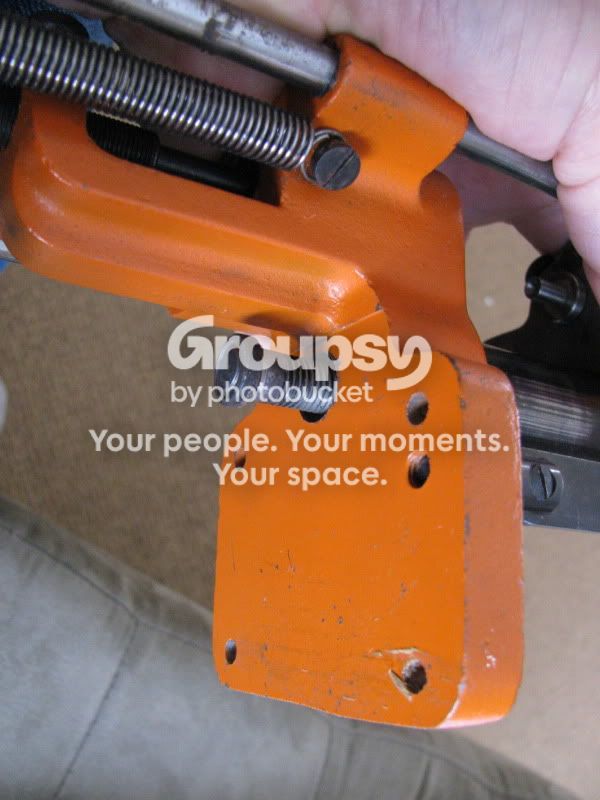
Showing the screw protruding from the bottom of the casting.
IMG_1674.jpg


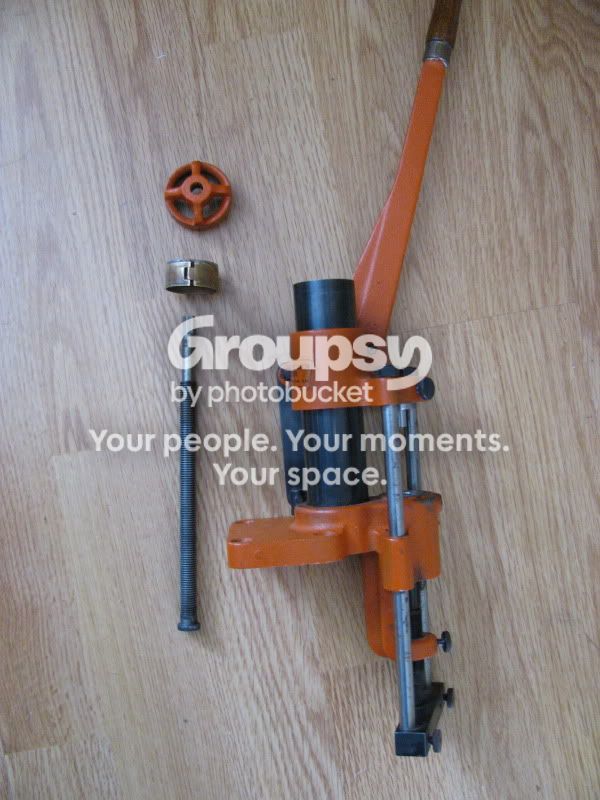
Showing all the parts from the lube chamber laid out beside the Lyman #45


IMG_1676.jpg


Cheers
Trev
 
Last edited:
You shouldn't be through with this thread.

You are trying to solve a problem, that isn't one on a 45. The 45 does not use the staked in plug that the 450 does. Just a hole in the casting. Different animals for sure. If he drills and taps anything like you suggest, he'll screw it right up. The pressure screw needs to turn, eh.:)

For pitty sake, read my postings and look at the picture!
I told him to drill in the exact ring where the punch marks are. That round plate, 1 1/4 inches across, does not turn. the 5/16 th flat srew bottom in the centre of it turns. What I told him to do will not "screw it right up," but would leave it in better condition than when it left the factory.

I have no problem to to solve. I was trying to help out someone with a lubricator he is not familiar with, and so far, I think I have been very polite.
 
Look again. He does not have that ring where the punch marks are. He has a Lyman 45, not a 450. Different beastie. So maybe not so helpful.

Cheers
Trev
 
Alright I got it figured out. Nothing was stripped or broken so it's all good. The brass washer was spinning with the grease screw. I found a way to stop that so I am good to go.

Thanks guys
 
Any luck finding a mold or sizer dies?

If you are not adverse to the wait, take a look on castboolits on the Active Group Buy forum. There are three different group buys going for .22 cal molds. One is a copy of the 225107, a nice bullet for a Hornet. Another is similar to the 225415, at about 55 grains, while the third is a heavy for fast twist barrels.
When you consider that they include a top punch to match, it's not a bad price.
I'm still debating a 225107 in a hollow point.

Cheers
Trev
 
Back
Top Bottom