
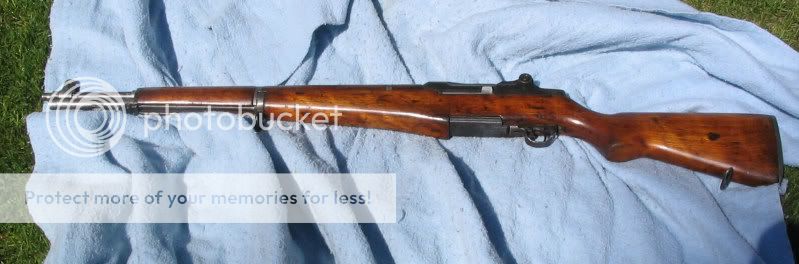
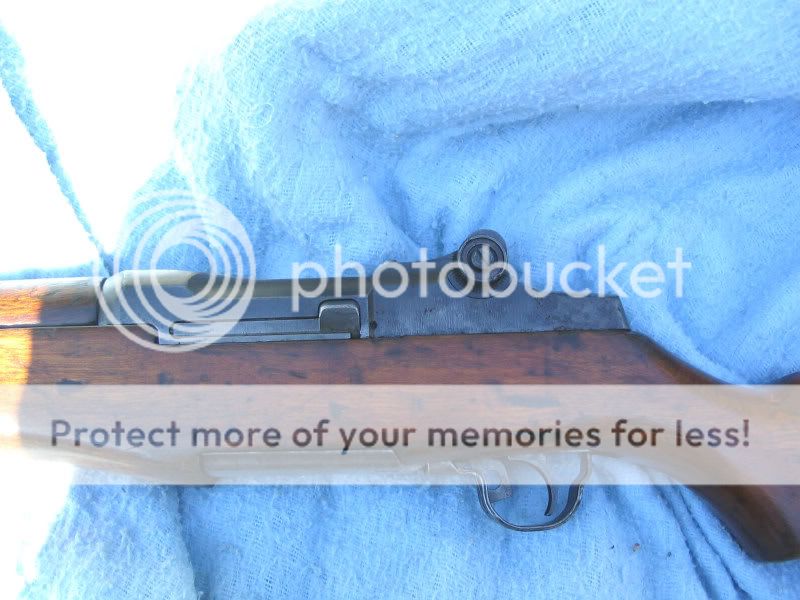
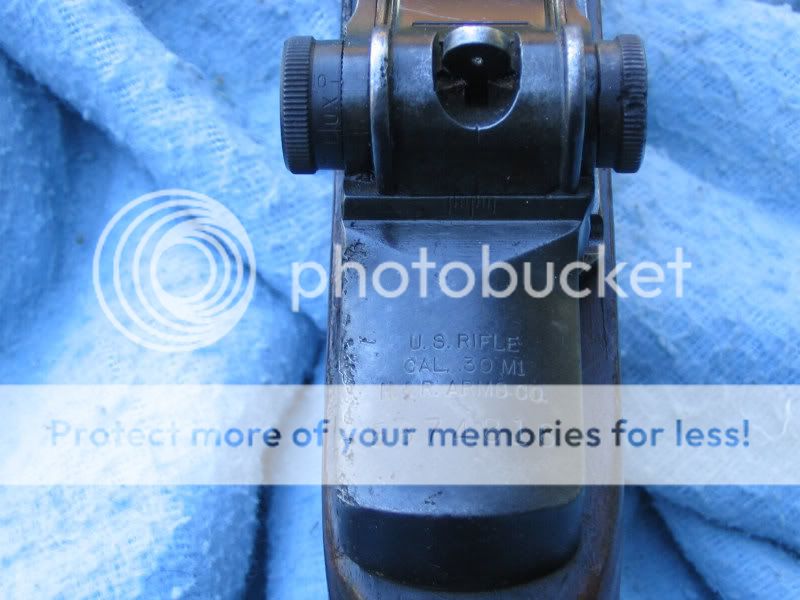
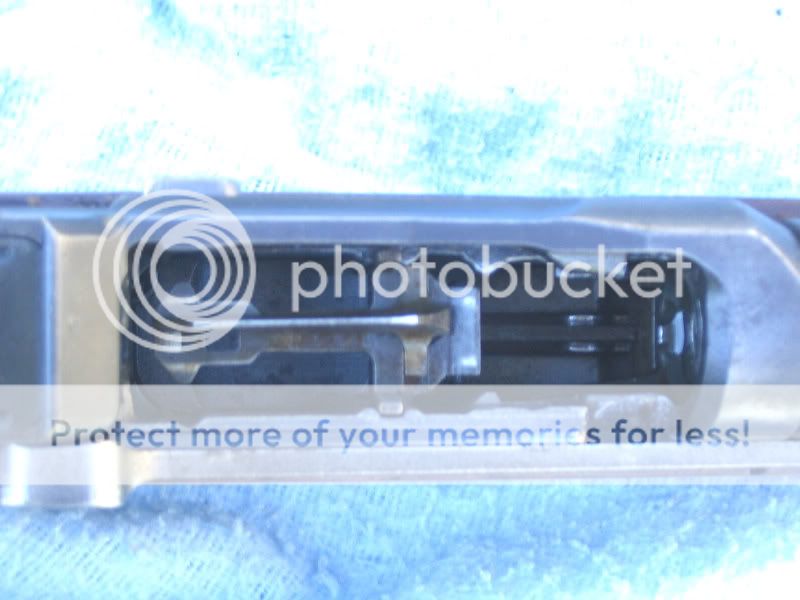
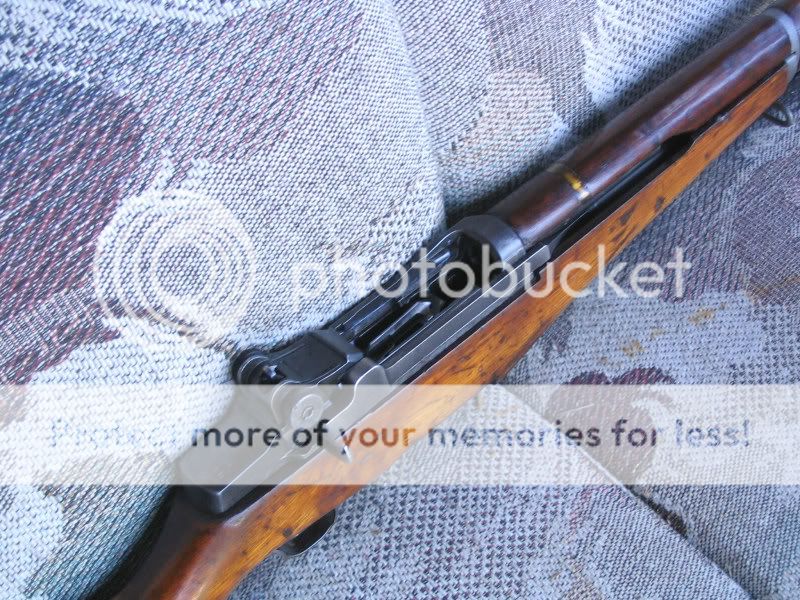
Hello well I did something different today and bought myself a well used M1. Never had one of these beauts before. It's a parts gun with a H&R receiver. The barrel seems to be dated to 1944. Lots of pitting on the receiver but the rifling seems fair. There is quite a bit of play at the gas lock and I was wondering if shims for a tighter fit would be worthwhile? The trigger group doesn't pull the receiver tight to the stock either. More shims? Also when the enblock is in, can you get it out without ejecting whatever rounds are in it? Is there any checks to see about performance ie ..odds of blowing up. Thanks in advance for any info Cheers













































You are using an out of date browser. It may not display this or other websites correctly.
You should upgrade or use an alternative browser.
You should upgrade or use an alternative browser.
M1 Garand
- Thread starter emmab
- Start date

Not sure about the shimming, but for sure you can eject the enbloc if you pull back the bolt manually and then push in the little tab that sticks out of the action on the left side. It launches the enbloc out pretty good so watch your face! 

From a safety point of view the headspace should be checked with a set of gauges to verify that it within spec.You should also verify that the safety is intact and that the nose is not broken off.This condition is often found in well worn rifles.It is also a good idea to verify that the receiver is sound and not cracked.The absolute test for this is by magnafluxing,but there are a couple of simple checks as well.
One check is to strip the rifle to receiver and barrel only and then tap the rear of the receiver with a hardwood block.You should get a resonating sound like a tuning fork.If it sounds like a dull thud,then you need to investigate further.A further verification is to immerse the receiver in a quick evaporating solution like gasoline or mineral spirits.If there is a crack it will become apparent as the solution evaporates from the surface,but remains visible in the crack.I identified a cracked Garand receiver this way last fall and had also found a defective '03 Springfield using this method in the past.
From a functionality point of view there are a wide range of checks that are essential to confirm correct setup for both functioning and accuracy.You would be best to seek out someone with considerable experience on the Garand to do this.Timing of the action should be checked to ensure that all related parts are in order and that bolt release occurs at the proper time in the loading process.The barrel throat and muzzle, as well as the gas cylinder and op rod piston, should also be verified within spec for correct functioning and accuracy.Do not attempt to shim the gas cyl lock to get a better fit.The way to fix this is by trial fitting a number of spare locks until you get one that tightens up no further than the 9 o'clock position beyond the aperture of the gas cyl.Peening of barrel splines may also be necessary to achieve a tight fit of the gas cyl on the barrel.
Loose stock fit is destructive to accuracy and,where evident, can normally be corrected in one of the following ways:
1-glueing wooden shims onto the bearing surface for the rear legs of the receiver to eliminate fore/aft movement.
2-glueing wooden strips to the seating surfaces for the trigger housing at the bottom of the stock,so that tension is achieved when the trigger guard is closed.With the same aim,you should also verify that the locking lugs on the trigger guard are'nt worn to a point where they prevent a tight lockup when the guard is closed.
3-correcting stock ferrule fit to make sure that the ferrule is immobile and not binding on the op rod.
There is no way of ejecting the clip without clearing the chamber and emptying any remaining rounds from the magazine well in the process.HRA Garands were built in the 1953-57 timeframe and original barrels will be so dated.A 1944 bbl is a replacement which was routinely done.
One check is to strip the rifle to receiver and barrel only and then tap the rear of the receiver with a hardwood block.You should get a resonating sound like a tuning fork.If it sounds like a dull thud,then you need to investigate further.A further verification is to immerse the receiver in a quick evaporating solution like gasoline or mineral spirits.If there is a crack it will become apparent as the solution evaporates from the surface,but remains visible in the crack.I identified a cracked Garand receiver this way last fall and had also found a defective '03 Springfield using this method in the past.
From a functionality point of view there are a wide range of checks that are essential to confirm correct setup for both functioning and accuracy.You would be best to seek out someone with considerable experience on the Garand to do this.Timing of the action should be checked to ensure that all related parts are in order and that bolt release occurs at the proper time in the loading process.The barrel throat and muzzle, as well as the gas cylinder and op rod piston, should also be verified within spec for correct functioning and accuracy.Do not attempt to shim the gas cyl lock to get a better fit.The way to fix this is by trial fitting a number of spare locks until you get one that tightens up no further than the 9 o'clock position beyond the aperture of the gas cyl.Peening of barrel splines may also be necessary to achieve a tight fit of the gas cyl on the barrel.
Loose stock fit is destructive to accuracy and,where evident, can normally be corrected in one of the following ways:
1-glueing wooden shims onto the bearing surface for the rear legs of the receiver to eliminate fore/aft movement.
2-glueing wooden strips to the seating surfaces for the trigger housing at the bottom of the stock,so that tension is achieved when the trigger guard is closed.With the same aim,you should also verify that the locking lugs on the trigger guard are'nt worn to a point where they prevent a tight lockup when the guard is closed.
3-correcting stock ferrule fit to make sure that the ferrule is immobile and not binding on the op rod.
There is no way of ejecting the clip without clearing the chamber and emptying any remaining rounds from the magazine well in the process.HRA Garands were built in the 1953-57 timeframe and original barrels will be so dated.A 1944 bbl is a replacement which was routinely done.
It sounds like you have one of the Districorp Thai M1 Garand rifles from a few years ago. You should take it all apart and clean all the parts and see which one's need replacing. I bought a few of them....but the receivers were in vg++ condition and replaced the barrels, wood and some of the parts. The result was some nice guns....
Unloading Enbloc Clips
To unload a filled or partially filled clip:
Pull the op rod slowly to the rear. At the same time place left hand palm down over the receiver to catch the round as it is ejected. When the op rod reaches its rearmost position, hold it there. Place palm of left hand over the receiver and depress the clip latch with the left thumb, allowing the clip to be ejected up into the hand. Do not relax the rearward pressure on the op rod handle until after the clip has been removed.
Source: Department of the Army Field Manual FM 23-5.
To unload a filled or partially filled clip:
Pull the op rod slowly to the rear. At the same time place left hand palm down over the receiver to catch the round as it is ejected. When the op rod reaches its rearmost position, hold it there. Place palm of left hand over the receiver and depress the clip latch with the left thumb, allowing the clip to be ejected up into the hand. Do not relax the rearward pressure on the op rod handle until after the clip has been removed.
Source: Department of the Army Field Manual FM 23-5.
Thanks alot for the info.There's half a sticky right there! I'll read that all over a few times. I'm semi familiar with the chinese norcM14 and realized the similar operation. I've done the peening for gas lock fit on one of those. The operation seems smooth enough, and there is a nice ring when dry fired. It didn't have the combi tool or anything else in the butt. What is in the kit uaually? I've got a few enblocs around here and I can't wait to hear that ping( then go scrounging around the ground looking for the clip ) Maybe I'll talk the wife into firing it first LOL Cheers
You are getting good advice here. Headspace is the most important... be sure to have it checked unless it was verified before you bought it. Wooden shims work well under the trigger guard, but you might use shim stock from credit cards or the such. Gas cylinder locks on 99.9% of the Garands I have seen, require 12 full rotations. Make sure after the 12th rotation that the gas port is visible and fairly centered in the little 'square' of the gas cylinder. You'll know what I mean when you do it. If the gas cylinder lock doesn't screw in tight with that last 3/4 of a turn, don't sweat it. The gas cylinder lock screw holds everything tight. I'll bet if you peen the splines as purple stated, your gas cylinder lock problems will be eliminated. M1 Garands are fantastic weapons and superbly accurate. If you have problems, let me know and maybe I can help you out. I've been playing with them for quite a few years.
A caution there Will Robinson
Your "lunker" has obviously been away from competent technical surveillance and maintenance for some time as evidenced by the heavy pitting on the top of the receiver.This bears further examination of other areas of the receiver for pitting and metal bearing surface loss before firing this piece incl the front legs which retain the bullet guide,the front face where the barrel seats,the raceway for the op rod lug, the receiver bridge which bears on the firing pin,and the seats for the bolt lugs.I'd also pay close attention to the interior of the receiver heel for pitting or cracks. Remember that you are dealing with a 50,000 PSI pressure bloom a few inches in front of your face,so it is worth the time and effort to make all possible safety checks before shooting.I've examined and prooved a couple of fairly grotty looking and pitted receivers as safe for shooting,but made sure that the pitting was cosmetic only and in none of these critical areas.
Your "lunker" has obviously been away from competent technical surveillance and maintenance for some time as evidenced by the heavy pitting on the top of the receiver.This bears further examination of other areas of the receiver for pitting and metal bearing surface loss before firing this piece incl the front legs which retain the bullet guide,the front face where the barrel seats,the raceway for the op rod lug, the receiver bridge which bears on the firing pin,and the seats for the bolt lugs.I'd also pay close attention to the interior of the receiver heel for pitting or cracks. Remember that you are dealing with a 50,000 PSI pressure bloom a few inches in front of your face,so it is worth the time and effort to make all possible safety checks before shooting.I've examined and prooved a couple of fairly grotty looking and pitted receivers as safe for shooting,but made sure that the pitting was cosmetic only and in none of these critical areas.
Thanks purple(lost in space..one of my favourites!) and all, sound advice if I've ever heard it. I'll get it checked out. If worse comes to worse I'll get some different parts. Is it possible to find parts in Canada? ie barreled rec. Cheers
Last edited:

rchmontreal
CGN Regular
- Location
- Toronto, Ontario
The reddish shellac over the sanded hand guards and metal bands, deep pitting on all metal surfaces (especially under the wood) and general loose condition say "Vietnam" to me. These arrived in Canada many years ago after a temporary "seizure" in Seattle, if memory serves me correctly.
It looks like the lower stock has had the shellac removed. These were the left overs from the ARVN and RF-PF, stored for years under poor condition by communist Vietnam after the collapse of the South.
Like any rifle with no providence, do as the above members recommend. Have it thoroughly checked for safety and head space. Minimally, you will require a new operating rod spring. Most that I saw were old, rusted, bent, short, missing a few coils, or all of the above.
The trigger group should be tested for function and safety. Consider replacing the hammer spring.
Check the rear sight for tightness also. Run the sight all the way up to the highest position (after having stripped, cleaned and correctly tensioned it) and push down on it with your thumb. If it falls down, then the range drum needs replacing. Make sure the splines are not worn too.
All the stocks were heavily sanded, many had cracked hand guards. The fitting up of the receiver to the lower stocks were completely compromised due to heavy over sanding. Check the rear of the receiver tang were it contacts the wood stock. If it is not touching, then scrap the stock. If the trigger group locks up with no resistance, and the entire receiver moves in the lower stock, then scrap the stock. Unless you are very good at glass bedding, it might be salvageable.
If your gas group is worn and loose, the hand guards rattle away, the receiver group moves in the stock, and the trigger group is in rough condition, your accuracy potential and reliability are going to be poor.
Most of these rifles were in horrible condition, and should have been scrapped for parts, maybe. If you invest enough time, money you might be able to restore it to a rack grade shooter. Wolff Gunsprings, and Boyd's Gunstocks are two places to check out for springs and stocks.
It looks like the lower stock has had the shellac removed. These were the left overs from the ARVN and RF-PF, stored for years under poor condition by communist Vietnam after the collapse of the South.
Like any rifle with no providence, do as the above members recommend. Have it thoroughly checked for safety and head space. Minimally, you will require a new operating rod spring. Most that I saw were old, rusted, bent, short, missing a few coils, or all of the above.
The trigger group should be tested for function and safety. Consider replacing the hammer spring.
Check the rear sight for tightness also. Run the sight all the way up to the highest position (after having stripped, cleaned and correctly tensioned it) and push down on it with your thumb. If it falls down, then the range drum needs replacing. Make sure the splines are not worn too.
All the stocks were heavily sanded, many had cracked hand guards. The fitting up of the receiver to the lower stocks were completely compromised due to heavy over sanding. Check the rear of the receiver tang were it contacts the wood stock. If it is not touching, then scrap the stock. If the trigger group locks up with no resistance, and the entire receiver moves in the lower stock, then scrap the stock. Unless you are very good at glass bedding, it might be salvageable.
If your gas group is worn and loose, the hand guards rattle away, the receiver group moves in the stock, and the trigger group is in rough condition, your accuracy potential and reliability are going to be poor.
Most of these rifles were in horrible condition, and should have been scrapped for parts, maybe. If you invest enough time, money you might be able to restore it to a rack grade shooter. Wolff Gunsprings, and Boyd's Gunstocks are two places to check out for springs and stocks.
Last edited:
Thanks rch. I think I have all of the above LOL. That's an interesting idea of being Vietnamese. I got this M1 for the price of an sks so I'm not too woried if I have to spend a little to get it going. In general after a full strip down, I'd say the parts are all right. Op rod is marked SA and looks ok. The gas group seems allright but fit is poor. Receiver to stock is horrible. TG is SA and seems OK Chamber seems good. Bullet guide and related reciever parts seem good. The bolt is HR and I haven't gauged it. Barrel is fair but don't know maker but stamped 1944. I have an M14 bolt tool that should work. Can you do the poor mans check with feeler guages between the right bolt lug and lock? What is the go no go specs? Function and action seems in order. It's really the receiver itself that has me a little worried. No apparent cracks but there is a bit of pitting inside. I've stupidly fired old milsurps without a pre check but they were bolt actions and I was dumber and all was good (just like the .308 in 7.62 chamber debate- ignorance is bliss til somebody informs you!.) The guy I got this garand from isn't the owner and doesn't know if it has been fired lately. Judging from the crud on it I'd say it hasn't. Anyways thanks Gents for the info and keep it coming! Cheers
Last edited:
Unfortunately there is no reliable way of checking headspace w/o the appropriate .30-06 headspace guages.The M14 bolt strip tool might work for a Garand -depending on the type of tool.Some have 2 settings for length and can be used on either bolt.Op rod piston diameter and fulcrum height on the bullet guide can be checked with a micrometer.The internal dimension of the gas cyl can be checked with an expedient "tool" made from a fired belted magnum case which mics to the correct diameter on the belt.
A timing check made with a clip of dummy rounds will determine if timing is in order and will indicate that related components should be checked/changed. All of bullet guide,follower,clip latch,op rod catch, follower arm,follower arm pin affect timing and must be changed until timing is OK.
The clip latch spring also affects clip seating and retention and the clip ejector spring bears on proper clip ejection.These aspects as well as extractor/ejector function can be checked by loading and hand cycling a clip of dummy rounds.
A sloppy/loose elevation pinion may indicate either a worn pinion "tit" or worn bearing serrations on the receiver itself.The elevation pinion can be changed,but worn serrations can only be corrected by installing a corrective disc on the receiver. Often the rear sight cover is worn on the interior to the extent that proper rear sight tension cannot be established.
The op rod spring must be intact,unbent,unworn on the surfaces and of correct length.I normally expect to replace this on a used rifle.
You should also do a "tilt test" do determine correct op rod fit.To do this remove barrelled action from stock with gas cylinder and handguards in place,remove op rod spring and then tilt the action back and forth to a 45 deg angle.The op rod and bolt should travel freely and bolt should close w/o interference from the inertia of the bolt and op rod.
A timing check made with a clip of dummy rounds will determine if timing is in order and will indicate that related components should be checked/changed. All of bullet guide,follower,clip latch,op rod catch, follower arm,follower arm pin affect timing and must be changed until timing is OK.
The clip latch spring also affects clip seating and retention and the clip ejector spring bears on proper clip ejection.These aspects as well as extractor/ejector function can be checked by loading and hand cycling a clip of dummy rounds.
A sloppy/loose elevation pinion may indicate either a worn pinion "tit" or worn bearing serrations on the receiver itself.The elevation pinion can be changed,but worn serrations can only be corrected by installing a corrective disc on the receiver. Often the rear sight cover is worn on the interior to the extent that proper rear sight tension cannot be established.
The op rod spring must be intact,unbent,unworn on the surfaces and of correct length.I normally expect to replace this on a used rifle.
You should also do a "tilt test" do determine correct op rod fit.To do this remove barrelled action from stock with gas cylinder and handguards in place,remove op rod spring and then tilt the action back and forth to a 45 deg angle.The op rod and bolt should travel freely and bolt should close w/o interference from the inertia of the bolt and op rod.
rchmontreal
CGN Regular
- Location
- Toronto, Ontario
Let's assume you spent anywhere from $250-300. Now you want to return this floppy specimen into fighting form.
Start with the barrel. Both the chamber and the rifling must be in good serviceable condition with no bulges, pits or gouges and an undamaged crown. You must confirm head space, throat erosion and muzzle erosion. If anything fails miserably, a new barrel will be $250 US. Don't mess around with take offs. They were taken off for a reason....
Now you want to refresh all your springs. A Wolff Springs service pak, with ejector, extractor, hammer and recoil spring is $26 US. The clip ejector is only a couple of bucks, and available from Fulton Armory.
Replacement stocks can be had at Gun Shows, but chances are they were taken off because they weren't serviceable in the first place. The collectors market in the States has consumed all the decent military stocks. A new virtual inlet set ready for finishing, is about $140 US from Boyd's or Fulton Armory.
Refinishing the metal is another expense...
If this project to create a reasonably accurate and safe M1 puts the price over $700, you can buy one in decent service grade condition for that or a little more.
My advice is to familiarize yourself with stripping, assembling and handling of the M1 first. Next, once you've confirmed the rifle is safe to shoot, take it to the range and see how it performs. Does it give good reliability (no failure to lock, unlock, cycle, short cycle, stove piping, failure to feed, jumping en bloc clip, multiple shots, etc) and good grouping (-6"). If you have reliability issues, and poor groups (larger then 8" at 100m, key holing, etc..) think about this:
Judging on overall appearance and description, have you thought about turning this old gal into a deactivated rifle? These are always sought out by non licenced individuals for display or reenactment. The value would be about $650+ in its current condition. The cost to dewat it is usually about $75. That would give you a good chunk of change to spend on a good quality shooter that won't disappoint.
Something to think about...
Start with the barrel. Both the chamber and the rifling must be in good serviceable condition with no bulges, pits or gouges and an undamaged crown. You must confirm head space, throat erosion and muzzle erosion. If anything fails miserably, a new barrel will be $250 US. Don't mess around with take offs. They were taken off for a reason....
Now you want to refresh all your springs. A Wolff Springs service pak, with ejector, extractor, hammer and recoil spring is $26 US. The clip ejector is only a couple of bucks, and available from Fulton Armory.
Replacement stocks can be had at Gun Shows, but chances are they were taken off because they weren't serviceable in the first place. The collectors market in the States has consumed all the decent military stocks. A new virtual inlet set ready for finishing, is about $140 US from Boyd's or Fulton Armory.
Refinishing the metal is another expense...
If this project to create a reasonably accurate and safe M1 puts the price over $700, you can buy one in decent service grade condition for that or a little more.
My advice is to familiarize yourself with stripping, assembling and handling of the M1 first. Next, once you've confirmed the rifle is safe to shoot, take it to the range and see how it performs. Does it give good reliability (no failure to lock, unlock, cycle, short cycle, stove piping, failure to feed, jumping en bloc clip, multiple shots, etc) and good grouping (-6"). If you have reliability issues, and poor groups (larger then 8" at 100m, key holing, etc..) think about this:
Judging on overall appearance and description, have you thought about turning this old gal into a deactivated rifle? These are always sought out by non licenced individuals for display or reenactment. The value would be about $650+ in its current condition. The cost to dewat it is usually about $75. That would give you a good chunk of change to spend on a good quality shooter that won't disappoint.
Something to think about...





















