M96 6.5x55 max load

xingyc

Regular
Rating - 100%
16   0   0
Location
GTA, Ontario
Hello
I recently snatch a sporterized M96, I'm trying to develop an load for the 6.5x55. I know there is a debate regarding the safe max load for these old 6.5x55 Mauser actions, I'm trying to figure out what loads do the Swedes use for their old mil-surp.

With 47gr of H4831SC, the rifle shoots 3 shots in 0.75'' group at 200m, the brass didn't show any pressure signs, and the rifle didn't blow up.
Please share your wisdom, is this a safe load for the action?

please don't turn this thread into another debate on the SAAMI conspiracy.
 
Last edited:
What bullet?
That's near max with a 120gr and over with a 140gr. according to Hodgdon website.
I've never used that powder, so I can't speak from experience.
 
Last edited:

Couple of things...
Norwegians used a Krag, and Swedes used the '96. Of the 2 I would suggest the 96 is a stronger action. I would also suggest a 96 may not be as strong as a more modern action.

Hodgdon's site didn't show a load for H4831sc, just the standard H4831. That max load (with both 140gr and 142gr bullets) is 47gr. Assuming you worked up your own load, and haven't seen pressure signs, you should be good to go. Personally, I get very ugly primer cratering (a 96 trait) at/before I reach published max loads. Not a true "pressure sign" but enough for me to not work it up any higher.

.75" at 200yds is a mighty fine result (sub .5 MOA)
 
Sorry forgot to mention the bullet.
I'm using Sierra gameking SBT 140GR. I used the loading data from Hodgdon's website.
The rifle has a sport barrel, new trigger and decent wood stock. The only stock part is the action.
 
OP, the 96 actions have been used for a lot of different rounds. The Europeans load them HOT. No, I'm not advising you to load HOT and would consider your load of H4831sc maximum for those actions.

The thing is, the rounds they were chambered for commercially such as 8x57, 30-06 and even 308Win are relatively high pressure rounds. I checked out a bunch of Norma 308Win, 8x57 and 30-06 commercial rounds for pressures. Not me personally but through a friend with a connection at White Labs in the US. This was a few decades back, in the late seventies.

None of the Norma offerings generated more than 50,000 PSI. Not even the 308 Win.

WHB Smith's "The Book of Rifles" states the that the "operating" pressures for the 6.5x55 cartridge as loaded for the military was around 41,000 PSI. Blue Pill rounds developed around 55,000 PSI.

OK, your loads are well above what is considered to be standard operating pressures. Not necessarily unsafe. There are several reasons for the military to restricts pressures. One, is for the general comfort of the troopie. The other, which likely had more to do with it at the time were the powders available at the time, which were much faster than H4831.

I have seen a couple of M38 rifles with their receiver rings blown off from extreme loads of Nobel #44 powder which is similar but slightly quicker than IMR3031. #44 powder was one of the powders used Husqvarna as a propellant for the 6.5x55 for the Swedes and Danes. Good powder as long as it was used properly.

When I looked at the receivers, there were indications that the rings may have been cracked for years and the well over max loads with cupro nickel FMJ 160 grain bullets was just more than those weakened actions could handle. Likely they would have been fine with loads in the 45,000 psi range.

Usually with these actions they don't let go unless there is something wrong with them. Most often they stretch or the area where the recoil lugs lock up set back.

The heat treatment on these rifles was as good as could be expected when they were made but mostly it was done by eyeball gauge. This means the surface hardness and depth varies. Not all of these rifles were created equally. They are safe for the operating pressures they were designed for. Anything above and beyond that ???????????????????

If that were my rifle I would have it magnafluxed or do it myself to see if there are any obvious cracks or imperfections before pushing the limits on it.

There are all sorts of rumors out there that the steel used in these rifles is superior to the steels used in other firearms. Consider that the first batches of these receivers were manufactured in Germany for Sweden and go from there.

Great actions, great craftsmanship and accurate. There are lots of people that end up with Kabooms on firearms for all sorts of reasons other than over pressure caused by to much powder in a case under a heavy bullet.

OP, that rifle will serve you well when you learn how to use its capabilities. Remember, it was state of the art when it was designed 120 years ago. IMHO the older rifles are loaded with nostalgia. If I were building a sporter on one I would definitely be doing it with one of the 1940s produced Husqvarna receivers. I doubt the steel is better or tougher but I would be willing to bet the heat treatment of the bolts and receivers would have been done with an optical pyrometer.

As far as pierced primers or escaping gasses around the primer pocket there are all sorts of reasons for that as well. In my modern 6.5x55 Tikka T3 I get much higher velocities but of course with higher pressures and IMR7828SSC powder over magnum primers. I don't get any gas cutting around the primers or pierced primers. Large military chambers may be part of the cause.
 
My 96 doesn't pierce primers, nor is there any indication it has leaked gas around them. Where firing pin strikes primer can look like a very ragged crater. It's usually attributed to firing pin diameter being smaller than the hole in the face of the bolt.

Another consideration about loading hot is that any wear or stress on lugs will show up much faster. Even on 100 year olds.
 
Might consider getting headspace gauges and learn how to use them - mauser design will stretch before bursting, and changes in headspace will tell you the tale regarding your carefully worked up load. If headspace is increasing, the load is too hot for that rifle, regardless of any other information you might be relying on.
 
Hundreds of these Swedish rifles were re-barrled as 7.62x51 target rifles. They shot thousands of rounds of ammo running 55,000 to 60,000 psi without a problem. Nothing weak about the action design and Swedish steel was top notch.

Pressure and velocity are related. The absolute speed limit for that bullet in that caliber in that rifle is 2900 fps. Check your velocity.

47 gr is Max in my rifle.

If there is no extra resistance to lifting the bolt, carry on.
 
Considering you are already 3grains over MAX in the Hornady 6th Edition manual I won't "spoonfeed" you what you want to hear. It specifically cautions against hotter loads with 96 +38 mausers.Why? Because if it lets go you will not be protected ,nor those around you because of the action.These old guns, nor the 6.5x55 need to driven balls to the wall to get superb accuracy.Kimber quit making altered sporters on the Swedish actions because of action failures/gun blowups. To each their own.......it's all safe and fine till it's not............Harold
 
The 6.5x55 is rated at 46,000 cup or 51,000 psi and the max load at Hogdons is 47 grains of H4831 at 45,700 cup with the 140 grain bullet.

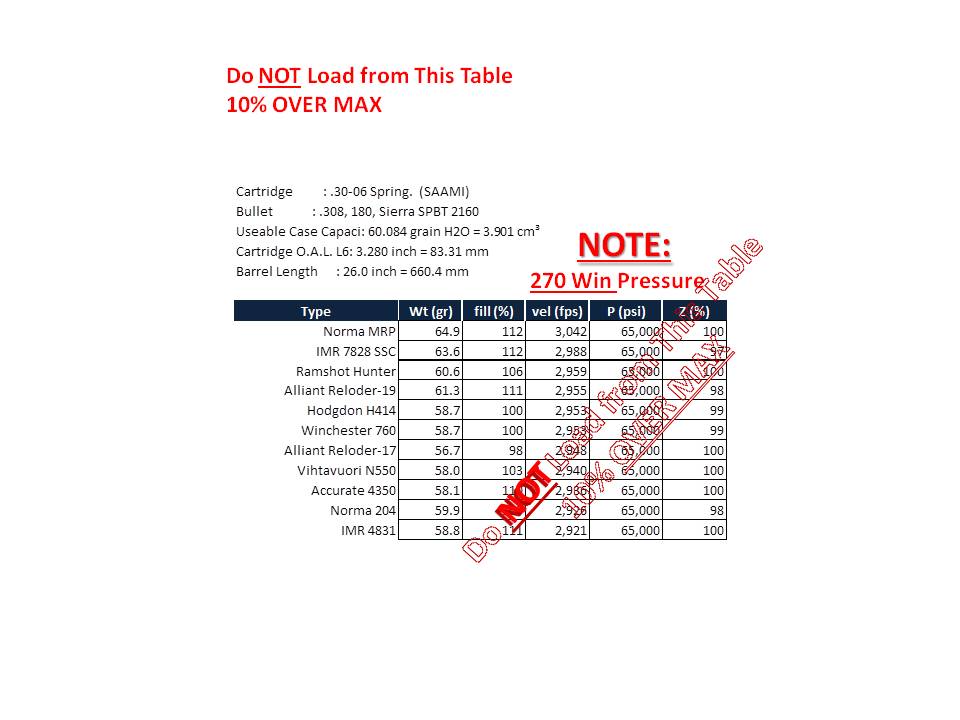
I have a Remington 700 30-06 and always wondered why my .270 Remington 760 Gamemaster could be loaded to 5,000 psi higher chamber pressure.

EPcuYSG.jpg


Bottom line, reloading manuals list load data for the oldest weakest action, and yet the No.4 Enfield rifle was later chambered for the .308 Win at 52,000 cup or 62,000 psi.
 
A No.4 Enfield has about as much in common with a 96 mauser as David Duke has with Martin Luther King..........just saying
 
Thanks for the comments
I guess the better question is: what is the pressure in PSI with 47gr H4831sc.
From Google search, the Swedes military loaded their cartridge to 46,000 PSI (From Wikipedia), If I'm under this pressure,I am comfortable with my reloads.
I don't want to test my luck by pushing the action over it's design, can someone confirm the max pressure of the Swedes ammo's. please include your reference or link. (no forum comments, old Swede military documents are preferred)

I know Hodgdon's website provides load pressures, but it's in CUP, please note: CUP and PSI are measured to different scales and are NOT interchangeable.
 
Thanks for the comments
I guess the better question is: what is the pressure in PSI with 47gr H4831sc.
From Google search, the Swedes military loaded their cartridge to 46,000 PSI (From Wikipedia), If I'm under this pressure,I am comfortable with my reloads.
I don't want to test my luck by pushing the action over it's design, can someone confirm the max pressure of the Swedes ammo's. please include your reference or link. (no forum comments, old Swede military documents are preferred)

I know Hodgdon's website provides load pressures, but it's in CUP, please note: CUP and PSI are measured to different scales and are NOT interchangeable.

Without a crony, you have no clue what YOUR pressure is in YOUR rifle with that load.
Hodgdon is kind enough to provide pressure and velocity for us with their load data. If the velocity matches what they list, then so does the pressure (or very close to it, close as you will be able to establish without pressure testing equipment).
 
I should have mentioned that I have have a 1943, m38 Husqvarna action that has been rebarreled to 6mm Remington. My loads are in the 55,000psi range and so far there are no signs of stretching or set back. The rifle is very accurate and wears an after market trigger with a #### on opening kit installed in the bolt. The barrel was a Remington take off and it's only issue is that it has the dreaded 1-14 twist rate. Still, it shoots better than I can hold.

Before this rifle was put together it was magnafluxed and tested for hardness. It met all of the criteria that I felt was necessary.

My thing about these actions is that they were made over a period of 50+ years for the military and more for commercial rifles. Metalurgics may or may not have been changed or tweaked during that time. The commercial actions are works of art and very smooth. The later ones would supposedly have been better but I haven't bothered to pursue that.

As Ganderite mentions, they are strong. As far as converting PSI to CUP, IMHO it's a grey area and not very accurate.

One thing as well that limits any action/barrel. They will only burn so much powder with a given weight of bullet and length of bbl. More in the case doesn't help. As mentioned there is an absolute relationship between velocity and pressure. Twist rates will also effect pressures.

Enjoy that rifle. As mentioned, if the bolt lifts fine without binding you should be good to go.
 
I just got a similar rifle and am reading up on it as much as I can. My approach is going to be to only use good brass and really keep an eye on it in an attempt to mitigate any chance of getting a gas blast.
So far I've been out with it once and have gone to 43 gns IMR 4350 143 gn ELD-x for 2475. I'd like to see 2600 but we'll see.
 
The Swede is a common rifle. So this story should be heard.

I have at least 5 of them. I have had no problem in loading 6.5x55 for them. And I have some more of them that I barrelled to other calibers, including 7-08 and 308.

Some of the Swedes came to us almost unfired. Some are well used. For this reason we should be careful about sharing our load data with others.

A buddy showed up at my range one day with a nice Swede that he had loaded some ammo for. It was the Start load for 4350.

After the first shot we could not get the bolt open. Back at the house we pounded it open with a 2x4. The primer hole was almost the size of the case head.

I took a round from the box and fired it in one of my rifles. Perfect!

The 6.5 has a lot of bearing surface. If something is wrong, things go bad quickly.

Start low and work up or down, as indicated.
 
Thanks for the comments
I guess the better question is: what is the pressure in PSI with 47gr H4831sc.
From Google search, the Swedes military loaded their cartridge to 46,000 PSI (From Wikipedia), If I'm under this pressure,I am comfortable with my reloads.
I don't want to test my luck by pushing the action over it's design, can someone confirm the max pressure of the Swedes ammo's. please include your reference or link. (no forum comments, old Swede military documents are preferred)

I know Hodgdon's website provides load pressures, but it's in CUP, please note: CUP and PSI are measured to different scales and are NOT interchangeable.

Look on page 11 of this link: http://saami.org/specifications_and_information/publications/download/Z299-4_ANSI-SAAMI_CFR.pdf
It is the SAAMI specs for cartridges. The CIP pressure specs are slightly higher in many cases.
 
SAAMI specs for 6.5 Swede is 46K CUP, 51K psi by transducer.
Basically 30-06 load levels. If you stick to that as an upper limit you will have no issue in a rifle in good condition.

The 30-06 max rated chamber pressure is 50,000 cup or 60,000 psi and the 6.5x55 is rated at 46,000 cup or 51,000 psi at .222 Remington levels and 4,000 cup or 10,000 psi lower.

So again The SAAMI establishes chamber pressures for the oldest and weakest action the cartridge will be fired in.

Bottom line, as many in this post have stated a "newer action" made with stronger steels can be loaded "warmer". And this will also be effected by the hardness and construction of the cartridge case. Example a Prvi Partizan .303 case vs a Winchester .303 case with the Prvi case being made to military standards and made Ford Truck Tough. ;)

Someone stated the Mauser action and Enfield action were not a good comparison. BUT the No.4 Enfield was made of higher grade steels than the No.1 and was later chambered in .308/7.62. And the early Krag actions were chambered in 6.5x55 and are the weakest link in the chain.

In a modern 30-06 like a Remington 700 the 30-06 can be loaded to .270 Win pressure levels "BUT" because older and possible weaker 30-06 rifles are still being used the SAAMI set the max chamber pressure lower.

Cartridge Pressure Standards
http://kwk.us/pressures.html
 
Back
Top Bottom