I have a M1871 carbine. It is a very well balanced smooth handling little rifle.Buy a 1871 Mauser in 43 mauser, buy new brass and go shoot.
That is a simples centerfire antique rifle.
It needs to be single shot, made before 1898 and bore bigger than 8.3mm to be an antique centerfire rifle













































You are using an out of date browser. It may not display this or other websites correctly.
You should upgrade or use an alternative browser.
You should upgrade or use an alternative browser.
Making 44 henry rimfire?
- Thread starter C96 1897
- Start date

I've seen starter pistol blanks used, a section of rim - base is milled out to fit the blank, not sure how safe that would be.Hey all
I am considering buying an original winchester 1866 in 44 henry, as it is an antique status, lever action rifle.
Of course ammo is a concern. I can't seem to find any information about making 44 henry, so I am curious if anybody else may know something?
My thought process is to take a 44 special case, drill out the bottom to accept a 9mm flobert case as a primer. But im not sure if that's would work like the smaller 32, 41 rimfire reloadable kits.
I would probably have to ask noe molds in the states to make me a proper heeled bullet design.
Any input on this would be greatly appreciated!
Last point to note, centerfire conversion is not an option here, as if it becomes centerfire, it will lose its antique status, which is the entire reason for owning it in the first place!


How did you do it?I've done it just this fall.
Got a mold if you are interested in a few bullets.
Make sure it doesn't have the double strike firing pin... that would be a problem
Just looked it up, that carbine is a nice looking little rifle! If you ever want to part with it i think I would be interested!I have a M1871 carbine. It is a very well balanced smooth handling little rifle.
44 Russian ☆- brass.How did you do it?
I used the cheesy Lee case trimmer and a new bastard file. Have to turn down diameter above the rim a touch. Maybe thin the rim... from the front. Thinning the rim is done with the mouth of the cartridge inserted into a small drill press.
Got a chunk of brass rod about the right size and soldered it in the primer hole... trim and grind it flush.
I have already run the 41RF... I had the plan.
Used the same method...6mm blanks.
Do the 6mm hole ( ain't a 6mm bit... 9/64ths or something) from down into the open mouth of the cartridge against the side on the case...slight angle. I used my hands and Kentuky angle to align it.
Drill the larger hole from the outside...a drop or two of oil... the brass wants to come off in big shavings...not what you want.
A slight channel to releave where the firing pin strikes.
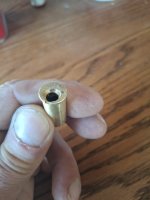
I'm lucky in that mine is a single pin... and have a life time of work that lends itself to building such things.
It's a lively round... I got a mold in from the US that is built for 44 RF...200 grain heeled.
Attachments
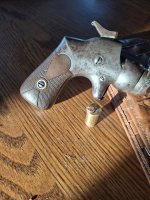
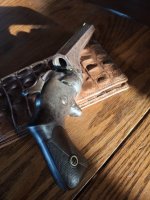
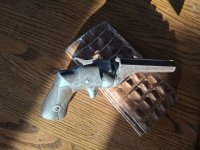
Last edited:
antiqueguy
CGN Ultra frequent flyer
- Location
- windsor ontario
Centerfires repeating rifles do not meet antique status just check the flowchart sticky above in this forum. Rimfire it is allowed.I had guys on here tell me that lever actions do not have antique status.
I've googled and could never verify it.
Also 1866 or some of them were centerfire. I'm not sure by Winchester or if aftermarket conversion?
The rimfire I've seen reloaded was with that French kit that uses 22 blank. Problem with lever action would be primer position loading through tube magazine

And ruin a good diy thread on a Monday morning?Something is missing in this post ?
if you don't have a pal and want to own a firearm ok if you could afford the rifle ammo is out there you certainly could afford the ammo
tell us the rest of the story
Yes, there is way more to this story/hobbyists plan.
Tight Groups,
Rob


If you have original empties, it would be feasible to build an expander to press out the previous firing pin-strike and use the 22LR reloading primer materials to re-prime the cases. Tedious, but doable.
If I had to do it for a repeater, I would build a collet to grip the case right above the rim, mount it in the lathe, and then build a shaft a little smaller diameter than the case mouth, with an adjustable tool steel barb, ground to the rim contour, and then manually turn the lathe-held cartridge around the mandrel to swage out the old pin strike. These were copper cases, making the job easier, I think.
The hardest part would be securing a supply of fired casings, which admittedly would have a fairly limited lifespan before the bases crack.
Forming new cases is possible, but a whole new level of difficulty. Think hydraulic presses, hardened stamping and forming dies to form cups (which you could make if you are a machinist). You'd need a supply of copper sheet. Ideally 95-5 copper-zinc alloy. Then you'd need to figure out how to swage in a recessed rim. I suspect factories did this with a rotating expandable interior mandrel whose base could be reduced in diameter so it can be removed-post operations, similar to how ER32 collets work. They call this "heading" or "bunting" but I've never seen how it actually works, the machines are self-contained and the videos out there of this process just show a big sheet metal encased machine doing "something".
To my thinking, making new copper casings is likely not worth the level of effort for the enthusiast.
If I had to do it for a repeater, I would build a collet to grip the case right above the rim, mount it in the lathe, and then build a shaft a little smaller diameter than the case mouth, with an adjustable tool steel barb, ground to the rim contour, and then manually turn the lathe-held cartridge around the mandrel to swage out the old pin strike. These were copper cases, making the job easier, I think.
The hardest part would be securing a supply of fired casings, which admittedly would have a fairly limited lifespan before the bases crack.
Forming new cases is possible, but a whole new level of difficulty. Think hydraulic presses, hardened stamping and forming dies to form cups (which you could make if you are a machinist). You'd need a supply of copper sheet. Ideally 95-5 copper-zinc alloy. Then you'd need to figure out how to swage in a recessed rim. I suspect factories did this with a rotating expandable interior mandrel whose base could be reduced in diameter so it can be removed-post operations, similar to how ER32 collets work. They call this "heading" or "bunting" but I've never seen how it actually works, the machines are self-contained and the videos out there of this process just show a big sheet metal encased machine doing "something".
To my thinking, making new copper casings is likely not worth the level of effort for the enthusiast.
Last edited:
Interesting... Form the rim by displacing metal outwards, rather than by sizing down the case to leave the rim standing proud.
I don't know why CBC/Navy Arms discontinued production of .32 RF and .41RF ammunition. I have to believe there would be a market for .25, .32, .38, .41 and .44 rimfire. Perhaps others. I don't know what would be involved in manufacturing ammunition like this, what production levels would have to be to amortize tooling costs. Given that it was done 150 years ago, the technology can't be all that exotic.
I don't know why CBC/Navy Arms discontinued production of .32 RF and .41RF ammunition. I have to believe there would be a market for .25, .32, .38, .41 and .44 rimfire. Perhaps others. I don't know what would be involved in manufacturing ammunition like this, what production levels would have to be to amortize tooling costs. Given that it was done 150 years ago, the technology can't be all that exotic.
antiqueguy
CGN Ultra frequent flyer
- Location
- windsor ontario
Here in Canada there would definitely be a market for .25 stevens, .32 rimfire and .41 Swiss.Interesting... Form the rim by displacing metal outwards, rather than by sizing down the case to leave the rim standing proud.
I don't know why CBC/Navy Arms discontinued production of .32 RF and .41RF ammunition. I have to believe there would be a market for .25, .32, .38, .41 and .44 rimfire. Perhaps others. I don't know what would be involved in manufacturing ammunition like this, what production levels would have to be to amortize tooling costs. Given that it was done 150 years ago, the technology can't be all that exotic.
How hard would it be to swap the bolt over to a centerfire version?
Like the conversions for the Spencer rifles?
It isn't a permanent change and can be swapped back and forth to maintaine originality.
Just not to sure how hard it is to find a 1866 Winchester bolt on the open market...
How hard would it be to make one?
Like the conversions for the Spencer rifles?
It isn't a permanent change and can be swapped back and forth to maintaine originality.
Just not to sure how hard it is to find a 1866 Winchester bolt on the open market...
How hard would it be to make one?
It’s not hard, but then it would no longer be an antique, would require a PAL, etc.How hard would it be to swap the bolt over to a centerfire version?
Like the conversions for the Spencer rifles?
It isn't a permanent change and can be swapped back and forth to maintaine originality.
Just not to sure how hard it is to find a 1866 Winchester bolt on the open market...
How hard would it be to make one?






















