












































Making progress on this hobby, but more questions.

Pyd

CGN Ultra frequent flyer
EE Expired
Rating - 100%
2   0   0
Location
Ontario
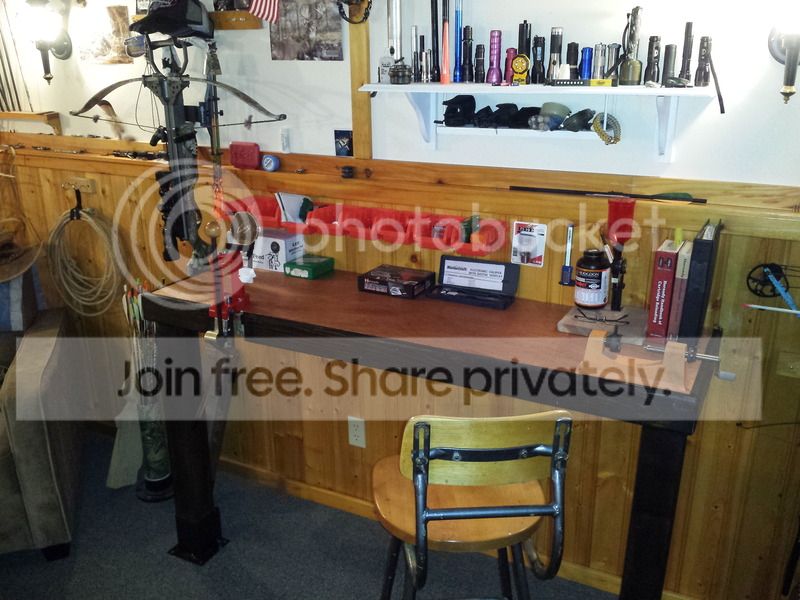
I started with a Lee kit, clamped to my dining room table, wife was a good sport, but I decided to make a bench. It is extremely solid, and small enough I could get it in to my gun room without sacrificing too much room. It was a start.

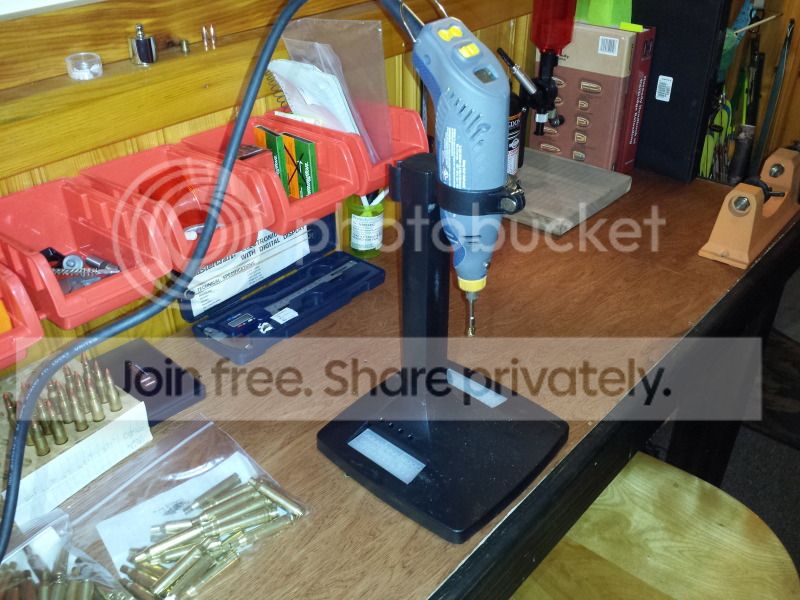
I have been having issues with getting my primers to seat properly, and blame the cheap primer pocket tool that came with the kit. I came up with this, my Dremel and a tiny brass brush, pockets are now coming out 10X cleaner in a fraction of the time. Hopefully it fixes my seating problem. To test my seating I have a 6" square plate of glass, if my case does not rock, I am assuming it is seated properly. Likely a better way, but it seems to be working.

The Dremel ready to clean..
20150314_101818_zpsba3d6212.jpg


1. I want to try neck sizing my next batch, is it possible to neck size only with the full length sizing die, or do I need a new die all together?

2. Powder, when I have powder in my powder dispenser (the Lee one in the photo), can it stay in there for a couple weeks, or should I put the unused portion back in the original container? This is a climate controlled room, no humidity spikes, even temperature.
20150313_104614_zpscikpuaws.jpg


My goal is to reload for varmint rifles, accuracy is very important to me, of course, but I don't have any intention of competing in anything. So, having said that, just how important are things like case sorting and primer lot number matching?

My old problem with feeding has been resolved by setting my bullets a bit deeper, but that also opened my group up to 1.5" at 100 yards. Seeing how I can't find any new powders or bullets I am stuck experimenting with 50 grain VMax and Varget powder. I set the bullet to maximum depth while still allowing the gun to feed, second shell is the only one that hangs up now, and it is intermittent.

I need lighting, and would like to use a LED light bar, anyone use something similar?
 
Just a couple of thoughts:

I would go with SS tumbling it seems to take care of primer pockets really well and I don't like to over work them with tools.

Neck sizing is an art form that I feel is not required for most folks unless one is competing in bench rest, full sizing should work well.

I clean up all my powder after a session and put it back in containers clean the press ready for next time.

I would stay away from any lighting that has transformers that may introduce noise spikes .. important if you get any digital scales later that seem to be twitchy on power sources.
 
Asked and answered, thank you.
I will look in to a SS tumbler, this thing I have now is a dirty mess, Lyman vibrating style.
I understand the importance of putting powder away so it doesn't get confused for another down the road, but with only one powder, not really an issue right now, good habit I suppose.

How about the primer lot numbers and case sorting? Again, I of course want accuracy, but if I get in to case sorting and lot number matching my ADD will make this far less enjoyable.
 
Neck sizing requires a neck die. Can't be done with a FL die. Considering that most benchrest guys FL size every time, I wouldn't worry about neck sizing. The key is to use a good set of dies.

Leaving powder in the measure is fine. Just don't mix up what you have in there.

Matching primer lots etc for varmint hunting is a waste of time. There are so many variables in the varmint field that will have a much greater effect that you will never notice the difference.

Years ago I spent all winter meticulously sorting Rimfire ammo for varminting. In the field I never noticed any difference and the gopher doesn't care if you hit him in the belly button or the sternum. So that was the last time I went to those lengths.
 
Thanks guys.
I have RCBS dies, I keep them clean and they look to be in perfect shape, so that's what I have to work with.
I have set up my FL die as per instructions, so now it is time to get started.
A left field question though. I have 3 bags of brass, all used. while I do load development, would there be an issue using 10 cases, 2 batches of 5, and repeating loads until I find one I am happy with instead of loading a new one every time? This is the ADD part, having a few cases that are different than the rest will keep me up at night. I would like to put a dozen aside for testing, then dispose of them when I am done, if that is what is required.

And, yes, I have a flashlight addiction.
 
Lose the Dremel. It's not necessary. Not that the wee brush is going to damage anything. Primer pockets don't need to be that clean. If you're having seating issues it's more likely from not pushing hard enough. As daft as that sounds.
Yes, you can setup FL dies to neck size. Trial and error thing though. And when you need to FL resize again, you'll have to set 'em up again.
 
As for leaving powder in the measure you might find that over time it will etch or discolor the plastic tube, Plus it is probably better to put it back in its container just in case,
 
I leave the powder in my measure if I'm going to be doing batches throughout a few days. But if I'm done for that batch and it'll be more than a couple of days before I start loading again it goes back into the container.

Instead of looking for rocking on a piece of glass I'd suggest you feel the primer seating with a finger. It should be slightly lower than the head. If it's only flush then it's not fully seated and might not ignite when the firing pin hits because part of the shock is taken up by seating the cup instead of pinching the compound. If you're having trouble feeling the slight indent of a properly seated primer than using a thin 6 inch ruler with a back light will quickly show if they are seated correctly or not. You can use one of your flashlights.... :d

By the time you get the case far enough into the die to size the neck the body is already sized. So if you want to neck size only then you need a neck sizing die. This especially applies to cases with shoulders. By the time the casing is deep enough to enter the neck sizing area the body of the casing is already sized down. You CAN avoid setting the shoulder back by not fully sizing that last little bit. But it's better to just avoid that sort of judgement call by getting a proper neck sizing die.

I'd strongly suggest losing the Dremel and brush as well. The steel bristles do such a nice job of cleaning the pockets because they are harder than the brass and they are cutting away some of the brass. Use that tool a couple of times and you'll be able to push the primers in with your thumb. And that's not good. If you really must use a power tool then get the end brush that use fiber bristles instead.

For accurate loading you do want to match the brass. At least by headstamp. Different makers use slightly different wall and head sizes so the internal volume is affected. And that varies how the loads will perform. You're also going to want to buy and use a case trimmer so you get all the cases to the same length.

So for the same bullet, primer and powder but different makes of brass you should find that you can match the POI between brass batches with a slight change in the powder charge that reflects the slight difference in the internal casing volumes. Or you may find that it's not enough to matter. That'll be up to your rifle and the group results.

The only other step that I do for accurate rifle rounds is that I weigh out each charge instead of relying on a powder measure. I'll do this by dropping a measure which is 2 or 3 grains under then use a powder trickler to come up to the final measure. With a bit of practice most loads will sit spot on according to the digital scale I use. And given the .2gn increments this means I'm within .1gn of the proper exact amount.

In order of importance I'd put using matched batches of brass properly trimmed as high on the list. That would be followed by weighing the charges. After that would come in no particular order how many loads have been fired in the brass, annealing the necks every so many firings, taking note of the batch number on the powder and making corrections as needed when going between batches to ensure the same muzzle velocity. It's possible, likely even, that at least changing between brands of primers would fit into that last list as well. And it would be worth keeping track of ammo loaded with the same brand primers but different batch numbers until you find out if there is a difference or not.

I may have missed something but these are the ones that I feel are significant enough to warrant my attention. Beyond that we'd be giving into our OCD and ADD or we'd be bench rest shooters that REALLY go over the top. Once you sink or rise to that level :d you get into weighing the bullets and separating them into batches that vary by a grain or two. And you start positioning your brass in the press and in the chamber so it's got the same orientation every time and a host of other things that ensure that as much as possible is done in identical ways to ensure consistency in your ammo.
 
With .223 cases when I hear someone say they are having trouble seating primers it's most often they aren't fully removing the crimp properly/fully... Seldom will a case chamfer tool get rid of it without destroying the pocket.

This is what I was thinking too.

With the brass you have, is it factory ammo (federal, winchester, ect ect) or military surplus stuff? Military brass has the primer crimped in place, and you need to remove that crimp before you can seat a new primer.
 
I've bought enough batches of brass that I finally bought a Lyman case prep machine. One of the tool head options it comes with is a primer pocket reamer to remove the primer crimp. Looking at the reamer it actually cuts down into the straight wall area as well as forming a short chamfer. I take it that this means the pocket swaging extends down quite far to form a reverse taper in the straight wall area. So yeah, if you try to remove it with a chamfering tool only by the time it takes a primer easily there won't be enough left to hold it.

It's not only the military stuff with the crimped pockets. I've seen a lot of the non toxic commercial ammo with crimped pockets too in my handgun brass.
 
If I am loading a large number rounds over a week, I leave the powder in the thrower. But I put a piece of masking tape on it noting the powder type.

I would not leave it there if I anticipated a 2 week break in loading. This dries out the powder and increases the risk of a miss identification of the powder, alter. Been there. one that.

Yes, you can neck size with a FL die. Your FL die should normally be adjusted to hit the shell holder well before there is any chance of the handle camming over. To neck size, back it off so the die clears the shell holder with about the clearance of a nickle. You want to back off enough that the shoulder does not get hit and the body does not get sized. Use a little case lube until you are sure none is required.
 
Back
Top Bottom





















