












































You are using an out of date browser. It may not display this or other websites correctly.
You should upgrade or use an alternative browser.
You should upgrade or use an alternative browser.
Making Tumblers
- Thread starter tiriaq
- Start date
Inspected carefully, the plugged holes from the frizzen spring can be seen. Had a #### which stopped against the flash pan fence. The little depression from repeated impacts can be felt. Would have been a waterproof pan, given the styling of the fence.
I don't think that a photo would have much chance of picking up the plug. Takes careful inspection in really good light. Whoever did the conversion was good. I suspect the little bit of engraving was touched up after the holes were filled. The drum is barrel shaped with little edge mouldings and the touch of engraving. I suspect that he was a real gunmaker. Not the usual just get it done and out of the shop conversion.
The ramrod is a bit unusual. I made the replacement starting with a red oak 36" dowel from Lee Valley. The surviving pipe is about 3/8" ID. The blank I started with was 3/8" diameter. Tapered it gradually, trying it into the hole in the stock, until it bottomed out. By the time the rod fit the full length of the hole, it was .27" diameter at the tip. Quite slender. I have read that some British sporting guns used ramrods made of baleen - so-called whalebone. Given the rather small diameter, I wonder if the original might not have been baleen. Strong and flexible. Turned the tips from brass rod. Usually I would make the small end tip with a capped screw for drawing wads to unload the gun. I didn't even try with this diminutive size. Drilled and tapped the tip 8-32 so a screw can be installed if needed.
Baleen is part of the upper jaw of a baleen whale. The whales are filter feeders and the baleen is a filter mechanism. Might have originally been baleen but, as I recall, I have restored at least three British fowlers with similarly tapered ramrods. Made tips with capped wad screws for two of them and need to make a couple more. You are correct. The small size is a bit of a challenge.
Don't recall who made your fowler, but wonder if it might have gone back to the builder for conversion. I understand that was a common occurrence.
Don't know how you feel about it, but I get a lot more satisfaction from bringing one of these old girls back to life than I do building something new
Don't recall who made your fowler, but wonder if it might have gone back to the builder for conversion. I understand that was a common occurrence.
Don't know how you feel about it, but I get a lot more satisfaction from bringing one of these old girls back to life than I do building something new
Licensed to kill
CGN Regular
- Location
- Peace Country Alberta
I would be interested in your method of making the threaded portion of the wad puller. I have only made one (for the sxs flint I made years ago) and, while I don’t recall how I made the patch puller, I do recall it being something if a PITA making those threads.Made tips with capped wad screws for two of them and need to make a couple more.
I have made wad pulling screws by digging through an assortment of wood screws to find an appropriate one, cutting off or turning down the head and then threading the shank. The cap and base piece are straightforward lathe jobs. If diameters are such that standard thread sizes can be used, it is easier to do.
With respect to baleen - years ago I could have acquired a piece from the first bowhead whale taken in the Eastern Arctic when whaling was restarted. As it happened, I armed the grenade fired from the whaling gun used to harvest the whale, and had an invitation to go on the hunt. Couldn't do it because I had non-refundable tickets to leave for our holiday.
I think that a ramrod that tapers right down would work for shotgun use because less force is required that seating a patched ball.
I, too, enjoy working on antiques at least as much as scratch building. The challenges are more varied. And nowadays it would appear that a manufacturer's license would be needed to make a cap gun, although longarms with touch holes are still OK.
The lock on this gun is signed I Whitehouse. Tiny London on top of the breech. Post 1813 Birmingham proofs on the bottom of the barrel along with IW (Isaac Whitehouse) and Stubbs.
Sometimes guns were returned to the maker for percussion conversion, or to another gunmaker, rather than a gunsmith. Not unusual for the conversion to be a remanufacture, rather than a simple conversion. Knew a chap who had a cased Joe Manton 20ga made in 1812 than had been redone. If Manton's shop didn't do it, it was a shop capable of work of the same high quality. New patent percussion breeches were fitted and the locks were reworked to suit. Beautiful little gun.
With respect to baleen - years ago I could have acquired a piece from the first bowhead whale taken in the Eastern Arctic when whaling was restarted. As it happened, I armed the grenade fired from the whaling gun used to harvest the whale, and had an invitation to go on the hunt. Couldn't do it because I had non-refundable tickets to leave for our holiday.
I think that a ramrod that tapers right down would work for shotgun use because less force is required that seating a patched ball.
I, too, enjoy working on antiques at least as much as scratch building. The challenges are more varied. And nowadays it would appear that a manufacturer's license would be needed to make a cap gun, although longarms with touch holes are still OK.
The lock on this gun is signed I Whitehouse. Tiny London on top of the breech. Post 1813 Birmingham proofs on the bottom of the barrel along with IW (Isaac Whitehouse) and Stubbs.
Sometimes guns were returned to the maker for percussion conversion, or to another gunmaker, rather than a gunsmith. Not unusual for the conversion to be a remanufacture, rather than a simple conversion. Knew a chap who had a cased Joe Manton 20ga made in 1812 than had been redone. If Manton's shop didn't do it, it was a shop capable of work of the same high quality. New patent percussion breeches were fitted and the locks were reworked to suit. Beautiful little gun.
Very similar locks. Looking at the Gallagher, you can see what was removed when the Whitehouse was converted to percussion.
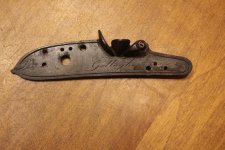
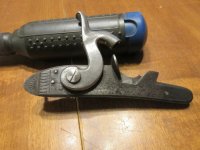
Incidentally, when I made the replacement tumbler, I changed the relationship of the full and half #### notches. Because the gun is now percussion, I set the half #### notch so that the hammer is not raised very far from the nipple. I think this is safer - should the half #### ever fail, the hammer doesn't have much of a fall and the cap may not fire. With a flintlock, the half #### notch must be positioned so that the c ock is further back to allow the frizzen to close.
Incidentally, when I made the replacement tumbler, I changed the relationship of the full and half #### notches. Because the gun is now percussion, I set the half #### notch so that the hammer is not raised very far from the nipple. I think this is safer - should the half #### ever fail, the hammer doesn't have much of a fall and the cap may not fire. With a flintlock, the half #### notch must be positioned so that the c ock is further back to allow the frizzen to close.
Licensed to kill
CGN Regular
- Location
- Peace Country Alberta
The other advantage to locating the half bent position low on a percussion lock is that the. Use if the hammer will help protect the cap from being swept off the nipple by a branch or just “because”.I set the half #### notch so that the hammer is not raised very far from the nipple. I think this is safer - should the half #### ever fail, the hammer doesn't have much of a fall and the cap may not fire. With a flintlock, the half #### notch must be positioned so that the c ock is further back to allow the frizzen to close.
Got one just about finished. Tumbler and stirrup are yet to be heat treated, and the hammer finished.
View attachment 1013137View attachment 1013138View attachment 1013139
very nice, I am impressed
cheers mooncoon

Metals R Us is owned by Rod Burns and they use to be in the same build as Rods machine shop, owned by Rod but ran by his son Melvin in Burnside. My first machinist job out of highschool was at rods machine shop. I worked there for 5 years. I've cut countless pieces of steel in Metals R Us
Also, impressive work. Looks awesome.
Also, impressive work. Looks awesome.
Tried to give the hammer a bit of varied colour to simulate casehardening. I'll let it sit for a while and then apply some browning to oxidize the surface slightly. Rubbed down to simulate wear it might not look out of place on the lock.
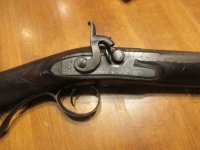
Tried to shoot the gun this week. No luck. Cap fires, but flash did not reach the powder. I had blown in the muzzle, and there was some air exiting the nipple, so I was hopeful. I had not been able to remove the nipple. Time to remove it, and make sure the passage is clear.
The nipple is square shanked, none of my nipple wrenches would engage it properly. So, I made a nipple wrench to fit. Took a piece of steel and drilled a pilot hole the size of round portion of the nipple. From the other end, I drilled a larger hole. Left about a quarter of an inch at the smaller diameter. Filed the hole square with a tight fit on the nipple's square. Cross drilled the end for a 1/4" rod. Barrel in the vise, wrench on the nipple. It turned right out. Cleared the flash channel, worked a length of paper clip in almost an inch and a half. Hooked out a wad of crud. Now a lot more air can be blown through the barrel. Should fire now.
The nipple is square shanked, none of my nipple wrenches would engage it properly. So, I made a nipple wrench to fit. Took a piece of steel and drilled a pilot hole the size of round portion of the nipple. From the other end, I drilled a larger hole. Left about a quarter of an inch at the smaller diameter. Filed the hole square with a tight fit on the nipple's square. Cross drilled the end for a 1/4" rod. Barrel in the vise, wrench on the nipple. It turned right out. Cleared the flash channel, worked a length of paper clip in almost an inch and a half. Hooked out a wad of crud. Now a lot more air can be blown through the barrel. Should fire now.

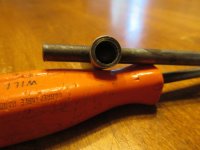
Now THERE is a trick I need to remember!Took a piece of steel and drilled a pilot hole the size of round portion of the nipple. From the other end, I drilled a larger hole. Left about a quarter of an inch at the smaller diameter. Filed the hole square with a tight fit on the nipple's square. Cross drilled the end for a 1/4" rod.
the one time I made a square socket, I drilled the end of a piece of 3/8 drill rod, then filed a slightly tapered square post with a blunt point on the end so that I could start it in the drill rod, then heated the drill rod red hot and hammered it over the square post.. Quite easy to do and more or less guarantees a square hole that is is square and is the right dimension
cheers mooncoon
cheers mooncoon






















