












































You are using an out of date browser. It may not display this or other websites correctly.
You should upgrade or use an alternative browser.
You should upgrade or use an alternative browser.
Mauser 98 Trigger gets 'pulled' when lifting bolt to ####
- Thread starter Taki
- Start date

- Location
- Western Manitoba
Kinda guessing that yours has a military two stage trigger, and the other ones that you saw had a commercial trigger. Post #2 suggested taking the rifle out of the stock and you would see it happen as you cycle the bolt - your picture in Post # 3 is showing that you have taken the bolt out of the rifle. Take the rifle out of the stock and watch the trigger as you cycle the bolt - am sure that will make it clear to you what is going on.
Kinda guessing that yours has a military two stage trigger, and the other ones that you saw had a commercial trigger. Post #2 suggested taking the rifle out of the stock and you would see it happen as you cycle the bolt - your picture in Post # 3 is showing that you have taken the bolt out of the rifle. Take the rifle out of the stock and watch the trigger as you cycle the bolt - am sure that will make it clear to you what is going on.
Ah ok I see, nah the one I saw was military surplus channel's K98 which is probably all matching. I'll have to get some tools to get the stubborn bands off.
- Location
- Western Manitoba
Also, perhaps a detail - trigger should not move if you have simply closed the bolt and then opened it - unit stayed "cocked" all the time. Quite probably it will move if you have closed the bolt, dry fired it, (or closed the bolt with the trigger pulled back) and are re-cocking it as you open the bolt. Assuming that you have a standard military sear and trigger arrangement. Commercial triggers work differently.
Last edited:
Also, perhaps a detail - trigger should not move if you have simply closed the bolt and then opened it - unit stayed "cocked" all the time. Quite probably it will move if you have closed the bolt, dry fired it, and are re-cocking it as you open the bolt. Assuming that you have a standard military sear and trigger arrangement. Commercial triggers work differently.
Yeah exactly, in the video the guy cocks it by opening the bolt, when I do it my trigger pulls back and slams forward the moment it is fully cocked
EDIT: and it pulls back ALL the way before slamming back to the normal position
- Location
- Western Manitoba
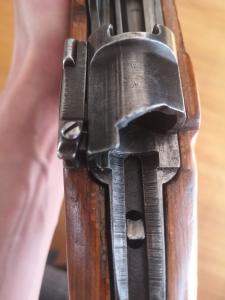
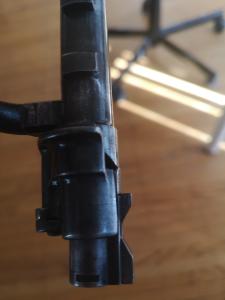
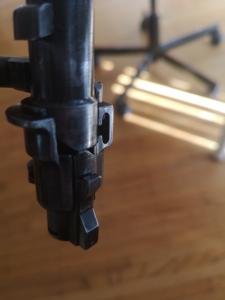
In your picture of the bolt - can see the underside of the cocking piece - those areas separated by the "V"'s - front edge is to be held back by sear until trigger is pulled - then cocking piece slams forward to fire the rifle - trigger sear ends up between those "V"'s - will be pressed down as the bolt is opened and pulled back. Just took a quick look at a 1909 Argentine on the work bench - its "V"'s are more central, perhaps back a bit more - any evidence whether the cocking piece is original to your rifle? Often has the last two digits of the rifle's serial number on the very rear end of it - but many are not marked at all. My best guess, without seeing your trigger and sear, which require removing rifle's action from the stock.
Should be two pictures following. You can see the top of the sear sticking up with your cocking piece groove on your pictures. Pictures here should show you how it works - what you might see if you remove action from your stock.
First picture - sear is holding back the cocking piece in its "cocked" ready to fire position, small screwdriver is pointing to the interface:
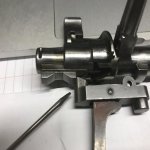
Second picture - sear has been dropped by trigger - cocking piece has gone forward, sear spring has returned sear back up - now between the "V"'s - so when opening and re-cocking, that "V" on the cocking piece cams down the sear, which causes the trigger movement:
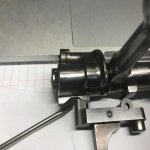
Apologies for the hair in the second picture - our Boy Cat had to come help and supervise as I was trying to get the picture - not really bearing many grudges against "supervisors" after 40 odd years in potash mines - but this cat is about as "helpful"...
Should be two pictures following. You can see the top of the sear sticking up with your cocking piece groove on your pictures. Pictures here should show you how it works - what you might see if you remove action from your stock.
First picture - sear is holding back the cocking piece in its "cocked" ready to fire position, small screwdriver is pointing to the interface:
Second picture - sear has been dropped by trigger - cocking piece has gone forward, sear spring has returned sear back up - now between the "V"'s - so when opening and re-cocking, that "V" on the cocking piece cams down the sear, which causes the trigger movement:
Apologies for the hair in the second picture - our Boy Cat had to come help and supervise as I was trying to get the picture - not really bearing many grudges against "supervisors" after 40 odd years in potash mines - but this cat is about as "helpful"...
Attachments


Last edited:
In your picture of the bolt - can see the underside of the cocking piece - those areas separated by the "V"'s - front edge is to be held back by sear until trigger is pulled - then cocking piece slams forward to fire the rifle - trigger sear ends up between those "V"'s - will be pressed down as the bolt is opened and pulled back. Just took a quick look at a 1909 Argentine on the work bench - its "V"'s are more central, perhaps back a bit more - any evidence whether the cocking piece is original to your rifle? Often has the last two digits of the rifle's serial number on the very rear end of it - but many are not marked at all. My best guess, without seeing your trigger and sear, which require removing rifle's action from the stock.
Yeah the bolt is mismatched which is probably why the safety is stuck on fire position as well.
Well now its not going backwards and just moving forwards a little bit after I tried to put my finger behind the trigger to stop it from moving when I #### it... EDIT: just kidding it's doing it again
Until I can get the band off and take out the action I'll just assume its because the bolt cocking piece is mismatched
Oh I see, hey glad that the Cat is trying to help haha
So does the lug thingy on the cocking piece push down on the sear when you rotate the bolt causing the trigger to move?
The trigger is also loose when it gets pushed back when I #### it; so I can easily stop it from moving when I'm cocking the gun if that adds any useful information.
Last edited:
- Location
- Western Manitoba
"safety is stuck in the fire position" - that is likely because that safety and that cocking piece have never been fitted together - that particular issue has nothing to do with the rifle - is between the safety lever and the cocking piece. However, your description about the trigger also raises questions about the cocking piece, so may truly be what is your issue? Mixing and matching - what could go wrong? Mauser 98's were made in dozens (?) of countries and factories, for 50 + years - and subtle variances between them - most definitely not always a "drop-in" solution, although, if, for example, you have all Radom marked parts, they will be very nearly all "drop in". No one said that a Yugo safety was going to work in an FN bolt with an Argentine cocking piece when installed in a Czech receiver, using a German trigger and sear, though.
Last edited:
"safety is stuck in the fire position" - that is likely because that safety and that cocking piece have never been fitted together - that particular issue has nothing to do with the rifle - is between the safety lever and the cocking piece. However, your description about the trigger also raises questions about the cocking piece, so may be truly is your problem. Mixing and matching - what could go wrong? Mauser 98's were made in dozens (?) of countries and factories, for 50 + years - and subtle variances between them - most definitely not always a "drop-in" solution, although if, for example, you have Argentine marked parts, they will be very nearly all "drop in". No one said that a Yugo safety was going to work in an FN bolt with an Argentine cocking piece when installed in a Czech receiver, though.
I see, yeah I will probably in the future take it to a gunsmith to have it fitted if possible. I'm just a university student who just got his PAL at the beginning of this year so I got no tools unfortunately haha
"safety is stuck in the fire position" - that is likely because that safety and that cocking piece have never been fitted together - that particular issue has nothing to do with the rifle - is between the safety lever and the cocking piece. However, your description about the trigger also raises questions about the cocking piece, so may be truly is your problem. Mixing and matching - what could go wrong? Mauser 98's were made in dozens (?) of countries and factories, for 50 + years - and subtle variances between them - most definitely not always a "drop-in" solution, although if, for example, you have Argentine marked parts, they will be very nearly all "drop in". No one said that a Yugo safety was going to work in an FN bolt with an Argentine cocking piece when installed in a Czech receiver, though.
oops posted twice
- Location
- Western Manitoba
If you want to play with this stuff, eventually, my suggestion would be to get a set of decent gunsmithing screwdrivers first. I buy stuff and just amazing to me how many people appear to have no clue that owning a Canadian Tire one-size-fits-all screw driver does NOT qualify them to work on guns or scope mounts. Should be able to remove and re-install a slotted screw with no sign whatever that it had been touched - screw driver has to fit exactly - to be ground with parallel sides and full width - for many of us a single screw is a lot more expensive to find "one of" to replace, than is making a properly fitting driver in the first place. I happen to use a Wheeler Engineering kit, but have dozens of extra bits ground to fit particular slotted screws. Next, I don't do U-tube much - I am old-school and prefer books - so for Mausers, get a copy of Jerry Kuhnhausen "The Mauser M91 through M98 Bolt Actions - A Shop Manual". There is so much stuff that has been "forgotten", that a WWI soldier could do without tools, in the rain, sitting in a muddy ditch, in the dark.
If you want to play with this stuff, eventually, my suggestion would be to get a set of decent gunsmithing screwdrivers first. I buy stuff and just amazing to me how many people appear to have no clue that owning a Canadian Tire one-size-fits-all screw driver does NOT qualify them to work on guns or scope mounts. Should be able to remove and re-install a slotted screw with no sign whatever that it had been touched - screw driver has to fit exactly - to be ground with parallel sides and full width - for many of us a single screw is a lot more expensive to find "one of" to replace, than is making a properly fitting driver in the first place. I happen to use a Wheeler Engineering kit, but have dozens of extra bits ground to fit particular slotted screws. Next, I don't do U-tube much - I am old-school and prefer books - so for Mausers, get a copy of Jerry Kuhnhausen "The Mauser M91 through M98 Bolt Actions - A Shop Manual". There is so much stuff that has been "forgotten", that a WWI soldier could do without tools, in the rain, sitting in a muddy ditch, in the dark.
Oh wow, yeah just having one of these kits and a clamp would make disassembling so much easier, thanks for all this knowledge. Once I have the time I'll definitely get one just so I can take guns apart for cleaning and whatever without killing myself in the process.
I think I've seen the book you're talking about that was when I was figuring out the different action lengths and the differences between M48 and K98 etc. Couldn't find a PDF version unfortunately.
- Location
- Western Manitoba
.....
So does the lug thingy on the cocking piece push down on the sear when you rotate the bolt causing the trigger to move?
The trigger is also loose when it gets pushed back when I #### it; so I can easily stop it from moving when I'm cocking the gun if that adds any useful information.
So, turning the bolt from closed and fired, to open, mostly "cocks" a Mauser 98. It is that action that pulls the cocking piece back - hopefully you can imagine from my pictures that the front "V" on the cocking piece will cam the sear down as the cocking piece moves back - then pulling the bolt handle rearward pulls that cocking piece completely away. The sear's spring will return it to position, so when you close the bolt, that sear will be in position to stop and hold the cocking piece. There is a slight bit of movement at the end of the bolt motion that finishes the "cocking" action. A Mauser 98 is called a "#### on open" action, but a bit of the "cocking" actually occurs on closing.
During the time that the Mauser sear is pressed down by the cocking piece lugs, the trigger is free to flop back and forth. Most of the time, the trigger guard slot is cut so that the trigger can not go too far forward. When you have the action right out of the stock, with no trigger guard, you can "fire" the thing by pushing the trigger forward - pushing it the wrong way. Can not be done in a correct trigger guard, since the metal slot will prevent that much forward movement.
Is actually a great system - hard to imagine it all came out of one guy's mind - Paul Mauser. Most all so called "improvements" since then have been to make manufacture cheaper and often overlook some aspect designed into the 98. An exception, to me, is the M1917 ability to single feed - a true original Mauser 98 can only be fed from the magazine - and the M1917 had a much larger, more robust extractor designed to single feed, and had clearance milled within the right hand side of the reciever to do that. Since a M1917 in 30-06 was the first centre fire rifle I got to use, I quite prefer it - even with "#### on closing" - because of it's original, unaltered design to single feed, although I wished it had the three position safety.
Last edited:
OP, Potashminer is giving you lots of information and to your credit, you're verifying it yourself.
From your pics, the leading edge of your sear is a bit worn, maybe it's the angle of lighting??
The issue you are experiencing isn't uncommon by any means. At least, 50 years ago it happened fairly regularly on rifles assembled from parts.
There were several causes.
The first, which likely made up 90% of the problem was a worn out or broken or cut down sear spring.
The second, was a worn sear edge
Then there were others, like bubba trying to file or grind off one of the cam edges on the trigger to make it a single stage trigger.
Many shooters had never learned to shoot on these lovely actions and the first stage would throw them off, leading to accidental discharges etc.
When I worked for Lever Arms, far to long ago, one of my jobs was to strip down FTRed surplus firearms or sporterised surplus firearms and to check for the condition you're describing. At first, I was surprised at how many of the sported firearms, which had been used in offshore nations, by target shooters and hunters, had trigger issues. Then it became a common problem and the biggest issue I had was acquiring replacement springs and sears.
Some of the match rifles had the first, trigger take up stage cam surface, removed to make them single stage. Then they honed the sear edge and the cocking piece to make their trigger let off very light/crisp. They also cut down trigger pull weight to around a half pound or less by cutting a couple of rings off the sear spring, or replacing it with a specialty spring, which used to be available.
It was such a problem in North America that companies like Numrich/Sherwood would sell replacement kits that had been done properly and would allow for a 3 pound let off.
From your pics, the leading edge of your sear is a bit worn, maybe it's the angle of lighting??
The issue you are experiencing isn't uncommon by any means. At least, 50 years ago it happened fairly regularly on rifles assembled from parts.
There were several causes.
The first, which likely made up 90% of the problem was a worn out or broken or cut down sear spring.
The second, was a worn sear edge
Then there were others, like bubba trying to file or grind off one of the cam edges on the trigger to make it a single stage trigger.
Many shooters had never learned to shoot on these lovely actions and the first stage would throw them off, leading to accidental discharges etc.
When I worked for Lever Arms, far to long ago, one of my jobs was to strip down FTRed surplus firearms or sporterised surplus firearms and to check for the condition you're describing. At first, I was surprised at how many of the sported firearms, which had been used in offshore nations, by target shooters and hunters, had trigger issues. Then it became a common problem and the biggest issue I had was acquiring replacement springs and sears.
Some of the match rifles had the first, trigger take up stage cam surface, removed to make them single stage. Then they honed the sear edge and the cocking piece to make their trigger let off very light/crisp. They also cut down trigger pull weight to around a half pound or less by cutting a couple of rings off the sear spring, or replacing it with a specialty spring, which used to be available.
It was such a problem in North America that companies like Numrich/Sherwood would sell replacement kits that had been done properly and would allow for a 3 pound let off.
Last edited:
- Location
- Western Manitoba
An excellent summary by Bearhunter. The first centerfire rifles I got to use were M1917 in 30-06 and Lee Enfield No. 4 in 303 British. Both have the two stage triggers, as does the Mauser 94, 96 and 98. When it is cold, I prefer them, now. With half frozen finger can feel that you have the trigger, can take up the weight of the first stage and just hold it on that "stop" - the break point of the second stage, until the sights are perfect and then break the weight. Going pretty much "nuts" trying to learn with a Schultz and Larsen Model 61 - I doubt that final set trigger pull is 2 ounces - have had it fire more than once where I did not even feel that my finger was pressing on that second trigger. As Bearhunter described, so many people tried to convert a military two stage into a "better" single stage trigger - yet I see many higher end target rifles being sold with two stage triggers!! Mausers, Lee Enfields, Enfields were all battle rifles - worked well - in my opinion they translate into fine hunting rifles for all the same reasons that made them fine battle rifles. They could be used, tuned and "improved" for competition, but almost every change from original design gives up something in reliability or another function. I suspect most problems occurred when "improved" by someone who did not appreciate the other consequences of their change - clipping sear spring coils being a prime example, or honing and changing sear interface angles.
Last edited:






















