Yes. The only book worth a damn is the scarlatta book.
And even it has an error in it.
After slugging over a dozen 88 bores, the only .318 bore I ever saw was on a replacement Czech barrel on an Ecuadorian-issue 88S.
Edit: This may explain it a little better for you. The 226gn 88 Patrone had a nominal diameter, on paper, of .318", but was a long, cylindrical bullet with a thin cupro-nickel jacket and a very soft lead core. The land to land diameter in the Gew88 (and Mauser 98) is 7.92mm, or .3115". I have two original WW1 88 patrone rounds in my collection, both measure out to .314", not .318", so even the .318" number is a bit dubious.
The M88 was the second small projectile high velocity rifle round to be invented, period. It was preceded only by the French 8mm Lebel. Modern concepts like spitzer bullets that are exactly the diameter of the grooves had not yet been invented. The 88 was a "lands rider" bullet that was intended to expand a bit in the bore so the soft lead heel would swell into the rifling to .321" diameter or so and give your bullet the right spin, it was based on black powder technology and ideas of the day. In other words, from day one, the rifle ALWAYS had a groove depth of between .321" and .323" owing to tolerances.
In service, the 88 worked well, but wore barrels out way too fast. Like 3 times faster than if the bullet had been a spitzer with a short bearing surface. Additionally, the cupro-nickel was not dissolved by the hot water cleaning the army was using from the Mauser 71/84 days. Over time it built up in the grooves, caused drag and pressure problems, and resulted in some burst barrels and injuries. It's important to note that the Gew98 used the M88 ammo until 1905 as well and had the same rifling specs!
Testing at Spandau around 1894 eventually showed the problem. The things done to fix the 88 and it's ammo included:
-Chamber area was increased in diameter and had a longer taper toward the muzzle to increase barrel strength.
-Bolt shroud was altered to include a gas deflection shield
-Alkali cleaning solutions and ballistol were adopted for barracks and field cleaning respectively to cut down on jacket fouling.
-A different alloy was adopted for barrels (such barrels stamped "nm" for "neu material")
-Development of a spitzer round was begun.
By 1905, the german adopted the M1905 8x57JS round which had a 154gn spitzer bullet with a short bearing surface and a nominal diameter of (on paper) .323". All my original ammo measures out to .321" though, so again... I am dubious of the original german drawings.
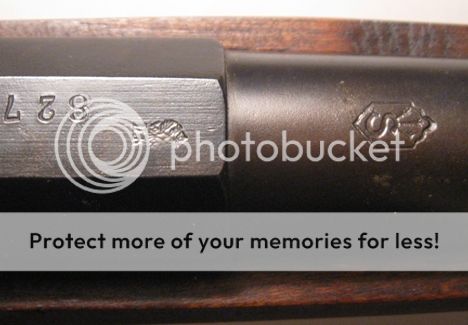
It is important to note that the Gew88 and M98 did not alter the rifling specification! Not one iota. They moved from a land rider design to a more smokeless-appropriate groove-rider bullet. What they did do was use a reamer in all Gew88 and Gew98 rifles made before 1905 to ensure the chamber necks on the rifles were large enough to accommodate a loaded .323" bullet, plus the diameter of the jacket. In most cases this would not have removed any metal since the area was already marginally within spec having been originally designed to accommodate black powder levels of fouling. Rifles so updated were marked with an "S", hence the Gew88S designation.
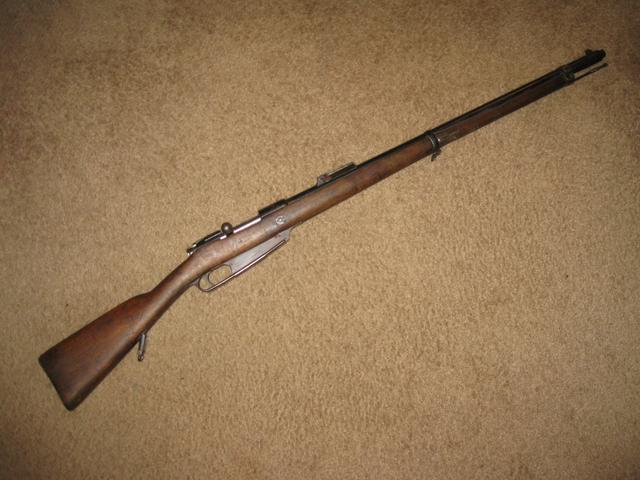
Next came the 88/05 conversion. This involved converting the 88 from a Mannlicher clip load system to an M98 charger clip system. Charger guides were soldered and pinned into place, which moved the rounds slightly forward on loading. Tis resulted in the need for a small relief cut in the front receiver ring. A lot of people think this was for the S ammo. It was not. The guns were backwards compatible for 88 ammo, which is longer, and the notch was for that 88 ammunition which, as I mentioned, sat slightly further ahead during charger loading and would have fouled on the receiver. Lastly, they added a shallow thumb cut so there was enough clearance to push all the rounds into the chamber under the German manual of arms.
Later, in 1914 when rifles were sorely needed at the front, the nice fit and finish of the 88/05 conversion was tossed out in favor of a crudely welded and machined set of charger guides. This was the 88/14, now considered rare. The prevailing theory is that in 1918 when the German Army had to divest itself of all rifles above the Versailles Commission-set limits on number of rifles, the cruder 88/14 rifles were among the first to go to the smelter to preserve more modern K98a and Gew98 rifles. The 88/05's are more plentiful than any other model today because those rifles in turkey were spared the 1919 arms reduction efforts and turkey had received the 88/05 almost exclusively.
There was also an 88/S version of the 88S which was basically the addition of a spring-loaded sheet metal cover over the trigger guard ejection port so that empty clips would eject up and out, instead of out the bottom. This was a 1914 modification to deal with trench mud that could be clipped onto any 88S rifle. Personally, I've never had one in-hand, but they are much more common in the US.
Now with all this info, why do we slug gew88 bores? Well, the answer is that Gibbs Rifle Company imported thousands of Gew88 rifles from Ecuador before the Turkish imports were available. with no basis of comparison, a LOT of early writers on the subject of the 88 believed these rifles to represent typical Gew88 production. It's thought Ecuador got their rifles some time between 1890 and 1914 through a sale of used rifles from the imperial government. By the 1920's, most needed overhaul and Ecuador ordered replacement barrels from BRNO in Czhechoslovakia. Nobody seems to know why, but they were supplied with .318 groove diameter barrels and nearly all those rifles were so converted. Perhaps for this reason, ecuadorian rifles are often found VERY rough looking form long inadequate storage condition, but all have as-new bores that were packed with grease since overhaul. It makes you wonder whether Ecuador didn't use the rifles after discovering the dangerous bore dimensions (?) and then allowed the rifles to deteriorate.
As for shooting, rifles with original barrels shoot the 154gn 8mm loading just fine in my opinion. Personally, I would not advise shooting the WW2 era M1934 version of the 8x57JS with a 198gn bullet. Turkey stuck with the 154gn version until they dropped the 8mm from service simply because their Gew88 and pre-98 mausers would not tolerate that heavier load very safely.
Does that help?
PS: Sorry for the hijack!