Mean radius seems to be easily misunderstood. I wrote a small Windows application that will hopefully help illustrate what MR means, and more importantly, show you how much of an error window there is when talking about a given number of shots.
You can get the application here:
https://github.com/ShortyCM/MREviz/releases
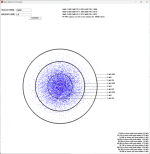
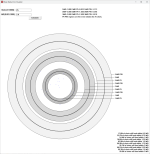
You can enter any number of shots from 2-10000 and enter a particular mean radius. The app will then calculate the P5-P95 error window for you and display how that relates to the mean radius in question. You will see three dark circles representing the mean radius you have entered, shown as 1 MR, as well as 2 times that MR (2 MR) and 3 times that (3 MR). There are also some shaded regions around that which outline the error window region that surrounds each MR value. That error window region shrinks as you add more and more shots, so that you can get an indication of how precise an answer you're getting with having measured a given number of shots.
There are three lines at the top that show you 1MR, 2 MR, and 3MR values related to the MR that you input. And it also shows the corresponding P5 and P95 values for each error window. In the screenshot it shows 25 shots have been entered with a MR of 1.0, and it says the P5 value for 1MR is 0.833 and the P95 value is 1.173. What this means is that for your measured mean radius of 1.0, say 1.0 MOA, the error window for 25 shots is 0.833 MOA to 1.173 MOA. So while you measured a mean radius of 1.0 MOA for those 25 shots, the fact that there is only 25 shots in the dataset means the actual mean radius value lies somewhere between 0.833 MOA and 1.173 MOA. With fewer shots that error window would be larger, and with more shots the error window would be smaller. And playing with the input values in the application will let you see how the number of shots changes those error window regions.
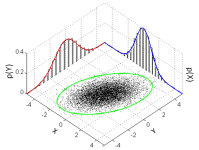
I also included what percentage of shots will land in given fractional multiples of the MR at the lower right of the window. This is to give you a better idea of how to think about mean radius in general. Mean radius is a predictive value. It tells you what you can expect to see in the dispersion on target. I think the most basic way to think about it is, for a target of any given size, you will want a mean radius of half its size in order to have more than 95% of your shots hit the target. As you can see in the list, for a given MR, you can expect 95.7% of shots to hit inside a circle that is twice that MR value. Those values are simply derived from the Rayleigh distribution, which you can also think of as a circular-normal distribution. A "normal distribution" with one dimension is the classic bell curve most people know about. A "Rayleigh distribution" or "circular-normal distribution" is a normal distribution with two dimensions, an x and y axis in this case. A typical bell curve in the x axis and a typical bell curve in the y axis combine to give you the Rayleigh/circular-normal distribution. And that's what gives these percentages for these fractional multiples of the MR.