Min. Scope clearance ?

broadhead67

CGN frequent flyer
Rating - 100%
72   0   0
Location
B.C.
I have seen slow motion vid of barrels behaving like a whip (exaggerated) under recoil . So what is considered a safe minimum clearance ?
I would imagine it moves very little near the chamber / front scope bell area but I’m curious now
 
If I can place a business card between the bell of the scope and barrel then I feel comfortable there will be no interference. Phil.
 
Also keep in mind that if you want to put an objective cover on your scope you might want a bit more clearance to allow for that.
 
I’ve gone with the credit card rule in the past
This rifle is a Savage M99 in .308 w/ standard thickness barrel
Thx for the info
 
If I can place a business card between the bell of the scope and barrel then I feel comfortable there will be no interference. Phil.

Well, not quite.
For short scope and moderate caliber rifle (up to say 30-06) business card thickness clearance would be OK.
For large magnum, large objective scope with large frontal overhang I say 1/16" to sometimes 1/8" clearance wouldn't be to much.
Also I like at least 1/4" clearance between bolt handle and scope's ocular.
GR8's 2c worth....
 
The thick chamber end of the barrel won't move much at all, it is the muzzle end where the motion is. Since the objective lens sits over the chamber end I just go with as long as I can see light between there I feel it's safe, I do prefer to have a couple millimeters so I can slip on a lens cap though.
 
It's nice to keep enough clearance so you can get something between barrel and scope for cleaning too.

To clean what???

The thick chamber end of the barrel won't move much at all, it is the muzzle end where the motion is. Since the objective lens sits over the chamber end I just go with as long as I can see light between there I feel it's safe, I do prefer to have a couple millimeters so I can slip on a lens cap though.

The objective bell will flex and whip more than the chamber end of the barrel. ;)
 
I had a bushnell legend 5 to 15 x 40 on a savage model 12 in 204 once. This was an adjustable objective scope. The adjustable part had small ribs for grip, and every 4th one or something like that was twice as high. With the parallax set on 100 yards( 90% of the time it stayed there) one of these taller ribs was right on the bottom. It had clearance but not much, it's been a while so I dont remember the exact clearance but I think you could have put an average business card under but not 2 of them. A few sheets of paper for sure.

Anyway one day the gun starts shooting crazy. One on paper then a few feet away. Yes feet. Send it back and bushnell promptly replaced it. When I took the scope off there was a nice shiny mark on the barrels blueing right under this higher rib.
 
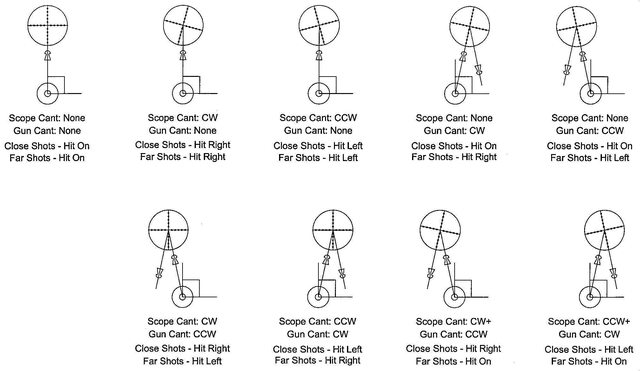
Scopes mounted low help minimize canting error. If a scope is too high it increases the problems associated with scope cant, when the reticle is not plumb. This causes the POI being further off the longer the target distance, a problem potentially compounded by wind. In long distance shooting, if the scope is perfectly set up, that is without being "off level" or out-of-plumb, accuracy is unaffected by how high the scope is mounted. When both the rifle and scope are canted accuracy is again compromised as target distance increases. At shorter shooting distances there is a measurable difference when scopes are mounted higher.

If the scope is mounted plumb, that is the scope axis and bore axis are aligned, the most important thing is that it is comfortable to look through the scope when it is mounted on the rifle. There is an aesthetic appeal of a scope mounted low, but not all rifles have the same height combs. Easy eye-to-scope alignment is key.

 
Scopes mounted low help minimize canting error. If a scope is too high it increases the problems associated with scope cant, when the reticle is not plumb. This causes the POI being further off the longer the target distance, a problem potentially compounded by wind. In long distance shooting, if the scope is perfectly set up, that is without being "off level" or out-of-plumb, accuracy is unaffected by how high the scope is mounted. When both the rifle and scope are canted accuracy is again compromised as target distance increases. At shorter shooting distances there is a measurable difference when scopes are mounted higher.

If the scope is mounted plumb, that is the scope axis and bore axis are aligned, the most important thing is that it is comfortable to look through the scope when it is mounted on the rifle. There is an aesthetic appeal of a scope mounted low, but not all rifles have the same height combs. Easy eye-to-scope alignment is key.


The scope does not need to be plumb. The reticle needs to be plumb when in use. A canted rifle with a plumb reticle will still shoot and track properly.

 
The scope does not need to be plumb. The reticle needs to be plumb when in use. A canted rifle with a plumb reticle will still shoot and track properly.

Keeping a consistent cant from shot-to-shot is the challenging part. Technically nothing needs to be plumb if the same hold was possible in practice and target distance remained constant.

The image below shows the effect of cant, with the scope and with the rifle and scope. It was originally made for air rifles but the principles, of course, remain the same.

 
Back
Top Bottom