So I have a bunch of mixed headstamp brass for my 223 I was going to bulk load as varmint rounds. I've generally always stuck with single manufacturers on my brass, however in this case I'll obviously be loading a mix. My question is, how much real world variance can I expect from using mixed headstamp brass? Is this a moot point unless you're shooting competition? 0.1moa? 0.5moa? Minute of barn?













































You are using an out of date browser. It may not display this or other websites correctly.
You should upgrade or use an alternative browser.
You should upgrade or use an alternative browser.
Mixed brass load variance
- Thread starter Freyr_255
- Start date
My best groups with mixed brass 223, shot in a Ruger Precision Rifle 20" bolt gun 7" twist, bulk ball powder so it feeds from a progressive powder throw, loaded on a Dillon 650, Hornady 55gr Soft Point .224" bullet, were 0.7 MOA at 100m. With the Speer 52gr hollow point it was about 1.1". With CamPro 55gr FMJ bullet it was 2".
I do weight sort my 223 brass into a light group and a heavy group. The above was shot with the heavy group (93.6 grains and up). Weight range on 223 cases ranges from about 88gr to 101gr (measured prepped and without primer).
I do weight sort my 223 brass into a light group and a heavy group. The above was shot with the heavy group (93.6 grains and up). Weight range on 223 cases ranges from about 88gr to 101gr (measured prepped and without primer).
rifleman762
CGN Ultra frequent flyer
- Location
- Southern Alberta
Interesting. I've always been way too OCD to load mixed headstamp brass. At least in a rifle. Heck I always deburr flash holes and uniform the primer pockets, too! And I'll weight sort the matching headstamp brass... All without greatly increased accuracy, apparently! Hmmmm.

I load by headstamp at most. My shooting is all run and gun stuff under 200m with some slow fire typically 100-300m though. My accuracy ranges from amazing to good. Campro bullets are noticeably less accurate than almost any other bulk bullet I have tried as well.

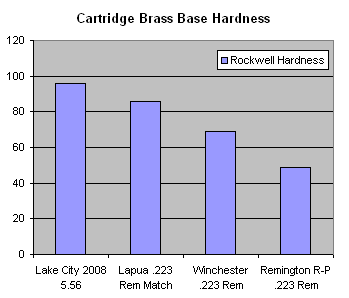
I buy bulk once fired Lake City 5.56 and 7.62 brass, because of its very low cost, brass hardness, uniformity and quality. Its not Lapua brass but its far better than Winchester or Remington brass.
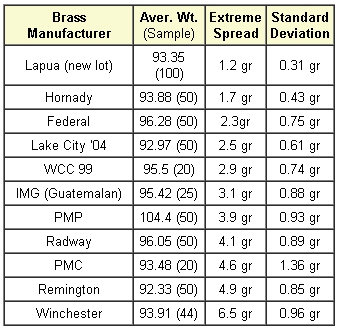
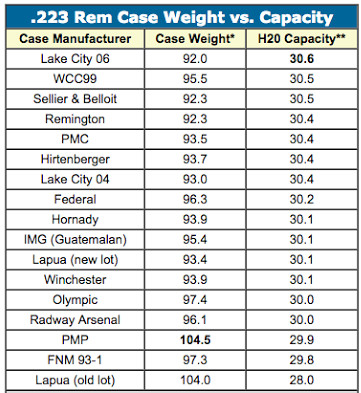
For blasting and plinking ammo mixed brass should be OK, "BUT" if you want uniformity and better accuracy sticking with one brand of case is to your advantage.
Below you can see that the majority of .223/5.56 cases are very close in capacity. "BUT" remember comertial .223 cases have softer brass than milspec brass.
Save $$ By Using Lake City 5.56x45mm Once-Fired GI Brass
http://bulletin.accurateshooter.com/2019/10/save-by-using-lake-city-5-56x45mm-once-fired-gi-brass/
Accuracy Potential of Mil-Surp 5.56×45 Brass
"So, how accurate can previously-fired GI surplus brass be in a good National Match AR-15? Well, here’s a data point from many years ago that might be of interest. A High Power shooter who wrote for the late Precision Shooting magazine took a Bill Wylde-built AR match rifle to a registered Benchrest match. His first 5-round group ever fired in a BR match was officially measured at 0.231″ at 200 hundred yards. This was fired in front of witnesses, while using a moving target backer that confirmed all five rounds were fired.
He recounted that his ammo was loaded progressively with factory 52gr match bullets and a spherical powder using mixed years of LC brass with no special preparation whatsoever. Obviously, this was “exceptional”. However, he had no difficulty obtaining consistent 0.5-0.6 MOA accuracy at 200 yards using LC brass and a generic “practice” load that was not tuned to his rifle."
For blasting and plinking ammo mixed brass should be OK, "BUT" if you want uniformity and better accuracy sticking with one brand of case is to your advantage.
Below you can see that the majority of .223/5.56 cases are very close in capacity. "BUT" remember comertial .223 cases have softer brass than milspec brass.
Save $$ By Using Lake City 5.56x45mm Once-Fired GI Brass
http://bulletin.accurateshooter.com/2019/10/save-by-using-lake-city-5-56x45mm-once-fired-gi-brass/
Accuracy Potential of Mil-Surp 5.56×45 Brass
"So, how accurate can previously-fired GI surplus brass be in a good National Match AR-15? Well, here’s a data point from many years ago that might be of interest. A High Power shooter who wrote for the late Precision Shooting magazine took a Bill Wylde-built AR match rifle to a registered Benchrest match. His first 5-round group ever fired in a BR match was officially measured at 0.231″ at 200 hundred yards. This was fired in front of witnesses, while using a moving target backer that confirmed all five rounds were fired.
He recounted that his ammo was loaded progressively with factory 52gr match bullets and a spherical powder using mixed years of LC brass with no special preparation whatsoever. Obviously, this was “exceptional”. However, he had no difficulty obtaining consistent 0.5-0.6 MOA accuracy at 200 yards using LC brass and a generic “practice” load that was not tuned to his rifle."
I've always loaded mixed brass and have had great accuracy. I have found through the years that the larger the case the less difference it makes. My hornet shoots better with same head stamp compared to mixed but my 7mm mag doesn't mind. I'm not competing with either one but they get game.

M12shooter
CGN frequent flyer
- Location
- East St. Paul, mb
If your precision loading then every bit of deviation that can be removed with components makes a difference I would think. Even manufacturing lots between the same cases would be a concern. With this duffer, I generally shoot brass that my barrels like and never mix manufacturers and such. With this said, I'm happy shooting slightly sub MOA which is way more than needed for shooting 6 inch steel at 400 yards, killing coyotes and other vermin, and a whitetail or two each November.
My take away from this is nobody has really ever played with it in real life. Guess when I find some free time I'll do some experimentation between brass types using the same loading. I need to do a little tweaking on my current loading as I just hacked it together from a single round of load development due to time constraints and then get to bulk loading. Will be interesting to see how this works out.


Eh. Gophers at 1-300m when I head back to southern Alberta would be the most challenging. Not shooting competition but once I'm past 200m the mildot is generally bigger than the gopher lol. I have to pull my loading book, but I want to say current loading is a little under 1moa using Winchester brass, h335, and 53gr vmax lobbed out of a 700 LTR that absolutely hates slower powders. I got it down to 0.3moa but that loading was h4895 with a 0.1 grain window and a shotgun pattern on either side so I decided to not go that route due to weather variations probably causing issues with such a sensitive loading. I figure tweaking will get h335 down to 0.5-0.75 moa.Playing around at short range you might not see much difference.i Close range accuracy is as much about an opportune exit time as anything. At long range high velocity ES will chew you up and spit you out.
I guess my goal here is to keep everything under 1 moa with the mixed headstamp. I probably won't have time for a few months to sit down and work through all this properly though.
https://www.gunsamerica.com/digest/reloading-science-do-you-really-need-to-sort-your-brass/
This is a good test. Depends on the accuracy you need and how the rifle can shoot.
I have read this along with a few others. There doesn't seem to be much consensus on the topic, although many who actually use mixed headstamp report very little difference, while the arm chair warriors harp about consistency. I'm not saying it's an invalid point to make, but it seems like very few have actually tried mixed brass. So, paper vs real life. They don't always agree. And it's the internet...so even more difficult to get things to align lol!
Eh. Gophers at 1-300m when I head back to southern Alberta would be the most challenging. Not shooting competition but once I'm past 200m the mildot is generally bigger than the gopher lol. I have to pull my loading book, but I want to say current loading is a little under 1moa using Winchester brass, h335, and 53gr vmax lobbed out of a 700 LTR that absolutely hates slower powders. I got it down to 0.3moa but that loading was h4895 with a 0.1 grain window and a shotgun pattern on either side so I decided to not go that route due to weather variations probably causing issues with such a sensitive loading. I figure tweaking will get h335 down to 0.5-0.75 moa.
I guess my goal here is to keep everything under 1 moa with the mixed headstamp. I probably won't have time for a few months to sit down and work through all this properly though.
For clarity I go by the target shooting definitions of 0-300 as short range, 300-600 as mid-range and 600-1000 as long range. I used a fast twist .223 with 80s in F-class for awhile. Highly recommend it for people who don’t have enough frustration in their life.


Oh yeah I hear ya!For clarity I go by the target shooting definitions of 0-300 as short range, 300-600 as mid-range and 600-1000 as long range. I used a fast twist .223 with 80s in F-class for awhile. Highly recommend it for people who don’t have enough frustration in their life.
I have three different Fclass cartridges in several rifles , the 308 and .223 being the most common .
If I really want to drive myself nuts I get sons of the old ammo I used for coyotes and try and shoot if oast 600 in my Oalma rigid ! LOL
Mouse guns are great fun but one must realize their limitations for sure!
Even match bullets are not not that accurate once you go long I've you are not paying attention to all the small details like matched brass
Cat
Northman999
CGN Ultra frequent flyer
- Location
- Southern Yukon
When I was a teenager and started reloading, I always fired mixed brass, having no idea that according to the experts I should not be doing that. Then for many years, after I learn better, I started separating all my brass and doing everything recommended by most modern handloaders. I still do that the majority of the time. However I had an interesting time at the range just recently. I purchased a batch of used 243 brass from an older fellow who was getting out of shooting, completely mixed, unknown firings but apparently not many times. Anyway I just got a new 243 and loaded up 50 rounds of 85 grain TSX is over reloader 17 using this brass, and hit the range to sight in my rifle and check results. My new rifle was shooting sub 1 inch groups over and over again with this load at 100 meters, and conditions were actually pretty windy. I’m sure groups would’ve been tighter under better conditions. I couldn’t be happier. Now keep in mind this is a hunting rifle, and I just hunt normal hunting conditions, so an animal at 600 yards is going to get an automatic free pass anyway. I know checking over the brass that I fired there was a mix of Winchester, Imperial, Federal, and Norma.
When I was a teenager and started reloading, I always fired mixed brass, having no idea that according to the experts I should not be doing that. Then for many years, after I learn better, I started separating all my brass and doing everything recommended by most modern handloaders. I still do that the majority of the time. However I had an interesting time at the range just recently. I purchased a batch of used 243 brass from an older fellow who was getting out of shooting, completely mixed, unknown firings but apparently not many times. Anyway I just got a new 243 and loaded up 50 rounds of 85 grain TSX is over reloader 17 using this brass, and hit the range to sight in my rifle and check results. My new rifle was shooting sub 1 inch groups over and over again with this load at 100 meters, and conditions were actually pretty windy. I’m sure groups would’ve been tighter under better conditions. I couldn’t be happier. Now keep in mind this is a hunting rifle, and I just hunt normal hunting conditions, so an animal at 600 yards is going to get an automatic free pass anyway. I know checking over the brass that I fired there was a mix of Winchester, Imperial, Federal, and Norma.
Thanks for the commentary. When I find time I'm definitely going to play with this subject as anecdotally, there's lots of reports of mixed headstamp being just fine. After years of reloading, I've come to the conclusion that people going for ultimate consistency in a bench rest style of detail aren't gaining that much in the real world. But, we shall see when I get this rolling. I'm going to dial a load in with one type of brass, then bulk load and shoot each headstamp individually, followed by one of each type in a group. I suspect however, that the fussiness of one's gun will actually be the deciding factor on overall groupings more so than the brass. I've got a buddy who just loads 26gr of varget behind any 55gr bullet in his 223 and it's instantly sub moa. For which I'm eternally envious of as he gets to play with all the fun random old bullets he comes across without the dicking around of load development lol!

Over 50 years ago an article suggested weighing brass.
Box #1 of Dominion 30-06 weighed 186 - 203 grains; Box #2 weighed 183 - 206.
From that I selected 20 rounds within about 5 or 6 grains of variation.
About that time I weighed two boxes of Norma 6mm Remington and the first box varied 1.1 grains and box 2 varied 0.8 grains and fit within the first box.
Loved the story of a shooter claiming he missed a moose and wanted me to check the reloads he received from a friend.
Not only were there three different brand of brass there were four different bullet types. He had no idea which was used to miss a moose.
Box #1 of Dominion 30-06 weighed 186 - 203 grains; Box #2 weighed 183 - 206.
From that I selected 20 rounds within about 5 or 6 grains of variation.
About that time I weighed two boxes of Norma 6mm Remington and the first box varied 1.1 grains and box 2 varied 0.8 grains and fit within the first box.
Loved the story of a shooter claiming he missed a moose and wanted me to check the reloads he received from a friend.
Not only were there three different brand of brass there were four different bullet types. He had no idea which was used to miss a moose.

So many things can affect the way a rifle shoots. I will relate one such thing - the brass.
I took some ammo to the range to shoot in my M700 7mm Rem Mag.
Half were loaded in R-P brass, half in WW-Super brass. Both were loaded with identical
components: CCI 250 primers, 66.0 grains of Norma MRP, 160 Nosler Accubonds. Same
seated COL.
The two different brass types both shot excellent groups <moa, but the loads in the
R-P brass shot exactly 1¼ higher than those loaded in the WW Super brass.
Sorting brass is a worthwhile effort, [even within the same manufacturer] Dave.
I took some ammo to the range to shoot in my M700 7mm Rem Mag.
Half were loaded in R-P brass, half in WW-Super brass. Both were loaded with identical
components: CCI 250 primers, 66.0 grains of Norma MRP, 160 Nosler Accubonds. Same
seated COL.
The two different brass types both shot excellent groups <moa, but the loads in the
R-P brass shot exactly 1¼ higher than those loaded in the WW Super brass.
Sorting brass is a worthwhile effort, [even within the same manufacturer] Dave.





















