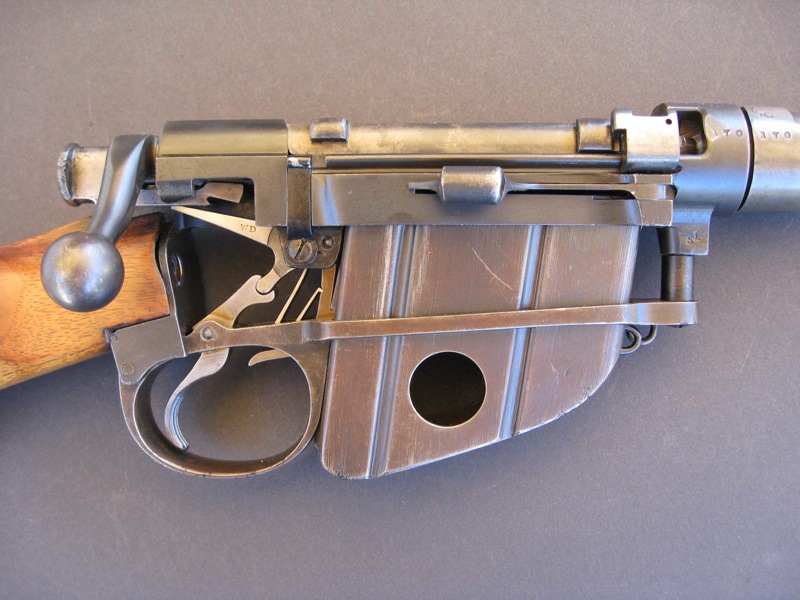
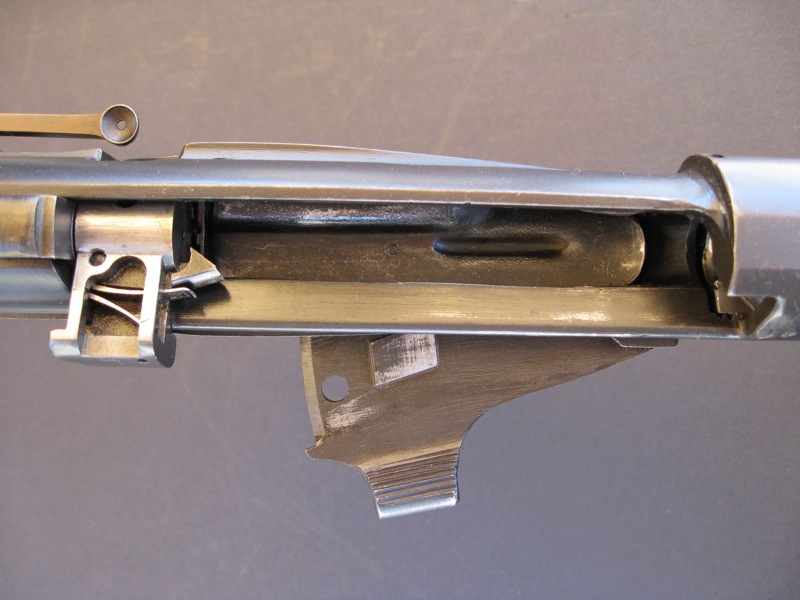
Mk III bolt marks

Which point are you referring mate?

Leaving the factory as a MkIII* with a slot.

I can see a 1918 LSA MkIII* leaving the factory with a slot as they, like Lithgow, changed from the MkIII to the MkIII* in 1918 & i can see that it would be feasable rifles made at the time of the change over having a slot but MkIII*s
 
Yep no disagreement from me, only I thought it was absolutely the case that actions that had the slot machined as MkIII's but assembled after cutoffs were deleted, were marked MkIII* but not necessarily at the same time depending on which factory.
Correct me if I'm wrong.

So in the case of the OPs rifle, a 1916 Enfield, can my point above be applicable? Or is it that it the rifle entered service as a MkIII, was then returned to stores to have cutoff removed and became MkIII*, and finally later on, cutoff reinstalled and star barred out?


 
With it being a 1916 ( i have a1916 EFD MkIII with cutoff) anything any of us has put forward could be correct, we could be all correct as there are plenty of them out there with maybe many different stories to how they came to be, hell it might not have even been assemble into a rifle untill 1940!

Big thing for me is the amount of MkIII* star barred SMLEs out there but there's seems to a total lack of MkIII* with a slot with the star intact other than Lithgows but even if one was to pop up it would still not prove anything as the barring of the star could of been missed, what we need is actual paper work but the evidence i have seen over the years points me in the direction the slots were added later & i used to think the opposite.
 
Last edited:
Yeah that's right, it's hard to know. Add to the fact that theres no one still alive that work on these rifles, collectors and enthusiast rebuilding, restoring or just dicking around with rifles, the real story is lost.

I've owned and still own a number of WW1 and post war rifles that were greased and stored before they were sold from service and remain pretty much untouched from that time. The grease is my proof and greased rifles is what I mostly sort during my most active years of collecting. Most of these rifles were MkIII's but the cutoff was removed. I think that rifles with cutoffs still intact today are probably so in most cases because the purist put them back on.
 
I think most likely the OP's rifle was assembled in 1916 from a receiver that was made the previous year.During the war they utilized existing stores until they were depleted.Then in 1916 it was assembled to Mk lll*spec(no volley sight, no windage sight and no magazine cutoff.)After the war the cutoff was re installed, perhaps with a windage sight and the * was barred. When the rifle was re-barrelled in 1940 it was then probably returned to the Mklll* spec.
 
Mr.e moose, the Volley sights etc have nothing to do with a rifle being in MkIII or MkIII* specs, the only thing that makes a MkIII a MkIII is the slot & cutoff, the LoC of 1916 states the Volleys etc were to be omitted (not deleted) from future production of the MkIII, in a seperate paragraph they introduce the MkIII* which they state is the same as a MkIII but without the slot "so may embody" the modifications to the MkIII, not the omitted parts make a MkIII* which means a MkIII* can be fitted with volley etc & still pass inspection.
 
Yes & being a 1936 i would expect it to have one, the magazine cutoff being deleted in 1916 is a myth, it was not deleted untill 1941

On Lithgows that would be true. I think you will find on a British No1, the magazine cut-off slot was deleted after 1915 once existing stock of receivers ran out.
 
On Lithgows that would be true. I think you will find on a British No1, the magazine cut-off slot was deleted after 1915 once existing stock of receivers ran out.

Sorry but you are wrong, whilst there are not many post 1918 british made rifles around you would have to ask why... if the cutoff was deleted in 1915 why all the MkVs, No1 MkVIs & the trials No4s all had cutoffs.
Besides the LoC of 1916 begins with " part 1: modifications to the future production of the MkIII" & in part 2 introduces the MkIII*.
Btw went i get home from work i will post the 1916 LoC plus some pics of non Lithgow production MkIIIs
 
Last edited:
Sorry but you are wrong, whilst there are not many post 1918 british made rifles around you would have to ask why... if the cutoff was deleted in 1915 why all the MkVs, No1 MkVIs & the trials No4s all had cutoffs.
Besides the LoC of 1916 begins with " part 1: modifications to the future production of the MkIII" & in part 2 introduces the MkIII*.
Btw went i get home from work i will post the 1916 LoC plus some pics of non Lithgow production MkIIIs

I must have at least 10 post 1916 British No1 mk3* and none have a mag cut-off. Lithgow did continue until 1942 with them. As to the pictures of non Lithgow Mk IIIs please include the wrist stamp so we can see the date.
 
The rifle I looked at was a Lithgow

Tell us more about this rifle please Gerard. 1936 is a nice year for lithgows since they made very few.

Yes English made rifles were made as MkIII's with cutoff up until 1941. Lithgow the same, not 1942.
 
It would almost seem the standard arm between the wars was the MkIII & not the MkIII* & that would go along way in explaining the apparent the conversion of MkIII*s to MkIIIs by cutting a cutoff slot.
 
Last edited:
With thanks to Advisory Panel member Terry Hawker, there's an interesting article about cut-offs in the Technical Articles for Milsurp Collectors and Re-loaders (click here)http://www.milsurps.com/forumdisplay.php?f=25.

No. 4 Mk I (T), ex-Trials Rifle - Cut-off - Off or On? (click here)http://www.milsurps.com/showthread.php?t=7039

This article is accompanied by an extensive photo montage detailing the use and descriptions of the various of magazine cut-offs on Enfield rifles.

Article Extract .....

Still reluctantly struggling with the concept of letting the "Other Ranks" have the option of firing a second shot at their own discretion, cut-offs were introduced by the War Department upon the demise of the Martini-Henry, then retained in one form or another for over half a century.

A MLM Mk II Skeleton Action illustrates how the cut-off was initially configured to employ the rifle as a single loader until the situation required the use of the magazine held in reserve.


(Click PIC to Enlarge)

Regards,
Doug
 
Mark III* was a WARTIME EXPEDIENT to permit manufacture of more rifles in the same amount of time.

Mark III was the PREFERRED PATTERN and production reverted to this standard once the War was over.

Same thing precisely occurred during the Second War, ending with removal of Cutoffs yet again and all rifles treated as if they were III*s.

On the Number 4, Cutoff was removed before the rifle entered series production. Earliest rifles, including Trials Mark VIs and Trials Number 4s, all were toolroom rifles. By May of 1940, the Long Room still had not been equipped and set-up to build the Number 4, but enough tooling had been taken down that it no longer could build the Number 1. Following Dunkirk, orders were AT LAST given to BSA (which had maintained a complete operational Number 1 factory in a semi-mothballed state since the end of the Great War). The final BSA Number 1s also were Cutoff-less.

MUCH of this is explained in Reynolds' book.

You have a part which is finicky to make, gets in the way of the troopies, is seldom used except as a nuisance and requires special heat-treatment yet is not necessary in order to make the thing go "Bang!". OF COURSE you get rid of it. If you really want it for looking smart, you can bring it back in peacetime.

Rocket science it ain't.

Think of the coffee-grinder on the Sharps'.
 
Back
Top Bottom