I'm looking at a different scope for my 22. I want adjustable parallax. Looking at the bushnell ar optics scope. Only thing is it's mrad and I'm used to moa. Is it a tough transition? MOA just makes more sense to me, yes I'm older and like imperial. More stuff is available in mrad than moa but all ballistic charts are imperial. Yes I can do the math, but still. How did you guys find the transition?













































You are using an out of date browser. It may not display this or other websites correctly.
You should upgrade or use an alternative browser.
You should upgrade or use an alternative browser.
MOA to MRAD
- Thread starter Mulefan
- Start date

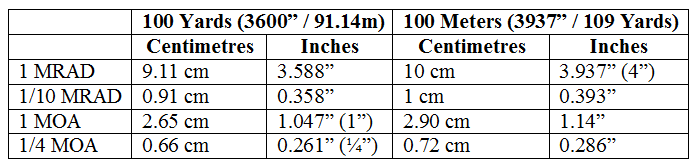
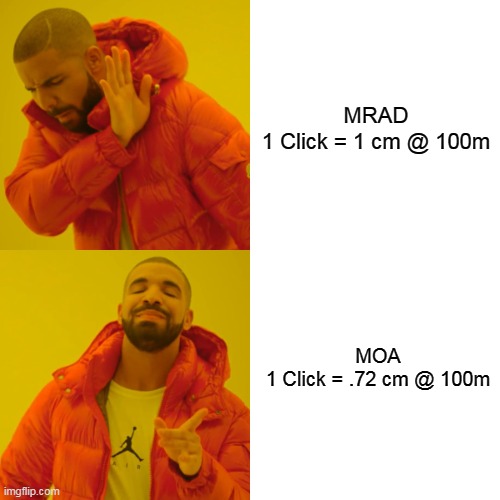


Ffp and mrad is like metric. Sfp and moa is like imperial. Both work. One is a little easier to use, imho.
You will like it.
direct calculations in 'sfp' ONLY works at a specific power, specified by that scope and manufacture. Not sure now as I only shoot ffp after I bought one years ago (can't go back) but as I used to know it was about 18x power on 24x scopes that the calculations were direct correlations.
I grew up with Inches and MOA makes 'easy calc' for me. I bought a Bushnell Engage with a MOA Christmas tree, then found Covenant scopes (Cabelas- then other brands) that have 'Numbers' every 4th MOA on Elev & Wind. Much easier than 'counting the bars' - I always lost my place. Now my Athlon Argos also has the 'Numbers'. YMMV - GOOD LUCK
BTW - ALL are FFP. If using for 'close shot' the reticle just looks like a Duplex when it 'shrinks'.
BTW - ALL are FFP. If using for 'close shot' the reticle just looks like a Duplex when it 'shrinks'.
No transition for me. Been working in MOA all my life. Too old and stubborn (and maybe stupid) to put my brain through such a traumatic shock.
THis. Picked up a new Athlon BTR FFP Talos for cheap in Mills and can’t do the math. Think in inches not 3.6cm. Gonna flog it on EE and go back to MOA like all my other glass. Mills just ain’t intuitive to me.


All my scopes are MOA turrets with MIL reticles. I've been doing that so long, it's easy. Can't wrap my head around an MRAD turret.
I can't wrap my head around a scope with MOA turrets and mil reticle.

I can't wrap my head around a scope with MOA turrets and mil reticle.
I can sort of relate to your point of view. I’m an MOA kind of guy that has to live in a world that my MOA turrets are often paired with mil-dot reticles. It did occur to me that on a second focal plane scope a mildot reticle suddenly turns into a 4 MOA subtention reticle with a power change. That by itself isn’t worth much, but a half milli radian reticle can turn into a 2 MOA spacing and all of a sudden the universe starts making sense again. The rounded of quick math is times .84 but that needs to be verified by test and the power dial marked. Who says you cant have it all?

Last edited:
I can't wrap my head around a scope with MOA turrets and mil reticle.
The you haven't been shooting for very many years.
Twentyish years ago, there was no such thing as a Milrad scope turret. All turrets and scope adjustments were MOA. But there was such a thing as a MilDot reticle. Thus one had to understand a Mil reticle and an MOA turret.
It's not that difficult. 1 Mil = 3.6 MOA or for ease of use, 3.5 MOA is close enough.
With the Xmas tree type mil reticles or even a X-hair style marked in .2 or .5 mil, I find it easy enough to use mil turrets, and pretty simple to adjust, as the reticle tells me what to adjust it. I grew up and was educated with english system, have to think about metric, but, I did it enough with it at work over the years, with bolts and etc, that it really isn't a big deal for me to figure out if need be. I like the FFP mil reticles, also have a 1/8MOA x-hair 6.5-20 still, no big deal between the two.
I run MOA scopes on my hunting rifles and MIL scopes on my long range precision rifles.
I don't have any issues working with either, I do that every day as part of my job anyway. As long as I have my rangefinder on the correct units for the scope I'm using (metric for MILs etc) I'm good to go.
Going forward it will be MILs only for me, base 10 is easier for me to work with at distance.
I don't have any issues working with either, I do that every day as part of my job anyway. As long as I have my rangefinder on the correct units for the scope I'm using (metric for MILs etc) I'm good to go.
Going forward it will be MILs only for me, base 10 is easier for me to work with at distance.
Mystic Precision
CGN Ultra frequent flyer
- Location
- Summerland, BC
As a long time F class competitor, I lived in a world of SFP and MOA... converting to mils took less then 5 mins. For scaling groups, targets, most will continue to talk in MOA.... for adjusting for distance/drop, you figure out distance with your rangefinder and adjustment with your ballistics dope. Precious little math needed nowadays.
If you decide to move to a FFP scope (either MOA or mil), hopefully, the reticle and turret adjustments match. If yes, then you just use the reticle like a ruler and dial/hold off as needed. The biggest improvement I have seen over the last 10yrs is where the reticle AND adjustments actually match up... repeat... and are reliable... and often, don't cost a fortune.
For games where you are constantly adjusting for various target distances, I vote mils... so much easier to do base 10 math. If I am working with another shooter, so much easier to talk adjustments in base 10 math... not a fan of fractions under stress. Again, no math involved... see impact, scale adjustment, call out the number... done.
I would definitely worry more about the parallax adjustment range. That can be very helpful with rimfire at close range. There are plenty of scopes that offer adjustment down to 10m. Budget, features and brands I will leave to your tastes
I am very biased towards Athlon, Sightron and Delta.
Jerry
If you decide to move to a FFP scope (either MOA or mil), hopefully, the reticle and turret adjustments match. If yes, then you just use the reticle like a ruler and dial/hold off as needed. The biggest improvement I have seen over the last 10yrs is where the reticle AND adjustments actually match up... repeat... and are reliable... and often, don't cost a fortune.
For games where you are constantly adjusting for various target distances, I vote mils... so much easier to do base 10 math. If I am working with another shooter, so much easier to talk adjustments in base 10 math... not a fan of fractions under stress. Again, no math involved... see impact, scale adjustment, call out the number... done.
I would definitely worry more about the parallax adjustment range. That can be very helpful with rimfire at close range. There are plenty of scopes that offer adjustment down to 10m. Budget, features and brands I will leave to your tastes
I am very biased towards Athlon, Sightron and Delta.
Jerry
- Location
- Western Manitoba
I can't wrap my head around a scope with MOA turrets and mil reticle.
Two different original purposes I think - I believe USA military wanted mil-dots to give shooter a way to guesstimate a range to the target - mostly replaced with laser range-finders these days - but the mil-dot still works much better than "eye-ball", for most, to tell difference between 525 meters / yards and 650 meters / yards - especially when shooting across a valley with no visual references along the route to target. But then you do not get wind effect references either.
The you haven't been shooting for very many years.
Twentyish years ago, there was no such thing as a Milrad scope turret. All turrets and scope adjustments were MOA. But there was such a thing as a MilDot reticle. Thus one had to understand a Mil reticle and an MOA turret.
It's not that difficult. 1 Mil = 3.6 MOA or for ease of use, 3.5 MOA is close enough.
Many years? Ha, I've never been shooting, guns are bad...
I have had Moa/Mil scopes in the past but when I learned about mil/mil it just made way more sense to me to use one method of measurement.
As a long time F class competitor, I lived in a world of SFP and MOA... converting to mils took less then 5 mins. For scaling groups, targets, most will continue to talk in MOA.... for adjusting for distance/drop, you figure out distance with your rangefinder and adjustment with your ballistics dope. Precious little math needed nowadays.
If you decide to move to a FFP scope (either MOA or mil), hopefully, the reticle and turret adjustments match. If yes, then you just use the reticle like a ruler and dial/hold off as needed. The biggest improvement I have seen over the last 10yrs is where the reticle AND adjustments actually match up... repeat... and are reliable... and often, don't cost a fortune.
For games where you are constantly adjusting for various target distances, I vote mils... so much easier to do base 10 math. If I am working with another shooter, so much easier to talk adjustments in base 10 math... not a fan of fractions under stress. Again, no math involved... see impact, scale adjustment, call out the number... done.
I would definitely worry more about the parallax adjustment range. That can be very helpful with rimfire at close range. There are plenty of scopes that offer adjustment down to 10m. Budget, features and brands I will leave to your tastes
I am very biased towards Athlon, Sightron and Delta.
Jerry
would be even easier if all targets were metric too, paper and steel
How easy to dial for a prs target sans rangefinder, use the reticle for a 2 second look, dial and shoot
instead its 'did I range the target or that weed/stump/rock





















