












































You are using an out of date browser. It may not display this or other websites correctly.
You should upgrade or use an alternative browser.
You should upgrade or use an alternative browser.
Monster moose taken in NB!
- Thread starter SuperCub
- Start date


Here's another pic of the brute .......

And they said moose couldn't be knocked down with a .22

And they said moose couldn't be knocked down with a .22
LOL ..... I'm signing off.
.

From Noslers marketing campaign, I believed that the Accubond was supposed to be a 80% weight retention type bullet.
Accubonds consistently retain ~65% weight, which is nearly identical in terms of weight retention, to the Nosler Partition. Accubonds are GREAT hunting bullets!

- Location
- St. Joe's Island, Ont
Buddy shoots a baby moose. Then he brags about it. And then you f'n idiots praise him and high five him. IT'S A F'N BABY MOOSE........ relax, it' aint'n no bragging trophy, it's just a F'N MOOSE, A BABY TO BOOT. So what? I don't feel as I should high five him for his accomplishment. Ok, so Paul, ya shot a moose, congrats. But don't expect appolations and praises as if you'd shot a record ram. For cryin' out loud ........It's just a f'n Moose. Amd everyone else... go and fuch yourselves.
Think it's time you took a little break from CGN.


Supercub waits 20 years for a 3 day season, shoots the first moose he sees (a nice meat moose) and is chastised for it.
Gitrdun can probably hunt elk every year but thinks it's fine to shoot the same class of animal...And it sure didn't look like a joke.
Making comments like this are both poor manners, and hypocritical.
Gitrdun can probably hunt elk every year but thinks it's fine to shoot the same class of animal...And it sure didn't look like a joke.
Making comments like this are both poor manners, and hypocritical.

Good hunt ....In Cabelas they have the sub groups listed of North American Moose..thought you might like article
Moose Subspecies in the World
The Eastern Canadian Moose
Alces alces americana
The Eastern Moose was introduced very successfully into the Province of Newfoundland to Gander Bay, NF in 1878 and to Howley, NF in 1904. Eastern Canada moose have a bulky body with a short, stubby tail and a long, oblong head. Adult body coloration of the moose is generally brownish black. The face lightens to a brown color in summer and becomes darker, almost black, in color as breeding season approaches. The legs are lighter in color than the body. Except for its slightly darker coloration and some cranial differences, the Eastern Moose is indistinguishable from the Western sub-species. Their ranges overlap north of Lake Superior, so most moose in this area are likely to be a hybrid between the Eastern and Western sub-species. Both the Boone and Crockett, and the Pope and Young Clubs combine these two sub-species together under the heading Canadian Moose.
The Western Canadian Moose
Alces alces andersoni
Western Canada moose (also called Northwestern moose) have a bulky body with a short, stubby tail and a long, oblong head. Adult body coloration of the moose is generally brownish black. The face lightens to a brown color in summer and becomes darker, almost black, in color as breeding season approaches. The legs are lighter in color than the body. This Western sub-species of the moose weighs about 800 to 1000 pounds for a large bull.
Cow moose are not a lot smaller than the bulls, and weigh only about 100 to 130 pounds less. This moose sub-species will have a set of antlers that typically measures in the 45 to 58-inche range.
The Yukon-Alaska Moose
Alces alces gigas
There are the largest moose in the world. Alces gigas is a comparatively new species, having been described in 1899. An average mature bull will stand between 6 and 6 1/2 feet at the shoulder, and weigh about 1,200 pound with some larger males that would reach 1,500 pounds mark. The antlers of a mature male could span 65 inches or more and weigh up to 70 pounds. Bulls lose their antlers during the winter, they grow back from spring to fall will surpass the antler growth of a white-tailed buck during his entire lifetime. All bull moose will experience their largest antler spread, maximum number of points and largest palm size between the ages of 8 ½ years to 10 ½ years old. At present the Yukon-Alaska Moose is still quite numerous along the Yukon and its tributaries. In the winter this is still the staple diet of Indians
The Shiras Moose
Alces alces shirasi
Shiras moose, also known as Wyoming moose, is the smallest of the subspecies of moose. In addition to being slightly more compact than its northern cousins, the Shiras Moose is noticeably lighter in color along its back. The face lightens to a brown color in summer and becomes darker, almost black, in color as breeding season approaches. Moose of both ###es have a "bell" which is the flap of skin and long hair that hangs from the throat. The legs are lighter in color than the body. A Shiras bull will weigh up to 1,000 pounds, while standing 5'6" to 5'9" at the shoulder. It carries a rack that spreads from 40 to 50 inche wide. Shiras moose are found in western Wyoming, western Montana, northern and central Idaho, southwestern Alberta, southeastern British Columbia, and in isolated areas of Utah, Colorado, and extreme northwestern Washington
The European Moose
Alces alces machlis
Its summer coat is a rich, dark color, although this varies from black to dark brown, reddish brown, or grayish brown. The back may be slightly lighter in tone, while the legs are much lighter, generally tan or gray. In winter, the coat becomes thicker, dulling in color to a grayish-brown. The young resemble adults, and, unlike many deer, do not have spots or other markings.
The broad nose overhangs the muzzle and acts as a prehensile appendage resembling a miniature trunk. There is a pendulous flap of skin under the throat known as a bell, as well as a short, dense mane on the nape of the neck. The legs of the European Moose are extremely long and slender, while the body is heavy and the neck short. The large antlers have a spread of up to 6 feet. The European Moose range goes from Norway, Sweden and Finland to Russia and Siberia. There is also a small population of moose in Poland.
Moose Subspecies in the World
The Eastern Canadian Moose
Alces alces americana
The Eastern Moose was introduced very successfully into the Province of Newfoundland to Gander Bay, NF in 1878 and to Howley, NF in 1904. Eastern Canada moose have a bulky body with a short, stubby tail and a long, oblong head. Adult body coloration of the moose is generally brownish black. The face lightens to a brown color in summer and becomes darker, almost black, in color as breeding season approaches. The legs are lighter in color than the body. Except for its slightly darker coloration and some cranial differences, the Eastern Moose is indistinguishable from the Western sub-species. Their ranges overlap north of Lake Superior, so most moose in this area are likely to be a hybrid between the Eastern and Western sub-species. Both the Boone and Crockett, and the Pope and Young Clubs combine these two sub-species together under the heading Canadian Moose.
The Western Canadian Moose
Alces alces andersoni
Western Canada moose (also called Northwestern moose) have a bulky body with a short, stubby tail and a long, oblong head. Adult body coloration of the moose is generally brownish black. The face lightens to a brown color in summer and becomes darker, almost black, in color as breeding season approaches. The legs are lighter in color than the body. This Western sub-species of the moose weighs about 800 to 1000 pounds for a large bull.
Cow moose are not a lot smaller than the bulls, and weigh only about 100 to 130 pounds less. This moose sub-species will have a set of antlers that typically measures in the 45 to 58-inche range.
The Yukon-Alaska Moose
Alces alces gigas
There are the largest moose in the world. Alces gigas is a comparatively new species, having been described in 1899. An average mature bull will stand between 6 and 6 1/2 feet at the shoulder, and weigh about 1,200 pound with some larger males that would reach 1,500 pounds mark. The antlers of a mature male could span 65 inches or more and weigh up to 70 pounds. Bulls lose their antlers during the winter, they grow back from spring to fall will surpass the antler growth of a white-tailed buck during his entire lifetime. All bull moose will experience their largest antler spread, maximum number of points and largest palm size between the ages of 8 ½ years to 10 ½ years old. At present the Yukon-Alaska Moose is still quite numerous along the Yukon and its tributaries. In the winter this is still the staple diet of Indians
The Shiras Moose
Alces alces shirasi
Shiras moose, also known as Wyoming moose, is the smallest of the subspecies of moose. In addition to being slightly more compact than its northern cousins, the Shiras Moose is noticeably lighter in color along its back. The face lightens to a brown color in summer and becomes darker, almost black, in color as breeding season approaches. Moose of both ###es have a "bell" which is the flap of skin and long hair that hangs from the throat. The legs are lighter in color than the body. A Shiras bull will weigh up to 1,000 pounds, while standing 5'6" to 5'9" at the shoulder. It carries a rack that spreads from 40 to 50 inche wide. Shiras moose are found in western Wyoming, western Montana, northern and central Idaho, southwestern Alberta, southeastern British Columbia, and in isolated areas of Utah, Colorado, and extreme northwestern Washington
The European Moose
Alces alces machlis
Its summer coat is a rich, dark color, although this varies from black to dark brown, reddish brown, or grayish brown. The back may be slightly lighter in tone, while the legs are much lighter, generally tan or gray. In winter, the coat becomes thicker, dulling in color to a grayish-brown. The young resemble adults, and, unlike many deer, do not have spots or other markings.
The broad nose overhangs the muzzle and acts as a prehensile appendage resembling a miniature trunk. There is a pendulous flap of skin under the throat known as a bell, as well as a short, dense mane on the nape of the neck. The legs of the European Moose are extremely long and slender, while the body is heavy and the neck short. The large antlers have a spread of up to 6 feet. The European Moose range goes from Norway, Sweden and Finland to Russia and Siberia. There is also a small population of moose in Poland.

Think it's time you took a little break from CGN.
Make it a 6 month one, will ya...

FWIW, I've seen pics of Finnish moose that are a lot smaller than SC's. They think the same way, you can't eat the antlers, so they shoot whatever comes out!

Thought I would wait for this guy to grow up!
In Cabela's listing of the moose species, they fail to state there is a good distinguishing feature between the Canada Moose and the Alaska moose.
The antlers on the Canada moose, that we are all familiar with, tend to round up, over the length of the antler, and rise higher. The Alaska moose, on the other hand, have antlers that spread wide, then turn up near the ends. The Alaska moose, that also roam Yukon and northern BC, are the largest of the subspecies, but in the record books the spread of their antlers are greater than the Canada moose, with heads with a similar score. Here is a textbook example of a Canada moose.
Edited to say: I was flying the aircraft and a BC Forester with me took the picture, using a wartime Fairchild aerial camera. Moose is in a meadow beside the upper Parsnip River, in north-central BC.
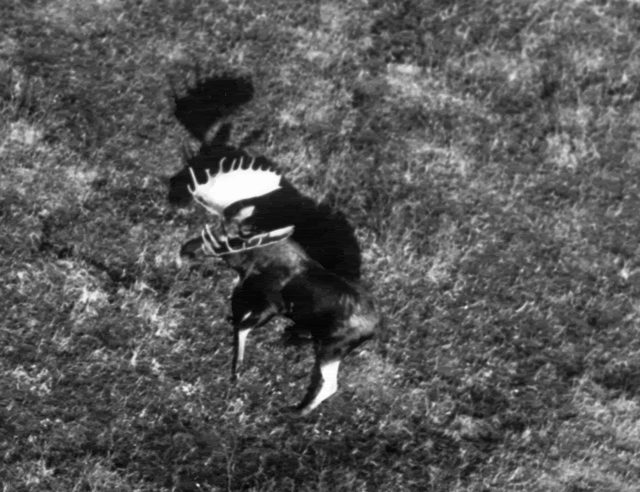
In Cabela's listing of the moose species, they fail to state there is a good distinguishing feature between the Canada Moose and the Alaska moose.
The antlers on the Canada moose, that we are all familiar with, tend to round up, over the length of the antler, and rise higher. The Alaska moose, on the other hand, have antlers that spread wide, then turn up near the ends. The Alaska moose, that also roam Yukon and northern BC, are the largest of the subspecies, but in the record books the spread of their antlers are greater than the Canada moose, with heads with a similar score. Here is a textbook example of a Canada moose.
Edited to say: I was flying the aircraft and a BC Forester with me took the picture, using a wartime Fairchild aerial camera. Moose is in a meadow beside the upper Parsnip River, in north-central BC.
Last edited:
Congrats....glad the long wait paid off! That will be some darn good eating. I'm going for my first moose hunt this fall too. I can't get time off work, so I'm going the next 2 weekends about 4 hours out of Ottawa in QC. I'll be packing my Winchester 1895 405WCF. Should do the trick if I can line one up.
Congrats again. Worth the wait and 12 minutes well spent!
Matt
Congrats again. Worth the wait and 12 minutes well spent!
Matt
Last edited:
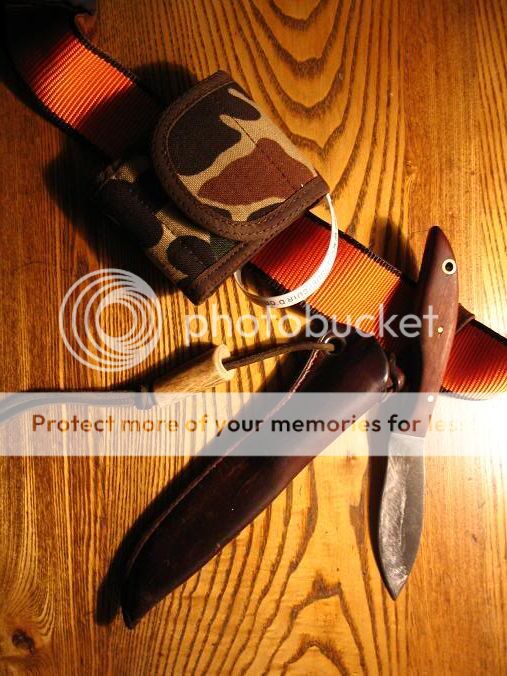
Funny story behind that knife ....Supercub, what flavour of knife is that on your belt? Or is that a knife?
It's a Russell belt knife custom clone. I bought it about ten yrs or more ago at a gunshow in Moncton and it quickly became a favourite, but I never knew who made it. A couple months ago there were some knives F/S on the EE that had the same maker's mark on the blade and I found out that "Garlochian" here on CGN had made that knife about 20yrs ago. This knife has given me good service over the yrs having skinned out a couple moose and more than a few deer. I recommend the Russell style knife wholeheartedly, in fact I also carry a Russell as a spare for doing big skinning jobs.
Yes ..... I'm very pleased with that rifle as it's fairly light at 8.5lbs scoped and easy to shoot.Congratulations Paul... is that the first kill for your newest toy ?
.
Good luck on you moose hunt. That 405 would definitely be the ticket for "moose medicine".I'm going for my first moose hunt this fall too. I can't get time off work, so I'm going the next 2 weekends about 4 hours out of Ottawa in QC. I'll be packing my Winchester 1895 405WCF. Should do the trick if I can line one up.
.
Thanks a lot Paul. I hope to have some pics to share with you folks next week too. Getting pretty excited about it!
Yeah, the 405 should indeed be good "Moose Medicine". I couldn't believe the whallop that gun has the first time I shot it a month or so back. Probably one of the funnest rifles I've ever shot, but truth be told, I wouldn't want to be shooting it all day!
Matt
Yeah, the 405 should indeed be good "Moose Medicine". I couldn't believe the whallop that gun has the first time I shot it a month or so back. Probably one of the funnest rifles I've ever shot, but truth be told, I wouldn't want to be shooting it all day!
Matt























