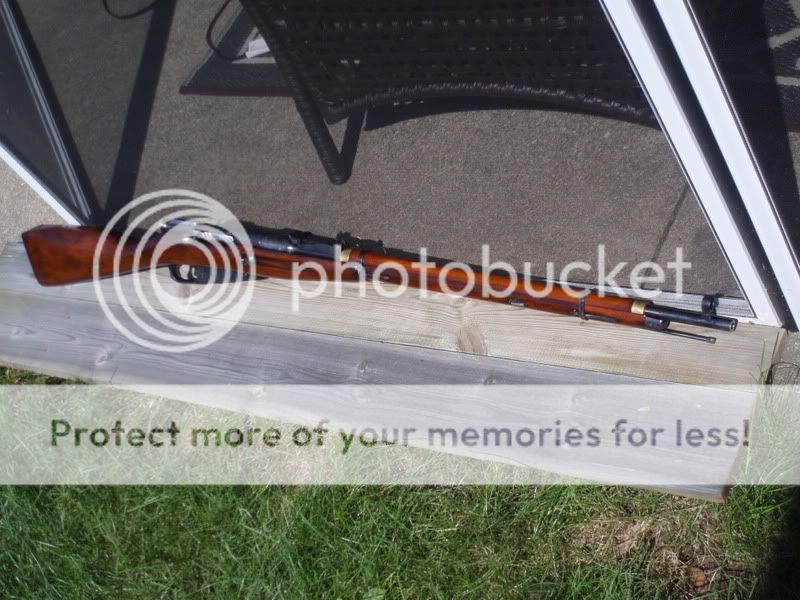
Mosin stock finish

Athrun[Zaft

CGN Regular
Rating - 100%
7   0   0
Hey there everyone;

I have a real pretty 1927 Izhevsk Mosin-Nagant. While her bluing is VERY nice, time hasn't been quite as kind to the shellac on her stock. I'm interested in giving the old girl's clothes a new lease on life, but I've never done anything like this before. Any tips or hints would be awesome! Another note; the stock bears some very clear cartouches, and I would like to keep it that way if at all possible.
 
Hey there everyone;

I have a real pretty 1927 Izhevsk Mosin-Nagant. While her bluing is VERY nice, time hasn't been quite as kind to the shellac on her stock. I'm interested in giving the old girl's clothes a new lease on life, but I've never done anything like this before. Any tips or hints would be awesome! Another note; the stock bears some very clear cartouches, and I would like to keep it that way if at all possible.

If you type Mosin Shellac into the Search pane, then set it to 36 months, you get tons of hits.
Basically you put a new coat of matching shellac on over the existing. Follow other's trials and tribulations and learn from their mistakes with that search.

http://www.canadiangunnutz.com/forum/showthread.php?t=619585&highlight=mosin+shellac
 
I was just gonna say I asked that... For what it's worth I never did it. I now have a mosin that someone painted brown with a paint brush - so I'll be re-doing that.
 
Last edited:
http://www.shellac.net/

Go to the above site, order some garnet dewaxed shellac, follow the instructions to the letter, and you will have yourself a Mosin with a finish as close to the original as you can get.

P7260020.jpg


Don't bubba the rifle by sanding the stock and staining it red.
 
Trust me, I have no intention of bubba'ing the gun up. My only concern with shellac is durability; how rugged will the finish be?

Quite simply the original finish is not rugged - but it certainly is easy to touch up. You can re-shellac over shellac and it melts right in. You just want to have a good colour match.
 
Shellac is a horrible finish for durability. But it was pleantiful and cheap. Once you've got it put on you'll want to handle it with some care unless you want to reproduce the scratched, scuffed look of a battle ground Mosin. But while it's one of the more poor finishes it's not like it's fragile like cheap stemware. Shellac will stand up fine to the usual way we handle any rifle in private hands.

What it won't like is sweaty hands hanging onto it for long period during a shooting session. You'll find that the spots where your hands fit get dirty and sticky fairly quickly from finger oils. It's also going to be sensitive to any number of cleaning products.

If you look at the wood used on the MN's it was a light cream coloured sort of hardwood. Other than during winter it would have stood out like a sore thumb in battle. I suspect the shellac dip was done to darken the wood.

Then in service as the shellac wore off fairly quickly it was replaced by a patina of dirt, grease and other stains from use which kept the wood dark looking.

To get as durable a finish with shellac as you can you'll want to degrease a fair amount of the cosmoline out of the wood. It's likely the generous use of that stuff which has caused the original shellac to have so poor a bond to the wood.

Then you'll want to thin the first few coats to an almost water like consistency to encourage a good deep penetration into the wood to achieve as strong a base as practical. The good news is that because the alchohal dries so fast you can recoat with shellac as soon as you can't smell the alchohal any longer. For the first couple of coats I'd do it in the shade. Once you've got the first couple of thin water like coats down in the wood you can mix the shellac up a little thicker.

You need to work fast with shellac as it dries quickly. So if using a brush flow it on and leave it alone. For this reason it's nice to thin it so it's about the same as water for the first couple or three coats. The rest should be about the consistency of 2% milk. Yes, it'll take 6 to8 coats to build up a nice finish but as it dries so fast you can achieve that in just a couple of days. Maybe even one if you can put the stock out in the sun to dry. With a decent varnishing brush work fast and don't go back over it once it's on. You've only got a few seconds to spread it before it dries to a thickness which is too hard to work. But working fast with thin coats is going to be easier and less splotchy looking than working with thicker material.

Shellac sands like a dream, so if you do botch it and get some runs or turn an area into a lumpy mess simply let it dry fully and smooth down the runs or lumps with some 400 grit wetordry. It's best not to flood it on so thickly though. Just simply get a nice wet coat on quickly and move on.
 
Here are some different finishes for you to look at. The light one is Polish and I know it's original. The others are refurbs or re-fins, none done by me.

Carbines002.jpg


Carbines004.jpg
 
Back
Top Bottom