My Enfield is off, waaay off.

ilikeoldguns

Regular
Rating - 100%
4   0   0
Took my dad to EESA the other day for a shoot, him with his new winchester 94 .45LC and me with my no1 MkIII Enfield.

It was his first time shooting the lever gun and my first time shooting my enfield with the full remilitarized stock.

My enfield was way off, we couldn't even get it on paper at 100 meters and had to go to the 50 meter mark where it was of by around 12 inches.

expected issues;

1. Frankenstein. Every bit of wood on this gun comes from a different rifle and I know that contact between barrel and stock in the right format is key on a Lee-Enfield.

2. I have an Indian nose piece on it.

3. fixed rear sight, no windage adjustment, it's a MkIII*

4. I do not have the book; The Accurate Lee Enfield.

I striped it down to put some tung oil on the forestock, is there anything I can do at this stage to help get my rifle back on target?
 
Pretty good group, for me at least. 3.5 inches from the standing, 174gr FMJ from PPU. and it was off to the right. Even using the bench rests it wasn't giving great groups, but the bench rests were pretty junky and I was way too tall for them.
 
I know it's an obvious question, but just for the sake of narrowing down the possibilities: where is the front sight blade, with respect to its base? Centre, way left, way right?
 
The Damned Crack is found at the back end of the Forestock, right where the Trigger goes down through the wood to mate with the Sear. The wood there is very thin and cracks easily. Sometimes a badly-cracked Forestock will crack all the way up to and even in front of the Magazine. This is repairable for pennies.

IF your rifle has The Damned Crack, degrease with brakedrum cleaner, glue with an epoxy glue and CLAMP IT for 24 hours, then trim any excess. It will not crack out again.

The Damned Crack is often symptomatic of other Forestock problems. I have one here that I had to rebuild the whole rear end of the stock: wood had actually cracked OUT and been lost!

Check the barrel channel. The barrel of the SMLE is supposed to FLOAT between the Chamber and the mid-barrel Reinforce (where there MAY be slight contact for about 1 inch but should not be) and then it should FLOAT again up to a point 2 inches behind the Muzzle. It rides the Stock again here. The Bisley shooters often found that cutting this Muzzle Reinforce back to ONE inch tightened their grouping...... but NOT always. So be careful.

The Barrel should NOT slap or wear on EITHER side of the Barrel Channel in the Forestock. If you remove the Forestock, you will be able to SEE any places where the Barrel is slaping. If you see one, sand it out until you can pass a doubled $5 bill between the assembled Stock and Barrel.

Properly bedded, the SMLE should shoot well with the Foresight close to the middle of its Bed.

For best testing of the rifle, use a FLATBASED bullet. Partizan uses a boat-tail and Enfield rifling is not at its best with boat-tails. Get a box of Winchester or Remington or Federal for testing or, better yet, handload with a Sierra 180 Pro-Hunter and a powder charge to give you 2250 ft/sec. Try 38 grains of IMR-4895; this is 200 ft/sec slower than a military Ball round but it tends to be extremely accurate. Seat your bullet to the OAL of a Ball round.

An SMLE in decent nick, off the sandbags, should be able to beat 2 MOA any time. I have three here which will halve that and one which will cut an INCH in half.

But the rifle HAS to be bedded right and it MUST have the ammunition it wants.

Hope this helps.
 
The front sight does appear to be off and noticably, to the left! But is very hard on there, no movement at all. I figured wheni first noticed it, it was zeroed that way.

The bedding thing i will check out, as the rifle is currently stripped for the first coat of tung oil on the stock anyway.

As for the crack, i have seen this before and junked my last stock because it would not mend with wood glue and clamps...this stock has some kind of heavy-duty factory reinforcemnt which i will describe as a "riveted staple".
 
I would start by drifting the front sight blade to its dead-centre position, shoot again, and see how bad it is. I'd also do a thorough check on the bedding of the forend, as so-eloquently-explained by Smellie!

Lou
 
The Damned Crack is found at the back end of the Forestock, right where the Trigger goes down through the wood to mate with the Sear. The wood there is very thin and cracks easily. Sometimes a badly-cracked Forestock will crack all the way up to and even in front of the Magazine. This is repairable for pennies.

IF your rifle has The Damned Crack, degrease with brakedrum cleaner, glue with an epoxy glue and CLAMP IT for 24 hours, then trim any excess. It will not crack out again.

Then I must have done something wrong to my No4 that cracked out. I followed the same advise and part of it still cracked out. I am trying to figure out how to re-fix the crack.
 
TUNG OIL is very much an AMERICAN thing. It comes from Asia. The British built their rifles with LOCAL materials insofar as was possible. The British used BOILED LINSEED OIL (made from Flax) on their stocks at manufacture, then issued RAW Linseed Oil on a regimental basis to the troops, semiannually or annually.

Think about this one for a minute: If your FORESIGHT is 'way off to the Left, that means that your BARREL is pointing 'way off to the RIGHT. The Bullet follows the Barrel, not the Sights. Drift your Front Sight more or less to Centre position and try again with FLATbase bullets.

Hope this helps.
 
off 12 inches to the right at at 50yds, so must be 24"± at 100yds.
Got a brass rod and hammer in the your tool box?
Center front sight and try it again at 50yds.
 
Last edited:
The Lee Enfield #4 Mk1 point of impact is raised or lowered by exchanging the front sight.Available front sights for the #4 are as follows;
-0.045
-0.030
-0.015
0
+0.015
+0.030
+0.045
+0.060
+0.075
+0.090
+105
+0.120

Never, ever use a drift punch to remove the front sight!! The proper front sight tool is more efficient and can be manufactured out of an old screwdriver.
 
Never, ever use a drift punch to remove the front sight!! The proper front sight tool is more efficient and can be manufactured out of an old screwdriver.

Why not. Armourers would use drifts all the time. In fact if the had a drift and the front sight pusher sitting on the bench, they would grab the drift. If you don't believe me go over to milsurps.com and ask Peter Laidler about it.
 
Why not. Armourers would use drifts all the time. In fact if the had a drift and the front sight pusher sitting on the bench, they would grab the drift. If you don't believe me go over to milsurps.com and ask Peter Laidler about it.

When I think there's a risk of scratching metal with a punch, should I miss and slip, I always have a few brass punches nearby. One great addition to any tinkerer's set of tools :)
 
Rifle Number 4 used the clamping screw to snug the front sight into place. You loosened/tightened it with a tool made by slottinghe tip of a ground-off screwdriver.

Rifle Number 1 (the SMLE Mark III* we are working at) used a drift to adjust front-sight lateral positioning.

BOTH rifles used a set of front sights to adjust vertial zeroing.

That said, both were zeroed for 200 yards. Combat aiming was "centre of the visible mass", then as now.
 
Have a bubba/sportered 1943 No4 Maltby that has the MKII front sight that is fiction hold only, no screw.

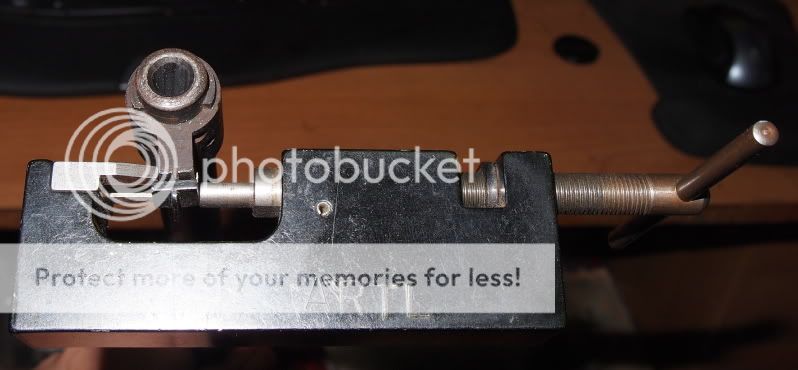
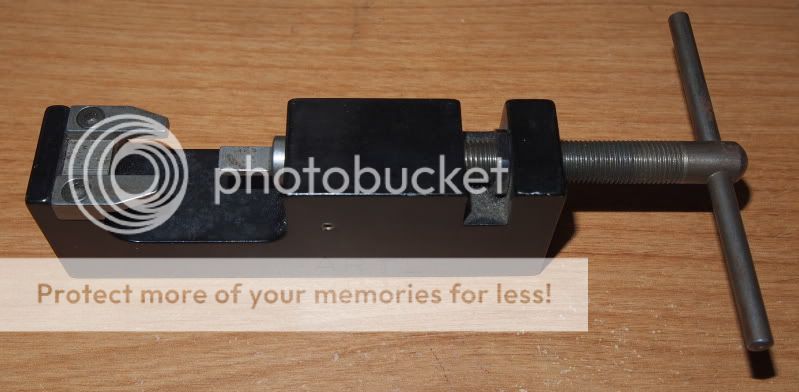
I use this front sight tool when need:
PA070548.jpg


PA070549.jpg


Not as nice as the K31/K11 front sight tool but it works on more rifles.
Swiss armorer's field kit has come in very handy on all sorts of fixes:
P1010176.jpg
 
Back
Top Bottom