- Location
- Jameson, SK
So, I'm the proud new owner of a Pentax 100ED scope. It's a different beast than most, so I thought I'd share what I've learned. This info did not come easy, trust me....
The 100ED is in between a spotting scope and an astronomical telescope in power, size, and weight. With this, comes some challenges in finding accessories, and choosing mounts, etc.
What I've found is that there is a lot of info available in the astronomy world, as well as the bird watching and videography world. It's a whole new language, but I'll try and articulate what I've learned so far.
I'll try and keep this brief and organized.
There are challenges with the scope. First, they're bloody huge. My 100ED is about 23" long with the eyepiece, and weighs about 5.75lbs. This means most photo tripods are not heavy or steady enough to keep this bad boy solid at high power. Easy enough - lets just get a bigger and/or better tripod, right?? Read on.
They also some with the body only, meaning that you have to choose what 1.25" eyepiece you with you use. There are fixed eyepieces from about 15x up to 180x, and zoom from about 30-97x. They are sold in mm - ie mine is a XM7, 7mm. Until now I didn't know how to go from mm numbers to X magnificaion, but I found out....!! Simply take your "lens focal distance" from the scopes spec sheet, and divide it by the mm value for your eyepiece. So, mine is 625mm/7mm = 89x. If any of you knew that already, god bless ya, but I didn't. I've also learned that the fixed power eyepiece are much clearer, with a much better field of view, than the zoom. The zoom, however, has it's obvious advantages. FYI - from what I've read one can see the rings of Saturn with a 100x scope....!!! Should be fun. No, I don't know how much power is needed to see Uranus.....
I'm told, and I really don't know what it means, that the ED's have an "atypical focal length". What this means for those of us that just want it to work is that all accessories (such as camera mounts) and eyepieces have to be Pentax. There are work-arounds, which I'll explain below.
The 100ED is only available is a straight model. I believe the 65 and 80 can be had with angles eyepieces. I originally though that this wasn't a big deal, but now that I have it I've realized that an angled eyepiece would be great for standing with a lower, more stable tripod, and for working prone and off the bench without having to re-position constantly.
After I found what those "angled thingies" are called - they're called diagonals - I found a myriad of choices in the astronomy world. They come in 45, 60, and 90's. There are varying qualities and prices. I'm going with either a Baaden Planetarium, or one from Siebert (see below).
This is where I learned about the work-around for the focal length issue. Enter Harry Siebert. Harry owns Seibert Optics in NC. He designs and builds optics for everything from shooters like us to huge astronony domes on volcanoes in Hawaii. I emailed him after finding his name on a birdwatching forum and he got right back to me - on a saturday!!! He makes a focal length adapter that allows the "atypical" focus length to work with things non-pentax. Things such as camera adapters (in case you want to take some Dartman-esque vids - freakin' love Dartman), or diagonals.....
Now, mounting issues.
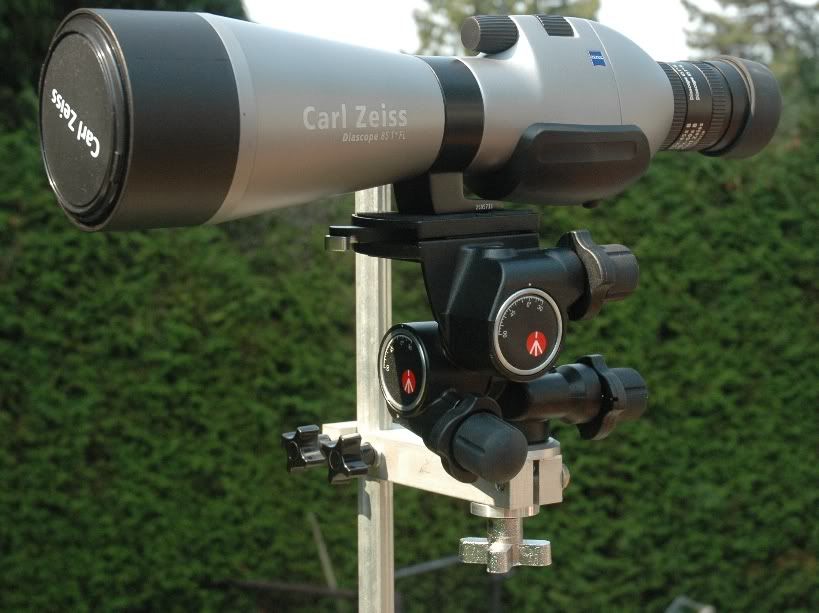
So, as I said, it's big. I have a couple of nice Rocketfish tripods that work great for my laser rangefinder and my gold ring spotter, but with this pig on it it looked like being in an earthquake. Off to the interweb I went to learn about stable tripods, and that took me the world of stargazing, and birdwatching. In the back of my mind I knew that there were heads with knobs that allow one to very finely move up-down and left-right. After looking and looking, I found them!! They're called alti-azimuth mounts (Al-Azi). There are a few differnt once available. I first looked at the Orion VersoGo III, but ended up with a celestron because it was 1/4 the price. The celestron is good for 110 Canadian dollars, but I'm far from overwhelmed by the machining or engineering. I may be upgrading in future.
Also, on the topic of my Rocketfish tripods - I have them topped with Vanguard pistol grip mounts that work great for finding and holding on target.
Now, with all these new mounts and tripods, comes a whole new set of connections. Standard photo tripods have a 1/4" lug, larger ones (usually video ones) have a 3/8" lug. There are 10mm lugs out there too. Astronomy Telescopes and tripods use slide in rails vs simple threads - Vixen and Losmandy they are called. So, how the hell does one go from a simple threaded lug to a "Vixen"?? There are adapters!!!... and they don't cost much. There are all kinds of adapters available on ebay and amazon as well. So, despite the suggestion by the Orion guy (see below) to call a machine shop, the interweb has my back (and yours too).
Specifically, the Orion VersaGo III can be taken off it's included tripod and placed on a 3/8" threaded lug via an adapter that is included with it. This adapter goes on the bottom of the head/mount, which in turn goes onto a tripod with a 3/8" mount. This is a point that is a complete mystery - even to a a customer service rep at Orion. The only way I was able to find this out is by watching a nice unboxing and setup vid on youtube. For this reason, the Orion will likely be what I go with in future.
I do have an Orion Slow Motion head on the way. It was only 55$ so I thought I'd give it a try. It has a 1/4" threaded receptacle on the bottom, and a 1/4" lug on the top.
I was also considering something called a Stellarvue M2. It's a head that isn't AlAzi, but rather very very smooth and precise. To move your scope you push it, but it has knobs on it that adjust the friction in both the left-right and up-down axis.
I also want a tabletop style tripod for prone and benchwork. After some looking, I am 100% sold on the Induro Hi Hat. It's from the video world, and is absolutely bombproof. It's not cheap, but by all accounts it's worth it. It's about 280USD. It comes with a 3/8" lug, and a 10mm is available. It's also available with a 75mm and 100mm half-sphere (google it, you'll see what I mean). The 100mm is a wee bit more money, but by the sounds of it the added stability is worth it. It has bubble levels an both the legs and the sphere. I haven't ordered one, but I will be.
So far I've had great help from Bill at Canadian Telescopes, Harry Seibert, and Robert and telescopeadapters.com.
Hope this post is helpful to someone who is as large-scope-naive as I was.
-Jer.
Reply With Quote
The 100ED is in between a spotting scope and an astronomical telescope in power, size, and weight. With this, comes some challenges in finding accessories, and choosing mounts, etc.
What I've found is that there is a lot of info available in the astronomy world, as well as the bird watching and videography world. It's a whole new language, but I'll try and articulate what I've learned so far.
I'll try and keep this brief and organized.
There are challenges with the scope. First, they're bloody huge. My 100ED is about 23" long with the eyepiece, and weighs about 5.75lbs. This means most photo tripods are not heavy or steady enough to keep this bad boy solid at high power. Easy enough - lets just get a bigger and/or better tripod, right?? Read on.
They also some with the body only, meaning that you have to choose what 1.25" eyepiece you with you use. There are fixed eyepieces from about 15x up to 180x, and zoom from about 30-97x. They are sold in mm - ie mine is a XM7, 7mm. Until now I didn't know how to go from mm numbers to X magnificaion, but I found out....!! Simply take your "lens focal distance" from the scopes spec sheet, and divide it by the mm value for your eyepiece. So, mine is 625mm/7mm = 89x. If any of you knew that already, god bless ya, but I didn't. I've also learned that the fixed power eyepiece are much clearer, with a much better field of view, than the zoom. The zoom, however, has it's obvious advantages. FYI - from what I've read one can see the rings of Saturn with a 100x scope....!!! Should be fun. No, I don't know how much power is needed to see Uranus.....
I'm told, and I really don't know what it means, that the ED's have an "atypical focal length". What this means for those of us that just want it to work is that all accessories (such as camera mounts) and eyepieces have to be Pentax. There are work-arounds, which I'll explain below.
The 100ED is only available is a straight model. I believe the 65 and 80 can be had with angles eyepieces. I originally though that this wasn't a big deal, but now that I have it I've realized that an angled eyepiece would be great for standing with a lower, more stable tripod, and for working prone and off the bench without having to re-position constantly.
After I found what those "angled thingies" are called - they're called diagonals - I found a myriad of choices in the astronomy world. They come in 45, 60, and 90's. There are varying qualities and prices. I'm going with either a Baaden Planetarium, or one from Siebert (see below).
This is where I learned about the work-around for the focal length issue. Enter Harry Siebert. Harry owns Seibert Optics in NC. He designs and builds optics for everything from shooters like us to huge astronony domes on volcanoes in Hawaii. I emailed him after finding his name on a birdwatching forum and he got right back to me - on a saturday!!! He makes a focal length adapter that allows the "atypical" focus length to work with things non-pentax. Things such as camera adapters (in case you want to take some Dartman-esque vids - freakin' love Dartman), or diagonals.....
Now, mounting issues.
So, as I said, it's big. I have a couple of nice Rocketfish tripods that work great for my laser rangefinder and my gold ring spotter, but with this pig on it it looked like being in an earthquake. Off to the interweb I went to learn about stable tripods, and that took me the world of stargazing, and birdwatching. In the back of my mind I knew that there were heads with knobs that allow one to very finely move up-down and left-right. After looking and looking, I found them!! They're called alti-azimuth mounts (Al-Azi). There are a few differnt once available. I first looked at the Orion VersoGo III, but ended up with a celestron because it was 1/4 the price. The celestron is good for 110 Canadian dollars, but I'm far from overwhelmed by the machining or engineering. I may be upgrading in future.
Also, on the topic of my Rocketfish tripods - I have them topped with Vanguard pistol grip mounts that work great for finding and holding on target.
Now, with all these new mounts and tripods, comes a whole new set of connections. Standard photo tripods have a 1/4" lug, larger ones (usually video ones) have a 3/8" lug. There are 10mm lugs out there too. Astronomy Telescopes and tripods use slide in rails vs simple threads - Vixen and Losmandy they are called. So, how the hell does one go from a simple threaded lug to a "Vixen"?? There are adapters!!!... and they don't cost much. There are all kinds of adapters available on ebay and amazon as well. So, despite the suggestion by the Orion guy (see below) to call a machine shop, the interweb has my back (and yours too).
Specifically, the Orion VersaGo III can be taken off it's included tripod and placed on a 3/8" threaded lug via an adapter that is included with it. This adapter goes on the bottom of the head/mount, which in turn goes onto a tripod with a 3/8" mount. This is a point that is a complete mystery - even to a a customer service rep at Orion. The only way I was able to find this out is by watching a nice unboxing and setup vid on youtube. For this reason, the Orion will likely be what I go with in future.
I do have an Orion Slow Motion head on the way. It was only 55$ so I thought I'd give it a try. It has a 1/4" threaded receptacle on the bottom, and a 1/4" lug on the top.
I was also considering something called a Stellarvue M2. It's a head that isn't AlAzi, but rather very very smooth and precise. To move your scope you push it, but it has knobs on it that adjust the friction in both the left-right and up-down axis.
I also want a tabletop style tripod for prone and benchwork. After some looking, I am 100% sold on the Induro Hi Hat. It's from the video world, and is absolutely bombproof. It's not cheap, but by all accounts it's worth it. It's about 280USD. It comes with a 3/8" lug, and a 10mm is available. It's also available with a 75mm and 100mm half-sphere (google it, you'll see what I mean). The 100mm is a wee bit more money, but by the sounds of it the added stability is worth it. It has bubble levels an both the legs and the sphere. I haven't ordered one, but I will be.
So far I've had great help from Bill at Canadian Telescopes, Harry Seibert, and Robert and telescopeadapters.com.
Hope this post is helpful to someone who is as large-scope-naive as I was.
-Jer.
Reply With Quote