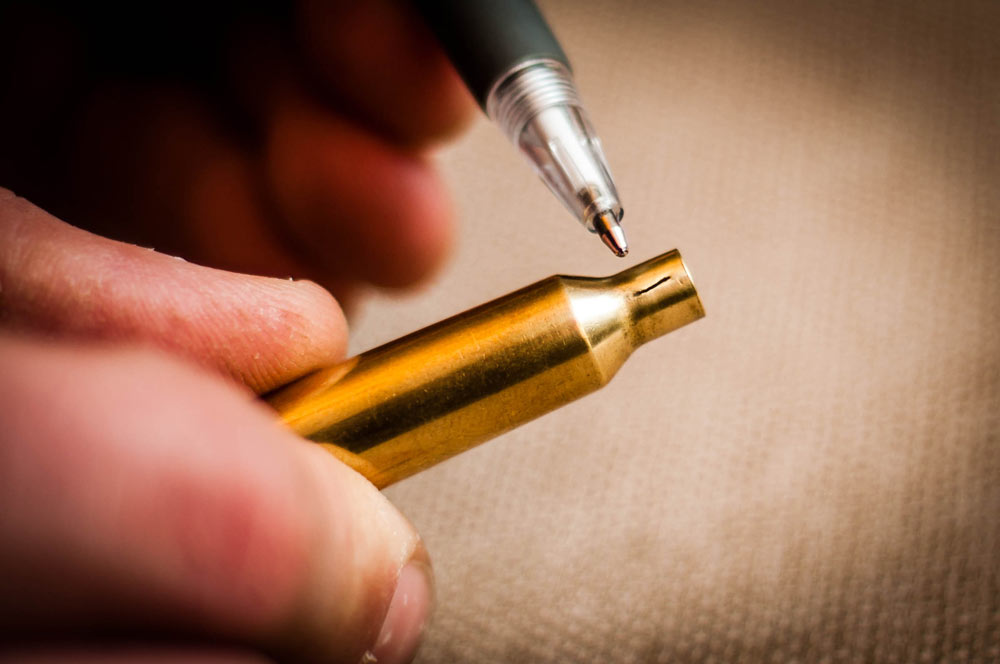
Neck Cracks

Picking a bushing for .002" tension doesn't compensate for a huge neck area in the chamber. I think what Ed is getting at is that a solid die gives more guidance when the case needs a lot of sizing from fired to your .002 under. A floating bushing will size it down, but not neccessarily in the center. A neck die or neck bushing die is just along for the ride, the case will do whatever it wants.

My point is, and it hasn't changed is that a bushing die works the neck brass less than any other die, other than a custom honed out fixed neck sizing die. It will be very similar. I think what seems to have gotten lost is that the OP is concerned about cracks, not concentricity. Yes, a large neck in the chamber is a problem, but short of buying a new barrel, you can't make it smaller.



There is no mystery about the cause of the cracks in the neck. If they look like the image below, it is just overworking the brass. Standard dies compress the neck down too much before they get expanded back up again, to load them, and again when they are fired. It is simply cyclic fatigue. If you catch it early with proper annealing you can prevent it, as will cycling the brass less.

A neck with thicker brass due to downsizing a bigger case is actually better in a standard SAAMI chamber, as they will fit tighter in the neck and expand less on firing.

Split-Brass.jpg
 
I agree with our friend from Pennsylvania: "The OP is sizing down 30-06 cases to 6.5 which makes his necks "THICKER" and if he is not neck turning the increased neck thickness is causing him to over work the case necks."

My first thought was that 308 to 264 is a 44 thou drop - where's all that extra brass going to go? Into micro-folds in the neck or what? Overworking might be an understatement...

I would have thought that 270 Winchester would have been a better choice of brass (.277 - .264 = .013)
 
I agree with our friend from Pennsylvania: "The OP is sizing down 30-06 cases to 6.5 which makes his necks "THICKER" and if he is not neck turning the increased neck thickness is causing him to over work the case necks."
My first thought was that 308 to 264 is a 44 thou drop - where's all that extra brass going to go? Into micro-folds in the neck or what? Overworking might be an understatement...
I would have thought that 270 Winchester would have been a better choice of brass (.277 - .264 = .013)

I don't agree that the thicker brass is a problem assuming they fit the chamber neck well in the gun. Yes, you might want to size them down in two steps, first to .277 and then to .264. For sure you want to anneal after sizing down, and possible after each step if you do two steps. I do agree that the .270 is a better starting point. Lapua doesn't make it, but Norma does at a higher price. And of course there is lots of Winchester around. Nearly all of my .264 WM cases are sized down 7mm RM cases. Have not had any issues with them compared to original .264 cases.
 
Hey Guys thanks,Ya I should probably turn the necks but it seems to work and I have nice tension going by feel and I have pulled bullets and I am not scraping anything off bullet.I do agree that my brass would last longer by not having so much on the neck so I will start doing that. I have neckled down used 270 brass and it worked great but no Lapua in that.As for the brass with the shoulders bumped to much if I shoot them the base will crack,what if I fireformed them with the pistol powder,cream of wheat method they might not crack.Only pistol powder I have is unique,how much should I use and how much cream of wheat.It can't hurt to try a few and see if I can't blow the shoulders back out.
I can tell you that this shooting game you are always learning something.
Thanks again
 
Last edited:
Hey Guys thanks,Ya I should probably turn the necks but it seems to work and I have nice tension going by feel and I have pulled bullets and I am not scraping anything off bullet.I do agree that my brass would last longer by not having so much on the neck so I will start doing that. I have neckled down used 270 brass and it worked great but no Lapua in that.As for the brass with the shoulders bumped to much if I shoot them the base will crack,what if I fireformed them with the pistol powder,cream of wheat method they might not crack.Only pistol powder I have is unique,how much should I use and how much cream of wheat.It can't hurt to try a few and see if I can't blow the shoulders back out.

As I suggested earlier, compare the neck diameter of a loaded round to that of a unsized fired round. If it is at least 0.001" larger than unfired, you do not have a problem with excessive neck thickness. If you turn the brass down you will increase the gap between a loaded round and fired round, stressing your brass even more, and causing more cracking. Turned brass is only for custom tight neck chambers. If you don't have a micrometer that reads to the 0.0001" then get one. Canadian Tire have cheap ones for less than $20 when they put them on sale. Made in China but they work just fine.

As for the cases you bumped too much, do you have a die or expander ball that is larger? Like a .277 or .284? If you do, you could expand the neck out larger. Then by starting long, size the neck back down to your 6.5 mm with only a partial neck resize. At first it will not chamber in your gun, but keep sizing it more until it just does chamber. With a bit of luck the false shoulder you created will keep the case from jumping forward on firing pin impact and firing. That will keep the case from going forward, grabbing the chamber, and then stretching back. Instead you will just fireform the front end of the cartridge.
 
Why don't we wait for the OP to tell us what type die he is using and if he is using the expander.

If his die does have a expander and he is using it the OP will be over working his "THICKER" case necks.

We need more information from the OP about the type resizing die he is using and how thick his case necks are.

Please read the link below carefully, not all standard non-bushing full length dies overwork the case neck. And not all expanders overwork the case neck and cause problems. It is amazing what a little case lube inside the case neck will do. I bought a Forster .223 full length benchrest die with the intentions of having the neck honed. It turned out the die did not need to have the neck honed, meaning the neck diameter of this die was on the plus size of tolerances, and did not overwork the brass. (now read the link below)

Are Your Sizing Dies Overworking Your Rifle Brass?
http://www.massreloading.com/dies_overworking_brass.html


Too much of what competitive shooters use when reloading filters down to the average shooter/reloader with off the shelf factory rifles, and is not needed.

Bushing dies and neck turning your brass in most cases is a waste of time and money on the average off the shelf factory rifle.
 
Hey Guys thanks,Ya I should probably turn the necks but it seems to work and I have nice tension going by feel and I have pulled bullets and I am not scraping anything off bullet.I do agree that my brass would last longer by not having so much on the neck so I will start doing that. I have neckled down used 270 brass and it worked great but no Lapua in that.As for the brass with the shoulders bumped to much if I shoot them the base will crack,what if I fireformed them with the pistol powder,cream of wheat method they might not crack.Only pistol powder I have is unique,how much should I use and how much cream of wheat.It can't hurt to try a few and see if I can't blow the shoulders back out.
I can tell you that this shooting game you are always learning something.
Thanks again


bubba300

Read the post below from Accurateshooter, and pay attention to post #5. (he turns his case necks when forming from 30-06 brass)

Best way to make 6.5-06 brass?
http://forum.accurateshooter.com/threads/best-way-to-make-6-5-06-brass.3742324/

More info below.
https://www.google.com/#q=forming+6.5-06+brass
 
If his die does have a expander and he is using it the OP will be over working his "THICKER" case necks.

Yes, to some degree. The die neck only sees fired brass size which is only determined by the chamber. However it will size down excessively, and the expander ball will be forced to size it back up again, and the increased thickness will increase the sizing required. However, if you turn the brass, the sized and loaded round will be smaller but it still will expand up to chamber size, so it gets stressed more by the firing. So it is win loose situation. I would take the tighter neck fit over worrying about the thicker brass, and I would not waste my time turning the necks.

Sorry, but I don't agree with your obvious bias against bushing dies. Bushing dies solve the overworking problem and thicker neck problem, and as a result solve the neck cracking problem that the "average shooter/reloader with off the shelf factory rifles" experiences. When you are paying today's prices of $2-3 each for brass, spending a little more on a bushing die or custom sized neck die is worth it.
 
I use a Hornady FL Die,I have the RCBS precision mic that I measure how much to bump shoulders,I usally only bump them .001 or .002 but somehow the one s that are giving me the problem are bumped .01( not sure what the true measure of the dial is but instructions say each line is.001 inches) I usally just try to bump them 1 or 2 lines on it but these ones are bumped 10 lines.Oh well I messed up somewhere ,somehow and have learned a few things so its all good.
Thanks again
 
I use a Hornady FL Die,I have the RCBS precision mic that I measure how much to bump shoulders,I usally only bump them .001 or .002 but somehow the one s that are giving me the problem are bumped .01( not sure what the true measure of the dial is but instructions say each line is.001 inches) I usally just try to bump them 1 or 2 lines on it but these ones are bumped 10 lines.Oh well I messed up somewhere ,somehow and have learned a few things so its all good.
Thanks again

There are a couple more options for that excessively bumped brass, other than forming a false shoulder. One is to size the brass with the expander ball out of the die to make a tight neck ID. Then seat bullets long that will go out and jam 0.005" or so into the lands. This will hold the case against the firing pin and let it stretch back more uniformly. Another option is to put sizing lube on the cases and just fire them. This is controversial, but I believe modern quality firearms are well design to take full bolt loading. Or, you could do both. Seat bullets tight and long, and put a thin coat of sizing lube on the cases.

Here is an article that explains the options pretty well.
 
If the OP bumped his shoulders back .010 (ten thousandths) I would be checking these cases with a bent paper clip for thinning in the base web area.

I have a RCBS case mastering gauge that can measure this thinning to less than .001

I have a feeling his next post will be asking why he is having case head separations.

The OP fired these cases with excessive head clearance and these cases stretched .010 to meet the bolt face.

In the links I posted it stated your better off using .270 or 25-06 brass to make 6.5-06 brass and not end up with thick case necks and turning the necks.

If the OP had a neck thickness gauge he would see forming from 30-06 to 6.5-06 in one step can create unequal neck thickness.

I would trash the cases the OP has been using and start over, brass is a expandable item.

The OP would never have posted his problem here if he had the proper gauges and neck turning tools.
 
I use a Hornady FL Die

Yes, it is likely to be oversizing your necks quite a bit. On quick look, it looks like Redding makes a bushing sizing die for the 6.5-06 A-Square, if that is what you have. Costly though. List price in the US is $138 for either the neck only sizer or the full length with a neck bushing. They do not do the neck and shoulder bump like Forster, which I think is the preferred choice. Forster don't make the 6.5-06 that I could see. RCBC might but their web site listing for sizing dies is so complicated, that I gave up.

The other option is to hand lap the neck of your Hornady FL die with a through-hole lap, and lapping compound. Here is an article on how to do it. I am in the process of getting set up to do that with my 6.5 RM RCBS FL die. The only thing is that it requires careful measurements. You know the old story about the carpenter. I cut it twice and it is still too short... You have to open up the neck size, but still keep it small enough to size the brass that has the thinnest necks. If all your brass is one type, it makes it simpler.

I don't think 0.010" headspace is all that big of a deal if you just do it once. Those who are doing a full FL resize and firing in a larger SAAMI chamber are doing it or more every reload. I would just seat bullet to jam 0.005 or so, and lube the cases, then fireform it. If you start to develop a crack then you will have to chuck them one by one. A buddy has the issue with his 7mm RM and part of his reloading routing is to use a hooked wire and scrape the inside of the case to feel for any thinning. It is quite easy to detect and does not require any fancy special tools.

If you buy any new cases fireform them with the bullet jam and lube trick. Then anneal them. It will get them off to a lot better start.
 
I would just seat bullet to jam 0.005 or so, and lube the cases, then fireform it.

Great advice, just jam the bullets into the rifling without telling him to reduce his load and to add insult to injury you tell him to lube his cases and double the bolt thrust.

Thats just what the OP needs is a over pressure spike and twice the load on his locking lugs.

Your telling the OP to lube his cases when the entire firearms industry tells you not to.

Great advice Ron AKA, your advice is creating a accident waiting for a place to happen. :bangHead:
 
Great advice, just jam the bullets into the rifling without telling him to reduce his load and to add insult to injury you tell him to lube his cases and double the bolt thrust.

Thats just what the OP needs is a over pressure spike and twice the load on his locking lugs.

Your telling the OP to lube his cases when the entire firearms industry tells you not to.

Great advice Ron AKA, your advice is creating a accident waiting for a place to happen. :bangHead:

Actually it is good advice. You don't seem to be in touch with modern rifle technology. Yes, I would not go with a full out hot load for fireforming, but I would not go with a light load either. As far as jamming, the pressure increase is not that significant. I do it all the time with maximum load. And the lube on the case thing is nothing but an old wives tale. Modern actions will take full case thrust with no problem at all. Old military junk like Lee Enfields may be another thing.
 
Actually it is good advice. You don't seem to be in touch with modern rifle technology. Yes, I would not go with a full out hot load for fireforming, but I would not go with a light load either. As far as jamming, the pressure increase is not that significant. I do it all the time with maximum load. And the lube on the case thing is nothing but an old wives tale. Modern actions will take full case thrust with no problem at all. Old military junk like Lee Enfields may be another thing.

Not only are you giving out bad advice, I strongly advise everyone to ignore your case lubing advice that you posted.

The very reason for seating your bullets long and jamming them into the rifling is the hold the rear of the case against the bolt face and prevent case stretching.

The reason military cases are thicker and harder in the base is to raise the pressure point that the case starts to stretch.

You need to read about P.O. Ackley's experiment when he removed the locking bolt from a Winchester 94 30-30 and fired the rifle and nothing happened.

The chamber pressure of 38,000 cup or 43,000 psi was "NOT" great enough to cause the case to stretch and meet the bolt face.

You need to read the 1929 British Textbook of Small Arms, where it explains the British base crusher method of taking chamber pressure.

Chamber pressure was taken at the base of the case and in order to read actual chamber pressure the case had to be oiled.

If the case was not oiled the pressure reading was half of what a oiled cartridge case.

In simple terms when the "DRY" case fully grips the chamber walls the case acts like a shock absorber lowering dwell time the rear of the case is touching the bolt face and bolt thrust.

Below is a cartridge being fired and the brass stretching and yielding to meet the bolt face and reducing bolt thrust.

deform-1_zpsvutzmj96.gif
old wives tale

Below is from the Lyman reloading manual.

lyman1a-1_zpssfm8utby.jpg


Below is from the Sierra reloading manual.

scan0048a-1_zps0al0rej2.jpg


And below is from the United States Army.

dontlube-1_zpsxwwhdy19.jpg


Now tell us again about "old wives tales" and your lack of knowledge on the subject.
 
Not only are you giving out bad advice, I strongly advise everyone to ignore your case lubing advice that you posted. Now tell us again about "old wives tales" and your lack of knowledge on the subject.


First, let me say that I am a retired mechanical engineer with 40 years of experience. All those years I've fired reloads that have at least some residual sizing lube on them. I'm still here to write about it. I guess you did not bother to read that Guns Magazine article about fire forming cases. A quote:

"If the headspace is a little long but cases will still fire consistently, oiling the case will allow it to slip rearward without stretching. No, this doesn’t increase bolt-thrust. Any suitable oil loses its lubricity at pressures below 10,000 psi. Once pressure rises to 10,000 psi, the case grips the chamber wall firmly."

Lets think about this for a second. Your chamber and receiver are made from a high strength heat treated steel like 4140, and are very thick. Does it make sense that the structural integrity of the gun will be designed to depend on a thin little 0.020" thick case of soft brass? No, it does not need that brass to make it hold together. The main purpose of the brass is to seal the gases.

Lets now do a little math. On a large head magnum cartridge the area in the case that sees 60,000 psi pressure is about 0.4" in diameter. That generates a bolt load of about 7,500 lbs. The lugs on my Remington 700 are about 0.440" square and there are two of them. That gives a total shear area of 0.387 sq. inches. The shear loading with the 7,500 lb force is about 20,000 psi. Yes, if your bolt was made out of brass that would be a little bit of a concern. However it is not. A bolt would be typically made from 4140 oil quenched and tempered at 950 F to give a yield strength of about 150,000 psi. Shear strength would be 58% of that or about 87,000 psi. That gives a factor of safety of 87,000/20,000 or over 4. Normal industrial design is to a factor of safety of 2, but I guess gun makers are quite conservative, as they should be. Or, alternatively, the Remington engineers may design the bolt assuming load is only on one lug, and apply a factor of safety of 2 in that assumed case. Either way stresses are very conservative.

Now for the annecdotal stuff. Sure I have heard it all before. There was a poster on the net a few years ago (perhaps it was you??) that promoted this old wives tale stuff ad nauseum.

First on the case. Do you really think a 0.020" thin soft brass case can be a useful part of the structure? It can't, and just stretches. Stretching causes cracks. The case is telling you, it does not want this job. Leave it to the heat treated 4140 steel.

I have been loading for about 50 years now. My go to sizing lube has been STP. It works really well in full length sizing big magnums. However, it is actually quite hard to get off the case. At very best I gave it a wipe, but I sure did not degrease the cases. They just went in the cartridge case and then into the gun. So what do my cartridges look like? I've loaded Winchester brass up to 20 times before they finally gave up with a neck crack. No, I was not very good about annealing, and in the early days, had no idea it was required. How many cases have I had that have separated just above the head (0.264 WM Browning, and a Remington 700)? Zero, None, Nada! Anecdotal, but perhaps it was the STP relieving the brass of trying to do a job it is not capable of doing. And I don't think I am unique in the reloading world. Lots of cases are being left with sizing lube on them. It is to be expected and no sane engineer would design a gun to depend on an unlubricated thin brass cartridge to hold it together.
 
Last edited:
Back
Top Bottom