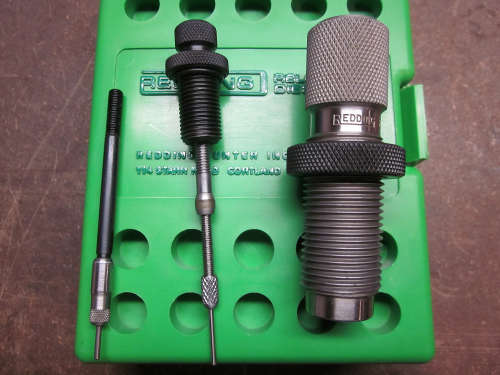
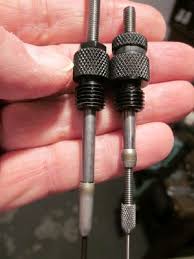
Neck sizing die creates runout!?

MozPhoq

Regular
EE Expired
Rating - 100%
12   0   0
Hi all,

I had been struggling with bad groupings I attributed to bad loads for a while (new rifle). Last week I bought pre rolled Federal Gold Match ammo and the shots with the same rifle went literally on top of one each other. I couldn't imagine this was attributable only to charge weights so I bought a Sinclair gauge and started to check my case necks for runout.

Many had 4 or 5 thousands of runout (I use Lapua brass and a Redding type S match die set). So then I went out into a batch of unfired new brass and checked those : 1 thousandth. Perfect.

I put these into my sizing die, bam! 4 thousandths! My neck sizing die is actually causing this runout! And it's not like I went cheap with the die set either. Does anyone have an idea about what is going on here? Just to test I put the now bad casings into a Lee full size resizing die and the cartridge went back to about two thousandths. Imagine! A 60$ die set.. I'm furious.

I took the bushing out (.336) cleaned everything out and put it back in, same thing. Changed the bushing to a .335, same thing. I just don't get it!

Help please!
 
Last edited:
Two points.
1) Runout is not the end of the world. There are a lot of factors that could cause your reloads to shoot poorly compared to factory.
2) Bushing dies can cause runout when downsizing the case neck more then a few thousands. If you can drop a bullet cleanly through the neck if a fired case, this is probably the cause of the runout.
 
Two points.
1) Runout is not the end of the world. There are a lot of factors that could cause your reloads to shoot poorly compared to factory.
2) Bushing dies can cause runout when downsizing the case neck more then a few thousands. If you can drop a bullet cleanly through the neck if a fired case, this is probably the cause of the runout.

Case thickness is 15 thousandths plus bullet .308 is .338 and I use a .336 bushing, so I'm not over resizing. I don't understand you last sentence.
 
Case thickness is 15 thousandths plus bullet .308 is .338 and I use a .336 bushing, so I'm not over resizing. I don't understand you last sentence.

Measure the outside diameter of a fired case. If that is more them 4-5 thou bigger then .338 then your bushing can be causing the runout when sizing.
 
I will. But in the mean time. I putting brand new brass (unfired) through the die and they come out with 3-4 thousandth when they had only one to begin with...
 
As Alpheus pointed out run out of .004-005 isn't all that bad. You can still shoot well under moa with this type of run out as long as it's with a load that your firearm likes. What size of groups are you getting.
 
As Alpheus pointed out run out of .004-005 isn't all that bad. You can still shoot well under moa with this type of run out as long as it's with a load that your firearm likes. What size of groups are you getting.

It may not be a big problem at ranges within 300m but when you shoot beyond that it will show. Whatever the results downrange, I was only explains how I got to investigate and realize the dies were creating all this runout. To me this is not normal. Some people will tell you that resizing cases that are near perfect will induce runout on them and that this is normal, I don't think it is true. A good die set should not create cases that are beyond 2 thousands IF they were under that to begin with.

So if anyone out there has an explanation on why these dies can take near perfectly straight (and new) casings and induce so much runout please step forward!

Thanks
 
So if anyone out there has an explanation on why these dies can take near perfectly straight (and new) casings and induce so much runout please step forward!

Bushing dies can cause runout when downsizing the case neck more then a few thousands. If you don't believe me, google it. I have owed/still own Redding S type bushing dies in 308 and 6.5x47L.
 
Bushing dies can cause runout when downsizing the case neck more then a few thousands. If you don't believe me, google it. I have owed/still own Redding S type bushing dies in 308 and 6.5x47L.

I absolutely agree with you! But with those new cases I'm only resizing .002. This can't be too much.
 
Mozphog
I understand where you are coming from. I had the exact same problem, but with non bushing dies. My problem was the expande. How I got around it was to size the body with a Redding body die then size the neck with a Lee collet die. This gave me next to zero run out. With all this said when I got my run out real low, I found it didn't translate into much smaller groups. My experience is that you need a rifle that can shoot in the 3's to take advantage of run out going from .004 to .001. Just what I found.
 
I absolutely agree with you! But with those new cases I'm only resizing .002. This can't be too much.

The bushing is floating inside the die. It will never be perfectly concentric the the centerline of the the case, and certainly not consistent case to case.

Runout is the last thing you look at when trying to shrink groups, not the first.
 
At the Whidden custom die website they tell you that non-bushing full length dies produce the most concentric cases.

When you reduce the neck diameter .004 or more from its fired diameter with a bushing die it will induce neck runout. This is why your are told to reduce the neck diameter in two steps to reduce the runout.

If you size a case in a full length die with the expander removed the case will be as concentric as it will ever be and have very little neck runout.And the biggest cause of neck runout is when the expander is locked down off center.

This is where Forster full length benchrest dies shine, the Forster die has a high mounted floating expander. And when the expander enters the case neck the case neck is held and centered in the neck of the die. Meaning the Forster dies will produce cases with the least amount of neck runout out of any other make or type full length die.

Bushing dies work best in custom tight neck chambers with neck turned brass. Too much of what benchrest shooters do filters down to the average reloader with off the shelf factory rifles and they are not needed and do not work in larger factory SAAMI chambers. And as stated above this is why many reloaders who neck size only use Lee collet dies and have far less neck runout than a bushing die.

And this is why the very smart, extremely good looking and modest reloaders use Forster full length benchrest dies. :evil:.......Because we found out the hard way that bushing dies are not the greatest dies on earth.
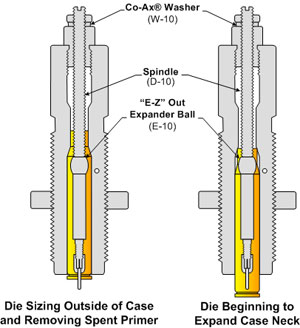
If you want to have concentric cases with little to no neck runout then use Forster full length benchrest dies and benchrest in-line seating dies below.

Y7Iyv8o.jpg


MomXeUI.gif


Below a modified Redding .243 full length die with a Forster high mounted expander that greatly reduced neck runout.

kWbieba.jpg


Below I also equipped all my older RCBS dies with Forster spindle and expander assemblies to reduce neck runout. The RCBS expander on the left is raised as high as it will move and not as high as the Forster expander.

5kfnKwd.jpg


Sell your bushing die to someone who doesn't know about Forster full length benchrest dies, and then buy the Forster die. Just don't tell the forum you screwed another reloader. :stirthepot2:
 
Run your brass through your bushing dies without expander in it at all. If its then the same or better than new brass, you know its the expander. In that case, it could be your brass is not concentric all around. Measure runout on neck of a loaded round after seating the bullet, using one new unsized case and one sized with the bushing die. Then look at the difference.
 
Last edited:
I ve found using Redding comp seater almost illuminates run out, insomuch as I don't bother measuring it anymore in 308, 300wm and 270..... not cheap. Like posted above, forester dies do work well. Seating bullets can give as much or more runnout as sizing.
 
I don't use the expanding ball. I use a Sinclair expanding die. But the runout appears right after resizing, as I've said, with both new and fired cases.
 
I had the same issue with my 260 AND 6mmBR Redding bushing dies - and, after reading/analyzing one of bigedp51's posts, I went Forster F/L BR and BR seater - did a 2 thou bump with the F/L die, and runout disappeared. Also switched Spindles/expanders on my other dies too.
I only do the 2 thou F/L every 3rd size, and use a Lee Collet outside of that.
A belated thanks Bigedp51 for the tip!
 
I had the same issue with my 260 AND 6mmBR Redding bushing dies - and, after reading/analyzing one of bigedp51's posts, I went Forster F/L BR and BR seater - did a 2 thou bump with the F/L die, and runout disappeared. Also switched Spindles/expanders on my other dies too.
I only do the 2 thou F/L every 3rd size, and use a Lee Collet outside of that.
A belated thanks Bigedp51 for the tip!

I guess your posts sums it up. I spent a few hours screening the net on the subject and the problem appears to be quite common with those said «#competition#» dies. I will FL resize all my brass with the Lee die and then try a couple of hints I saw such as reversing the bushing, allowing more free float of the bushing into the die, lubing the neck which I never thought necessary and we’ll see. If all fails I will just dump Redding and go FL Forster.

Thanks all
 
Everyone has forgotten something here. If your necks have different thicknesses around the diameter a bushing style neck die with push that over.

You need a neck trimmer if you use those dies.

Trim necks + Redding body die + Lee collet die = ZERO runnout
 
Back
Top Bottom