
- Location
- Jameson, SK
I suppose I can't know that unless I try, correct??
But .330 is a good start?
.012 a reasonable thickness??
But .330 is a good start?
.012 a reasonable thickness??













































I have the Redding Case Neck Concentricity Gage and with one twist of the case it tells you all you need to know. Meaning it much quicker than a ball mike taking severial readings. The Redding gauge quickly tells you if the case is even worth the effort of neck turning. Cases with wide variations in neck and body thickness will expand more on the thin side and warp.
Below the Redding gauge and a Remington .223 case with .004 neck thickness variations, and the reason why many reloaders buy Lapua brass. Some of these Remington cases had as much as .008 neck thickness variations.


Below you can't make a silk purse from a sows ear, meaning if I neck turned and neck sized the Remington case above it would still cause .004 misalignment with the bore. I full length resize these Remington cases and just use them in my AR15 carbine for practice at 100 yards or less.

As a side note I have been buying once fired Lake City 5.56 brass because of its quality and cost.
I would imagine I first need to purchase something to allow me to measure runout, such as this redding tool, the one in the picture you posted with 4 thou of runout - is that the redding tool you mentioned above?


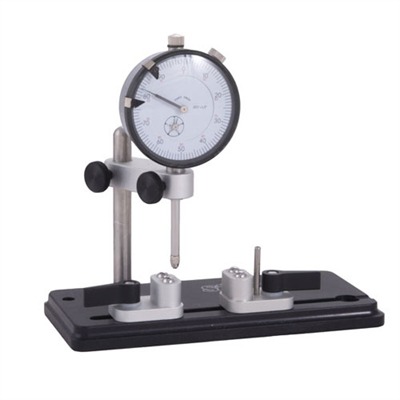

The Redding gauge uses a caliber specific arbor and a pin that pokes through the flash hole.....does that's not Center it??
Is the one it comes with not good enough?
























